The global magazine and marketplace for classic car enthusiasts, by enthusiasts.


Make a choice:
- Cars
-
Make >>
-
Year >>
-
- Bikes
-
Make >>
-
Year >>
-
-
Location >>
- Parts & more
-
Make of car >>
-
Manufacturer >>
-
Category >>
-
Countries


The Market; all post-war cars and bikes for sale
Overview of related ads to ad 1948 Jaguar Mk IV 3½ litre
-

1965 Jaguar Mk. II Saloon (3.8 Litre, M/OD) | Ascot Racecourse 12th March 2022 Sale | Historic Auctioneers
Arguably one of the most famous Big Cats from Browns Lane, these four-door saloons certainly did not pull any punches. Equipped with the same engine as Jaguar’s legendary E-Type and good for 123mph, they were rightly chosen by both Her Majesty’s Constabulary and, often, the focus of their attention as well; ‘four up and a boot full of swag’. Speed..JaguarMk. II Saloon (3.8 Litre, M/OD)SOLD -
1947 Jaguar Mk. IV SE (1.5 Litre) | Ascot Racecourse 12th March 2022 Sale | Historic Auctioneers
The 1945-1948 Jaguar Mk. IV was Jaguar's first car after World War II and were essentially continuations of the 1938-39 models. Very few of these cars were built for the righthand drive markets as steel was being rationed for goods for export. The origin of the name is rather odd since, back in 1948, there had been no Mk. I to IV Jaguars; the Mk. I..JaguarMk. IV SE (1.5 Litre)SOLD -
2003 Jaguar XJ8 Sport | Ascot Racecourse 12th March 2022 Sale | Historic Auctioneers
The first XJ was launched in 1968 and the designation has been used for successive Jaguar flagship models ever since. The original model was the last Jaguar saloon to have had the input of Sir William Lyons, the company's founder. With the introduction of the X308 generation in 1997 came a switch from the 'XJ6' nomenclature to 'XJ8', reflecting the..JaguarXJ8 SportSOLD -
1964 Jaguar Mk. II Saloon (3.8 litre) | Ascot Racecourse 12th March 2022 Sale | Historic Auctioneers
The Jaguar Mk. II was a medium sized saloon built from 1959 to 1967 as a successor to the 2.4 and 3.4 litre models. The Mk. II was handsome, powerful, and good handling saloon which was offered with a choice of three six-cylinder twin cam engines; 2.4 litre, 3.4 litre or 3.8 litre. After the appreciation of the Mk. I, Jaguar's successor was well re..JaguarMk. II Saloon (3.8 litre)SOLD -
1989 Jaguar XJS Convertible | Ascot Racecourse 12th March 2022 Sale | Historic Auctioneers
In 1975, the Jaguar E-Type finally gave way to an all new and more efficient Jaguar, the Jaguar XJ-S. This new luxury grand tourer, although never quite having the same sporting image as the E-Type, was actually more aerodynamic with the final example leaving the production line on 4th April 1996; at that stage 115,413 units had been manufactured d..JaguarXJS ConvertibleSOLD -
1969 Jaguar E-Type Series II Roadster (4.2 Litre) | Ascot Racecourse 12th March 2022 Sale | Historic Auctioneers
From its launch in 1961 to the end of its production in 1975, the Jaguar E-Type went from design revelation to motoring icon in a generation. Based on Jaguar’s three time Le Mans winning D-Type and known internationally for its beautiful sleek lines and a top speed of 150mph, this revolutionary car had three significant series changes during its fo..JaguarE-Type Series II Roadster (4.2 Litre)SOLD -
1972 Jaguar E-Type Series III Roadster | Ascot Racecourse 12th March 2022 Sale | Historic Auctioneers
The E-Type Series III was introduced in 1971, with a new 5.3 litre, V12 engine, uprated brakes, and standard power steering. Optionally, an automatic transmission, wire wheels and air conditioning were available. The brand new V12 engine produced 272bhp, had more torque, and a 0-60mph acceleration of less than seven seconds, which was phenomenal fo..JaguarE-Type Series III RoadsterSOLD -
1971 Jaguar E-Type Series III Fixedhead Coupé | Ascot Racecourse 12th March 2022 Sale | Historic Auctioneers
By the mid-1960s, the Jaguar E-Type was appealing to the man with a young family but who were restricted by the size of the current Jaguar E-Type Coupé and its open topped sibling. This prompted Jaguar to offer a third option in the form of a 2+2 Coupé. By adding nine inches to the wheelbase and two inches in height, it was then possible to fit a r..JaguarE-Type Series III Fixedhead CoupéSOLD -
1969 Jaguar E-Type Series II 2+2 Fixedhead Coupé | Ascot Racecourse 12th March 2022 Sale | Historic Auctioneers
The Jaguar E-Type was initially designed and shown to the public as a grand tourer in two-seater coupé form and as a convertible roadster. Open headlights without glass covers, a wrap-around rear bumper, re-positioned and larger front indicators and taillights below the bumpers, better cooling aided by an enlarged 'mouth' and twin electric fans, to..JaguarE-Type Series II 2+2 Fixedhead CoupéSOLD -
1961 Jaguar Mk. II Saloon (2.4 litre) | Ascot Racecourse 12th March 2022 Sale | Historic Auctioneers
Synonymous with the swinging ‘60’s and the hit TV series, Inspector Morse, the Jaguar Mk. II has been used as a vehicle to transport everyone from dignitaries and politicians to bank robbers and the criminal select. When released, traditional Jaguar buyers had no need to feel alienated by the new offering from Coventry as the interior was up to the..JaguarMk. II Saloon (2.4 litre)SOLD


Featured
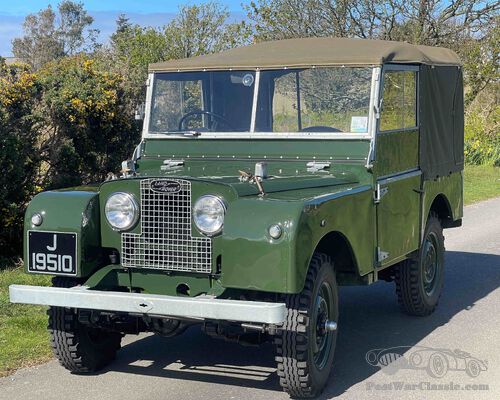
1952 Land Rover Series 1
Technical Specifications:Mark & Model: Land Rover Series 1Year: 1952Registration plate: Jersey registered
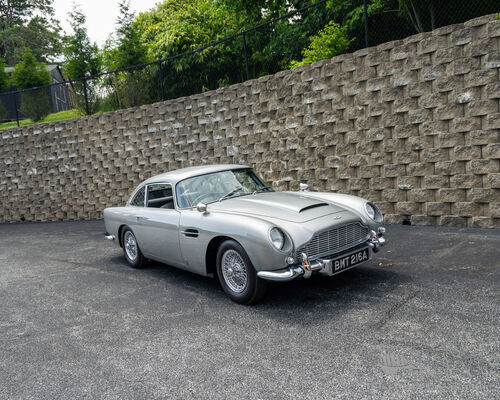
2020 Aston Martin DB5 Goldfinger Continuation | RM Sotheby's | The Monterey Auction
To Be OFFERED AT AUCTION at RM Sothebys' The Monterey Auction event, 13 - 15 August 2026. $1,000,000 - $1,500,000 USD One of 25 examples co..
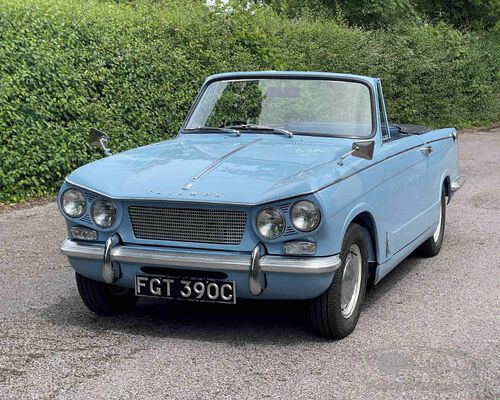
Triumph Vitesse 6 Convertible
Technical SpecificationsMark & Model: Triumph Vitesse 6 ConvertibleYear: 1965Registration plate: UK registered