The global magazine and marketplace for classic car enthusiasts, by enthusiasts.


The Market; all post-war cars and bikes for sale
Overview of related ads to ad 1972 Ferrari 365 GTC4 by Pininfarina
-

2006 Ferrari F430 Spider | Bicester Heritage 23rd September 2023 Sale | Historics Auctioneers
The Ferrari F430 was produced by Ferrari from 2004 to 2009. A successor to the Ferrari 360, it debuted at the 2004 Paris Motor Show. Designed by Pininfarina, under the guidance of Frank Stephenson, the body styling of the F430 was revised from its predecessor, the Ferrari 360, to improve its aerodynamic efficiency. Although the drag coefficient rem.. -
2009 Ferrari 430 Scuderia | Bicester Heritage 23rd September 2023 Sale | Historics Auctioneers
In 2008, Ferrari put into production their new lightweight 430, evocatively named the Scuderia. Replacing the 360 Challenge Stradale was always going to be a tough proposition, but with 510bhp, a new lightning-fast gear change, and an exhaust note which sounded pure F1, the Scuderia managed to be quicker, yet a lot less demanding to drive than the .. -
1977 Morgan Plus 8 | Bicester Heritage 23rd September 2023 Sale | Historics Auctioneers
The Morgan Plus 8 began production in 1968 and continued all the way through until 2004. The iconic Plus 8 returned in 2012 for a further six years, ending production again in 2018. Its iconic design remained largely unchanged throughout its life, lightweight construction, and powerful V8 engine. The Plus 8 is built on a steel chassis with a handcr.. -
1972 Ford Escort Mk. I to Mexico Specification | Bicester Heritage 23rd September 2023 Sale | Historics Auctioneers
There was, in the early days of the Ford Escort, a higher performance version for rallies and racing. The Mk. I Escorts became very successful as a rally car and eventually went on to become one of the most successful rally cars of all time. The Ford works team was practically unbeatable in the late 1960’s and early 1970’s; arguably the Escort's gr.. -
2003 Ferrari 360 Modena | Bicester Heritage 23rd September 2023 Sale | Historics Auctioneers
The Ferrari 360 was manufactured from 1999 to 2005 and succeeded the F355. It is a mid-engine, rear-wheel drive, V8 powered coupé and Ferrari partnered with Alcoa to produce an entirely new, all aluminium spaceframe chassis that was 40% stiffer than the F355. Along with a lightweight frame, the new Pininfarina body styling deviated from traditions .. -
1997 Ferrari 550 Maranello | Bicester Heritage 23rd September 2023 Sale | Historics Auctioneers
The Ferrari 550 Maranello is a two-seat grand tourer manufactured from 1996 and is powered by a front engined V12. It shared its platform and 5,474cc engine with the 456 but was positioned as the company's high-end model. Featuring a luxurious and spacious interior and, unusually for a Ferrari, the boot could accommodate a set of golf clubs. The 55.. -
1971 Alpine A110-1647, Rally, Sprint and Hillclimb car | Bicester Heritage 23rd September 2023 Sale | Historics Auctioneers
Automobiles Alpine was founded by Jean Rédélé in 1955. In 1964 they licenced a company in Mexico to manufacture their designs under the name DinAlpin and launched a 1,296cc competition version of the A110 in 1967. The next year an accord was signed with Renault which saw the Renault diamond badge added to the bonnet and the brand name changed to Al.. -
1994 Ferrari 456 GT | Bicester Heritage 23rd September 2023 Sale | Historics Auctioneers
Introduced at Garage Francorchamps, Belgium in 1992, the 456 was Ferrari’s attempt to produce a motor car that was somewhat different from their usual offerings. The idea was to generate the space and comfort of a Gran Turismo (GT) whilst being the most powerful 2+2 in the world. The 456 GT incorporated features familiar to generations of Ferrari c.. -
1975 Ford Escort RS1800 Rally Car | Bicester Heritage 23rd September 2023 Sale | Historics Auctioneers
The squarer-styled Escort Mk. II appeared in January 1975 with the first production models having rolled off the production lines on 2nd December 1974. Unlike the first Escort (which was developed by Ford of Britain), the second generation was developed jointly between the UK and Ford of Germany. Codenamed ‘Brenda’ during its development, it had th.. -
1970 Jaguar E-Type Series II Fixedhead Coupé | Bicester Heritage 23rd September 2023 Sale | Historics Auctioneers
From its launch in 1961 to the end of its production in 1975, the Jaguar E-Type went from design revelation to motoring icon in a generation. Based on Jaguar’s three time Le Mans winning D-Type and known internationally for its beautiful sleek lines and a top speed of 150mph, this revolutionary car had three significant series changes during its..


Featured
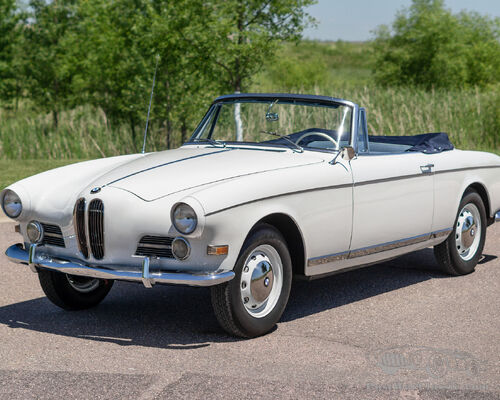
1957 BMW 503 Cabriolet (V8) 1 of 13 Built for US Market #Matching Example
1957 BMW 503 Cabriolet Series 1 Original Aluminum V8 # Matching Original Aluminum Body with Factory Stampings 1 of ..
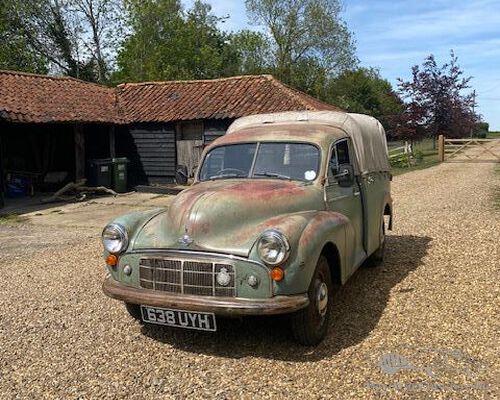
1954 Morris Minor Series II Pick Up
Morris Minor Series II Pick-Up, first registered 15th Jan 1954. Exported from new to Australia, returned to the UK in 2014. Swansea documentation r..