The global magazine and marketplace for classic car enthusiasts, by enthusiasts.


Filter
Classic Singer for sale - Singer cars for sale
-

1959 Triumph TR3A
Technical Specifications: Mark & Model: Triumph TR3AYear: 1959Registration plate: Jersey registeredChassis Number: TS 43982LEngine Number: TS 44364EEngine Capacity: 2138 ccTransmission: 4-speed manual + overdriveMileage: 8,990Body style: 2-door RoadsterInterior color: Blac.. -
Morgan Plus 4 110 Anniversary 2.0 litre
Technical Specifications: Mark & Model: Morgan Plus 4 110 Anniversary 2.0 litreYear: 2019Registration plate: UK registeredChassis Number: S3737Engine Number: Engine Capacity: 1999 ccTransmission: 5-speed manualMileage: 6,110Body style: 2-door roadsterInterior color: Mulber.. -
1953 Lancia Aurelia B20 GT 3rd Series
Lancia is one of the world’s oldest and most respected motor car manufacturers and the Aurelia is one of the most influential cars in motoring history. Known for superb engineering and excellent performance the Aurelia was designed under the supervision of the legendary Vittorio Jano, the mastermind behind the all-conquering Alfa Romeo P2, 6C an.. -
1989 Aston Martin Lagonda Series 4
1989 Aston Martin Lagonda Chassis number: SCFDL01S6KTR13602 Registration Number: G51TBH Mileage: 13,000 miles The Aston Martin V8 Lagonda was a luxury four-door saloon built between 1976 and 1989. A total of 645 examples were produced at an average selling price of £150,00.. -
1952 Rolls Royce Phantom 4 (Two available.)
1952 Rolls Royce Phantom 4 One of two we have available. Eastern Europe EEC Tax paid. Qualified buyers please call for full details/photographs/histories on both. Both fully restored cars wanting for nothing. Richard Biddulph 0044 7967 260673 -
1962 Alvis TD21 Series2 DHC
1962 Alvis TD21 Series2 DHC Chassis Number: 26833 Registration Number: 700TKT These cars have an understated, timely elegance from every angle, make a great alternative to a classic Jaguar or indeed, Rolls Royce or Bentley, and in their day were seen as the sort of car tha.. -
2014 Jeep Wrangler Sahara 3.6 Litre V6 Petrol
2014 Jeep Wrangler Sahara 3.6 Litre V6 Petrol Vin Number: 1C4HJWHG3EL153580 Registration number: KJ14JXE Another simply immaculate rust free low mile Japanese import Jeep Wrangler which has covered a scant 47,000 miles from new. It boasts the powerful 3.6 Litre V6 engine g.. -
Lancia Aurelia B24S (LHD) Mille Miglia Eligible
Known for superb engineering and excellent performance the Aurelia was designed under the supervision of the legendary Vittorio Jano, the mastermind behind the all-conquering Alfa Romeo P2, 6C and 8C of the pre-war years. Jano’s arrival set the stage for Lancia’s burst of fame and glory on the international competition stage, in which the Aureli.. -
1977 Fiat 131 Abarth Rally Stradale | RM Sotheby's | The Zürich Auction
To Be OFFERED AT AUCTION WITHOUT RESERVE at RM Sothebys' The Zürich Auction event, 26 September 2026. Offered Without Reserve | CHF120,000 - CHF180,000 Please check back soon as our dedicated cataloguing team is preparing the description for this lot. To view this car and others currently consigned to this auction, please visit the RM website a..


Singer
GB, 1905 – 1970
(1) Singer & Co Ltd, Coventry, Warwickshire, 1905 – 1936; Birmingham, 1927 – 1936
(2) Singer Motors Ltd, Coventry, Warwickshire, 1936 – 1956; Birmingham, 1936 – 1956
(3) Singer Motors Ltd, Tyton-on-Dunsmore, Warwickshire, 1956 – 1970
The Singer cycle firm acquired the manufacturing rights of the Perks and Birch motor wheel in 1901, and made front-wheel drive Singer tricycles as well as motor bicycles. These gave way to a line of conventional Singer tricars, which were still available as late as 1907 with water-cooling, wheel-steering and 6hp and 9hp engines. Car production started in 1905 with a 15hp 3-cylinder Singer car designed by Alex Craig, and made under licence from Lea-Francis. This Singer car had horizontal cylinders with overhead camshafts and 30in connecting-rods, and final drive was by chain. 2-cylinder versions Singer cars were also made, but the beginning of a new line Singer cars came with a conventional 2.4-litre 4-cylinder in 1906: an experimental 6-cylinder engine was exhibited in a Singer car, but not offered for sale. Only orthodox Singer cars with front vertical engines were listed in 1907, the smaller ones (a short-stroke 900cc twin Singer car, a 1.4-litre 3-cylinder, and a 1.8-litre 4-cylinder) having T-head White and Poppe power units, the larger fours Singer cars of 2.4-litres and 3.7-litres using Aster engines. Thereafter White and Poppe engines were standardized in Singer cars, and in 1909, when the Singer car company was reorganized, there was a 2.5-litre Singer sixteen with 3-speed gearbox and all brakes on the rear wheels, this Singer car selling for £380. L-head fours of 2.6-litres and 3.3-litres were introduced on Singer cars for 1911, in which year the biggest Singer car had worm drive, Sankey steel detachable wheels were featured, and the circular motif in the radiator core was discarded. The White and Poppe-powered Singer cars had quite a brisk performance, G.O. Herbert’s ‘Bunny Junior’ being capable of 3.000rpm, and wresting the Brooklands 16hp class records from Coatalen’s Sunbeam, while a modified 15hp Singer car with lengthened stroke and overhead inlet valves ran in the 1912 Coupe de l’Auto. This year saw the introduction of Singer cars first best-seller, the 1.100cc L-head Singer Ten with pair-cast cylinders and 3-speed gearbox in unit with the back axle. Though qualifying as a cyclecar in terms of weight, the Singer car was in fact one of the first modern baby cars, and sold for £185: Haywood’s tuned Singer car put 72 miles into the hour at Brooklands, and the fortunes of the Rootes brothers’ motor business were founded on the sale of this Singer car. The following year Singer cars own engines spread up the range with a new monobloc 2.4-litre fourteen, this Singer car was available with electric lighting, and fitted with Singer-made shock absorbers. By the outbreak of World War 1 only the big 20hp Singer cars retained the White and Poppe unit, and very few of these Singer cars were made. Singer motorcycle manufacture ceased in 1915, and the few Singer Tens being made to civilian account had a new rounded radiator and electric lighting. Singer Tens were also supplied to the Armed Forces during the war.
The first post-war 1 years saw for Singer cars a concentration on the 10hp model, now with full electrics, but otherwise little changed. A 60mph sports version Singer car cost £500 in 1920, and 33bhp was claimed from a racing Singer car which ran in the 1921 200 Mile Race. In 1922 the gearbox was placed amidships, and by 1923 the Singer car had been completely redesigned with an ohv monobloc engine and unit box. For one reason only (1923) a cheapened Singer car was offered under the Coventry-Premier name, this being a motorcycle and cyclecar concern which the Singer car company had acquired in 1921.
It was in 1921 that a trend towards a complicated Singer car range began which was to bring about the Singer car firm’s subsequent financial difficulties, though in 1928 Singer cars ranked third behind Morris and Austin among all-British private-car manufacturers. Their first production six Singer car was available in 1922, this Singer car being a long-stroke 2-litre with side valves, thermos-syphon cooling, magneto ignition, 3-forward speeds, spiral bevel final drive, and disc wheels, selling for £675. 4-wheel brakes were optional on this Singer car model in 1924, and had spread to the Singer Ten two years later, and a smaller 1.8-litre ohv power unit was introduced in a Singer car in 1927. Also in 1924 fabric bodies were listed for Singer cars, though curiously enough Singer cars avoided these during the late 1920s when fabric was fashionable. By 1927 also the Singer Ten had grown up into a 1.3-litre Subger Senior with plate clutch, and a new and very successful baby Singer car had come on the scene in the shape of the 848cc ohc Singer Junior, initially this Singer car was with 3-speed gearbox and brakes on the rear wheels only. The Singer car was a roomy four-seater with 4 doors, a 7ft 6in wheelbase, and a price of only £418.10s., and this Singer car was made until 1932, as well as being the ancestor of all Singer car models up to the Rootes takeover in 1956. 1928 brought the abandonement of cone clutches in Singer cars, the provision of 4-wheel brakes on the Singer Junior, and the introduction of an improved 42bhp 1.9-litre ohv six with a 7-bearing crankshaft. There was also a short vogue for fully convertible saloon Singer cars with wind-down roofs. 1930 Singer cars had wire wheels and coil ignition, but things became impossibly complicated for Singer cars in the 1931-1933 period, when the Singer car marque went in for ribbon radiator shells, not to mention the ‘Kaye Don’ six with waterfall-style radiator grille and twin carburetors, selling for £480. Eight models Singer cars were listed in 1932: the Singer Junior with 4 speeds and rear tank, a 972cc Singer Junior Special version destined to grow up into the Singer Nine, both Singer cars with overhead camshafts, a sv 1.3-litre 4-cylinder Singer Ten, and four 6-cylinder Singer cars ranging from a short-lived 1½-litre sv 12/6 at £235 up to the big ohv push-rod Singer Kaye Don. Hydraulic brakes were standardized on all Singer cars but the biggest six in 1933, when the first 972cc sports Singer Nine was introduced; these Singer cars challenged MG and did very well in reliability trials, which suited their rather low gearing. In standard form the Singer car offered 70mph and 5.300rpm for £185, though even the 4th place (and best-placed British car) by a Singer car in the 1937 TT failed to make up for the catastrophe of the 1935 race, when the whole Singer car team was eliminated by spectacular steering failures. This unfortunate affair also sounded the death-knell of an excellent 4-bearing 1½-litre sporting six Singer car introduced during 1933.
The permutations went on. Singer cars own ‘perm-mesh’ clutchless change came in 1934, in which year there was also a 1½-litre ohc Singer Eleven with independent front suspension and fluiddrive transmission at £245. This Singer car could be bought with a fullwidth aerodynamic saloon body known as the Airstream. All 1935 Singer cars had ohc engines, fluidrive and independent front suspension being applied also to the de luxe 9hp saloon Singer car and the 2-litre 6-cylinder Singer car model at the top of the range. In 1936 there were six modelsof Singer cars, cheapest of which was the 9hp Bantam Singer car with 3-speed gearbox, electric pump feed and 12-volt electrics, looking very like the Morris 8, and competitively priced at £120 for open models. Enevitably another reorganization of the Singer car company followed, and more models. A 42bhp Singer Twelve with an engine of just over 1½-litres’ capacity sold for £225, this Singer car had an X-frame, and market a reversion to the beam front axle, but a similarly-powered sports model Singer car was almost stillborn, and after 1937 there were no more true sports Singer cars or 6-cylinder models. Instead, a 1.2-litre Singer Ten with the option 3 or 4 forward speeds was listed for 1938 at prices from £168.10s. up, and the Singer car company’s confidence in its ohc power units was reflected in the issue of a bore guarantee with the 1939 Singer cars. The Singer Nine (now of 1.074cc) reverted to mechanical brakes, and a semi-sports roadster style was offered as an alternative to the saloon Singer car on this chassis. 1.100cc and 1½-litre engines were supplied to HRG, who continued to use Singer car power units for the rest of their series-production career.
After World War 2 Singer car production was concentrated at the Birmingham works (opened in 1927), and Singer re-introduced their pre-war types. In 1948, however, the saloon Singer cars were replaced by a full-width, slab-sided 1½-litre model, the Singer SM 1500. This Singer car retained a separate chassis, and featured column change, hypoid final drive, and coil-spring independent front suspension. At £799 the Singer car was more expensive than its rivals, and sales of Singer cars slumped once the era of the seller’s market came to an end. Neither this nor the improved 1951 1½-litre roadster Singer car, also with independent front suspension, could compete against the big manufacturers. None of the Singer car company’s subsequent innovations – the option of twin-carburettor power units in 1953, experiments with a fiberglass-bodied roadster in 1954, or the Singer Hunter saloon of 1955 with conventional radiator grille, fiberglass bonnet to and (on paper, at any rate) a rather expensive twin-ohc engine as an alternative – could save the day for Singer cars. Early in 1956 Rootes Motors purchased Singer car company, and by the end of the year the Hunter had been replaced by a Hillman Minx-based Gazelle retaining Singer’s 52bhp ohc engine. Even this last vestige of the old days had been phased out of production by the end of 1958, and since then the name of Singer cars had been carried by de luxe variants of the basic Hillman types, acquiring such Hillman improvements as optional automatic transmission in 1960 and hypoid final drive in 1961.
At the beginning of 1970 the Singer car range consisted of the rear-engined ohc Chamois (Imp), and the 1.469cc Gazelle and 1.725cc Vogue, both members of the Arrow family corresponding to Hillman’s Minx and Hunter. All these disappeared soon afterwards as part of the rationalization the Chrysler Corporation imposed on the old Rootes Group.
Source: Georgano, encyclopedia of motorcar; MCS
The information is written with the greatest of care. However, if you have any suggested amendments please contact us at office@postwarclassic.com


Featured
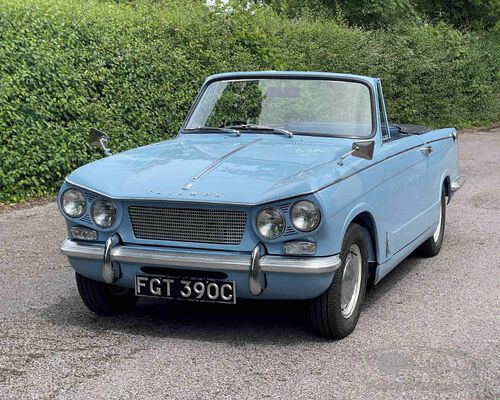
Triumph Vitesse 6 Convertible
Technical SpecificationsMark & Model: Triumph Vitesse 6 ConvertibleYear: 1965Registration plate: UK registered
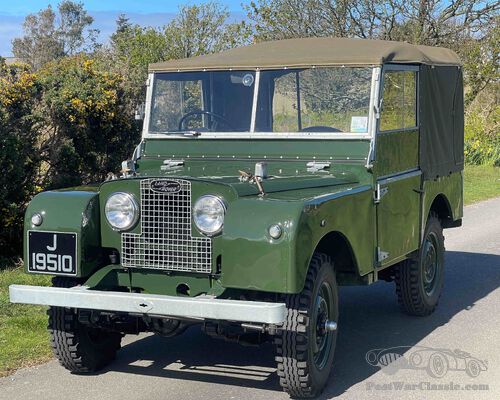
1952 Land Rover Series 1
Technical Specifications:Mark & Model: Land Rover Series 1Year: 1952Registration plate: Jersey registered
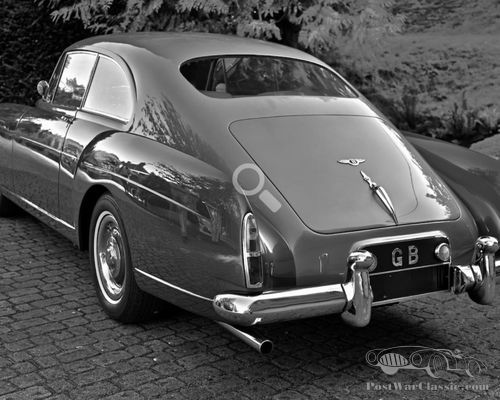
1957 Bentley S1 Fastback by H.J. Mulliner.
1957 Bentley S1 Fastback by H.J. Mulliner.A freshly restored award winning car in like new condition. A later car with Power assited steerin..