The global magazine and marketplace for classic car enthusiasts, by enthusiasts.


Filter
Classic Skoda for sale - Skoda cars for sale
-

Coming soon -1961 Jaguar E Type Series 1 LHD Flat Floor outside bonnet lock
Coming soon - 1961 Jaguar E Type Series 1 LHD Flat Floor outside bonnet lock Registration Number: OAGP008 (Belgium) Chassis Number: 875340 Arriving soon from a prominent European collection. EEC Registered & EEC taxes paid Full de.. -
1957 Mercury Monterey Convertible | RM Sotheby's | The Hershey Auction
To Be OFFERED AT AUCTION at RM Sothebys' The Hershey Auction event, 7 - 8 October 2026. $50,000 - $60,000 USD Please check back soon as our dedicated cataloguing team is preparing the description for this lot. To view this car and others currently consigned to this auction, please visit the RM website at rmsothebys.com/auctions/hf26/. -
1953 Packard Caribbean | RM Sotheby's | The Hershey Auction
To Be OFFERED AT AUCTION at RM Sothebys' The Hershey Auction event, 7 - 8 October 2026. $60,000 - $80,000 USD Please check back soon as our dedicated cataloguing team is preparing the description for this lot. To view this car and others currently consigned to this auction, please visit the RM website at rmsothebys.com/auctions/hf26/. -
An icon: Morgan 3 Wheeler with Krazy Horse Specs from 2016
The Morgan 3 Wheeler has become a cornerstone in the Morgan’s Malvern enterprise's history. This three-wheeled cyclecars first produced in 1910, has become an icon since it was launched at the Geneva Motor Show in 2011. This vehicle has its own personality. An impressive fast car that balances between modern look and performance and old-f.. -
2017 Citroen DS3 Prestige Cabriolet 1.6 litre THP S/S Manual.
2017 Citroen DS3 Prestige Cabriolet 1.6 litre THP S/S Vin Number: VF7SB5GZMHW502159 Registration Number: WM66VJJ Manual 6 speed Gear box. A really nice example with the higher power high pressure turbo engine that was jointly designed with BMW & is renown.. -
Alvis TE 21 Park Ward Coupe
BARN Find , this verry rare Alvis TE 21 Park Ward Coupefrom 1965. Between 1963 and 1966 there have only been produced 352 these special Park Ward Coupe's. You can recognise the Park Ward Coupe on his headlights two above each other. The Alvis has a six cylinder engine of 3000 cc which produces 130 HP which could reach a top of 170 km an hour. Th.. -
1984 Lamborghini Countach 5000 S | The Quail Auction 2026
Chassis No. ZA9C00500ELA12736 The Lamborghini Miura, the world's first supercar, was a nearly insurmountable act to follow. Its successor needed to be a forward-thinking purpose-built sports car, oozing futuristic design cues and cutting-edge engineering. Under Lamborghini's orders, no holds were barred for the new "LP112" project, which wou.. -
1965 Porsche 911 | The Quail Auction 2026
Chassis No. 300718 Engine No. 900893 Transmission No. 223981 (See Text) Porsche 911 chassis number 300718 was completed the same day as its sibling-The Quail Auction 2026 Lot 296-and was likewise delivered new via Porsche Car Northwest. It was sold to Pacific Northwest drag-racing champion John Schmauder and remained in the regio..


Skoda
CS, 1923 to date
(1) Akc. Spol. Drive Skodovy zavody, Plzen (Pilsen); Mlada Boleslav, 1923 – 1945
(2) Skoda np, Mlaa Boleslav, 1945 to date
Skoda was one of the most important industrial concerns of the Austro-Hungarian empire. After World War 1 it was included in the territory of the new Czechoslovak republic. The Skoda company branched out into car production, building Hispano-Suizas under licence. The first of these Skoda cars appeared in about 1923. The engine of the Skoda car was the 37.2hp 6-cylinder 6.6-litre, while the bodies were of Skoda’s own design. Production of Skoda cars was in the Skoda car works at Pilsen. In 1925 Skoda cars took over the Laurin & Klement works at Mlada Boleslav, and production of private cars under the Skoda car name began in this factory. The first Skoda cars were based on earlier Laurin-Klement designs. For the next few years the range of Skoda cars included various 4-, 6- and 8-cylinder models Skoda cars of conventional design. More advanced ideas were introduced with the Skoda 420 model in 1933. The engine of the Skoda car was a 995cc unit developing 20bhp, the chassis was on Tatra lines with a centre tubular layout and rear swing half-axles. The 420 Skoda car ushered in the 1930s range of Skoda cars with which Skoda became famous. The Skoda 420 developed into the Skoda Popular and the same technical features were to be found in the 4-cylinder Skoda Rapid (1.380cc and 22bhp) and the 6-cylinder Skoda Superb(2.480cc and 50bhp). Model 932 was an experimental Skoda car with rear engine. The Skoda Popular also appeared with a streamlined coupé body and this Skoda carwas quite successful in a number of sporting events, including the Monte Carlo Rally. All Skoda car models gradually increased capacity and output, and changed from side to overhead valves. The range of Skoda cars was supplemented by the 1.8-litre Skoda Favorit and the Skoda Monte Carlo with a Popular chassis and Rapid engine. In 1939 the Skoda car range consisted of four types, the most important Skoda car being the 1100 OHV (1.089cc and 32bhp) and the 6-cylinder, 3.140cc 85bhp model.
After World War 2, the Skoda 1100 OHV and 1200 OHV – based on pre-war designs –appeared, and these Skoda cars were developed into the well-known 40 or 50bhp Skoda Octavia with a capacity of 1.089cc, the Skoda Octavia Super (1.221cc and 45bhp) and the Skoda Felicia, a two-seater Octavia version with a 50bhp engine. The Skoda Octavia/ Felicia range was discontinued, with the exception of the station wagon Skoda cars, after the introduction of the Skoda 1000MB (MB for Mlada Boleslav) in 1964, a rear-engined 988cc 40bhp Skoda car. The Skoda Octavia wagons were discontinued in 1969, and a year later came a new version of the 1000MB Skoda car, the Skoda S110 with 1.107cc engine and disc front brakes. Even faster was the S110R coupé Skoda carof 1971. The 1972 Skoda car range embraced variations on the basic rear-engined theme with 48bhp, 53bhp and 62bhp power units. Disc front brakes were standard on Skoda car.
Skoda cars are now built as part of the Volkswagen AG group.
Source: Georgano, encyclopedia of motorcar; HON
The information is written with the greatest of care. However, if you have any suggested amendments please contact us at office@postwarclassic.com


Featured
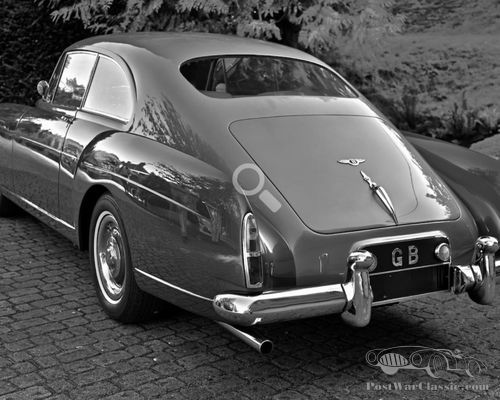
1957 Bentley S1 Fastback by H.J. Mulliner.
1957 Bentley S1 Fastback by H.J. Mulliner.A freshly restored award winning car in like new condition. A later car with Power assited steerin..
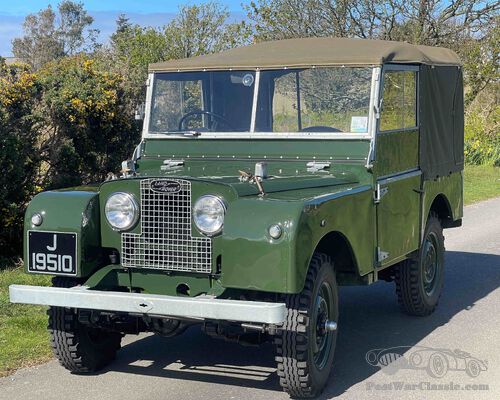
1952 Land Rover Series 1
Technical Specifications:Mark & Model: Land Rover Series 1Year: 1952Registration plate: Jersey registered
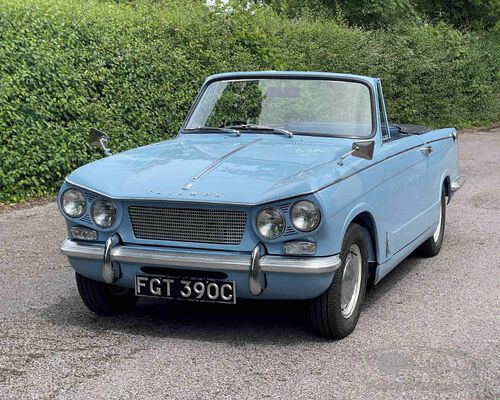
Triumph Vitesse 6 Convertible
Technical SpecificationsMark & Model: Triumph Vitesse 6 ConvertibleYear: 1965Registration plate: UK registered