The global magazine and marketplace for classic car enthusiasts, by enthusiasts.


Filter
Classic Abarth for sale - Abarth cars for sale
-

2013 Abarth Abarth 500 Assetto Corse 42/49 Stradale
*Power: 200 HP *Max Speed: 210 kph *Engine: 4 Cylinders Turbo, T-Jet *Year of manufacture 2010 *First registration 2013 *Odometer: 7000 Kms *Gearbox manual 6 speed *Weight: 930 kgs - Very Rare Specimen ..


Abarth
Italy, 1950 – 1971
Abarth & Co, Turin
Carlo Abarth, formerly associated with Cisitalia, launched out on his own in 1950, concentrating at first on tuning equipment for Fiat and other makes, though a few Fiat-based 1000cc sports coupés were made with Porsche trailing-arm independent front suspension. Serious car manufacturer started in 1955 with the 66bhp Boano-bodied Tipo 207/A Spyder, still using a front-mounted engine and Millecento mechanical components. This was rapidly followed by the first of his Fiat 600-based rear-engined sports cars, a 39bhp open two-seater. Fiat components were used mainly until 1962, though there was a 1-litre 88bhp coupé based on Alfa-Romeo’s Giuletta in 1958, and some special coupé bodies were built for Porsche in 1960. The make arrived on the map with a series of attacks on long-distance International Class Records which started in 1956, using rear-engined streamliners with 500, 750 and 1.100cc power units. A ‘750’ averaged 111,92mph for 72 hours in July 1957.
Production Abarths followed two lines of development: the first of these used the hulls and basic components of Fiat 500 and 600 berline, but the Abarth treatment included stiffer crankshafts, reinforced clutches, lowered suspensions, and (from 1961) front disc brakes. Parallel with these were the true Abarths, 600 based coupés with bodywork by Allemano and Zagato, sold initially with either a 747cc push-rod unit (in which form it did 95mph and sold for £2.248 in England in 1959) or with a fully-Abarthized twin-camshaft bialbero engine of 850cc. Bigger coupés and cabriolets with four wheel disc brakes and 2.2-litre Fiat-based 6-cylinder engines appeared in 1960, but they did not last long, and were the last of the front-engined cars. The marque won the Nürburgring 1.000 kilometre sports-car race five years in succession (1960-64), taking 2nd place in 1965. An unsuccessful design for Le Mans in 1961 saw the abandonment of swing-axle rear suspension and the introduction of a frontal radiator on the ‘hotter’ versions.
A year later the introduction of Simca’s 1000 model sparked off another family of Abarth derivatives ranging from a warmed-up and lowered 1.100cc, 55bhp saloon to the usual aerodynamic coupés. 1964 developments include a 995cc twin-camshaft Formula 2 racer, and a formidable Berlina using a twin-cam, 1.6-litre Abarth engine in the new Fiat 850 hull; its top speed was 137mph. The year 1966 marked a closer association with Fiat and the end of the Abarth Simcas – though some of these were purchased by the company’s British concessionaires, Radbourne Racing, and marketed with tuned 75mhp Fiat 124 engines in 1968. An immensely complicated range of Fiat derivatives, however, covered everything from a lightly tuned 27bhp 500 berlina up to fullytuned versions of the 850 coupé and spyder with frontal radiators, 5-speed gearboxes, and all-disc brakes, even the 1946cc 147bhp unit being available. In 1967 an Abarth took 4th place in the European Hill-climb Championship, and there was a 1-2-3 victory in the 1968 Nürburgring 500 Kilometres, but latter-day competition activities never quite came off. A 600bhp 6-litre V-12 sports racer planned for 1968 had to be abandoned in the face of revised international regulations, and though Abarth raced rear-engined sports models with their own 2.968cc V-8 engine, a Formula 1 car with this unit never reached a circuit. The 2-litre Group 5 4-cylinder was more successful, taking the first three places in the 1970 Circuit of Mugello, but towards the end of 1971 the company went into liquidation. The last new touring Abarth was the Scorpione of 1970; this was a rear-engined, wedge-shaped sports coupé with retractable headlamps, powered by a 75bhp, 1.280cc push-rod engine.
Source: Georgano, encyclopedia of motorcar; MCS
The information is written with the greatest of care. However, if you have any suggested amendments please contact us at office@prewarcar.com


Featured
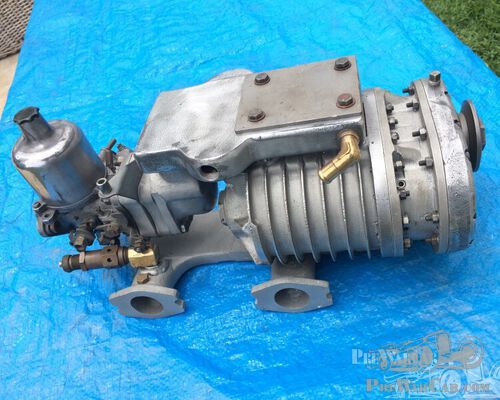
Blower / Compressor / Supercharger - Godfrey Marshall - A Series BMC Engine
SuperchargerA Godfrey Marshall cabin blower Type Mk22 converted to vehicle use by Barry Ekins of Sydney NSW. Ekins created kits for many popula..

One of one 1955 Mercedes-Benz 300 B with Durham coachwork and floor shift manual transmission
One owner from new, this 1955 Mercedes Benz 300 B sedan carries custom coachwork by Durham and is equipped with its original factory four speed flo..

Triumph Spitfire 1500
This stunning Triumph Spitfire 1500 is a Dutch-delivered example with only two previous owners. In its early years, the first owner carefully prepa..