The global magazine and marketplace for classic car enthusiasts, by enthusiasts.


Filter
Classic Alpine for sale - Alpine cars for sale
-

1954 Corvette C1 - SUPER RARE Black!!
Looking for her next lover, my classy 1954 Corvette C1. She's a beautiful sculpture. Never have i had so many adoring comments as when driving this vehicle. An utter pleasure to have cared deeply for, its time for her new owner to step in. Be quick and caring. Located in the UK at present. •Only 4 Black, C1 53-55 Corvettes,.. -
1954 Chevrolet Corvette C1
Fully restored 1954 C1 Corvette in Black. Stunningly beautiful car, feels like driving a sculptural work of Art. Known to be the oldest Corvette on the UK Classic Corvette register, this originally White car (virtually all were White) was nut / bolt restored in the US by a private collector. Finished in extremely rare Black, only 4 cars were thoug.. -
CADILLAC 75 Fleetwood Sedan - 1951, sortie de musée.
CADILLAC Series 75 Fleetwood Sedan limousine année 1951. La voiture a dormi de longues années bien au sec dans un grand musée Européen, elle a donc été bien préservée du soleil et des intempéries.C’est maintenant une découverte, un peu comme une sortie de grange qui est proposée à la vente.Il s’agit d’une Cadillac ass.. -
1947 Bentley Mark VI Windovers Drop Head Coupe
1947 Bentley Mark VI Windovers DHC.Chassis Number: B-108-AKRegistartion number: JFO394Chassis number B108AK was completed in August of 1947 to the order of Sir Alexander Rogers KBE. The Bentley was bodied as a drophead coupe by the respected coachbuilding firm of Windovers. Founded in 1856 in Huntingdon but from 1924 based in North West London, .. -
1956 Bentley S1 Continental H.J. Mulliner Fastback
1956 Bentley S1 Continental H.J. Mulliner FastbackRegistration number: TBAUnder long term ownership for several decades, this car is a low mileage example having covered a scant 66,000 miles. It is a very early example with single master cylinder having been registered first in January of 1956. We will be properly photographing i.. -
1965 Austin-Healey 3000 Mk III BJ8
Body No. 72940 As the final iteration of the "Big Healey" 3000 Mk III rolled onto the scene, the legendary British sports car manufacturer successfully retained the DNA of its classic curvaceous long hood/short deck sports roadster, while tweaking the cockpit to accommodate 2+2 seating and adding amenities directed towards the booming North .. -
1958 Rolls-Royce Silver Cloud 1 LWB
1958 Rolls-Royce Silver Cloud 1 LWB Chassis number: BLC7Registration Number: 877CGD06 (swiss) Kept in underground parking & Chauffeur driven in Switzerland for the last few decades. This car was purchased as a very low mile example in the 1970's from noted dealers Frank Dale & Stepsons. A chauffeurs .. -
1988 Jaguar Daimler Double Six Series 3 RHD
1988 Jaguar Daimler Double Six Series 3 Vin Number: SAJDDRLW3CA479661Registration Number: E897NOW Just 8645 Miles from new!!! This car is so pristine it still has its original plastic protective film on the sill plates. We sourced this car in 2016 from a prominent Japanese collection & supplied it to t.. -
1987 FERRARI TESTAROSSA LHD
1987 Ferrari Testarossa Vin Number: ZFFA17B000067981Registration Number: D138BSA Supplied new to Japan & with just 16,581Kms covered from new. The current Portugese owner is the second owner of the car & we supplied it to him as part of his collection in 2016. We purchased it in Japan from the first o.. -
1958 BENTLEY S1 CONTINENTAL PARK WARD DHC
1958 Bentley S1 Continental Park Ward DHC Chassis Number & Registration available on request to qualified buyers. Please call Richard Biddulph for details. Coming to us from one of the UK's most prominent collections along with a sister car a Bentley S1 fastback. This car is in impeccable..


Alpine
France, 1955 – date
Automobiles Alpine srl, Dieppe
This is one of the more successful French sports cars based on the rear-engined Renault, though production has been limited; 350 were built in 1964. The first model was the Mille Miles (so named because of its successful début in the hands of its sponsor, M. Redélé, in the 1955 Mille Miglia), which used Renault 4CV mechanical components welded to two/four-seater fiberglass coupé bodywork. It won its class in the 1956 Mille Miglia, and by 1957 buyers had the choice of two-seater coupé or cabriolet bodies as well as more powerful engines; the 845cc Dauphine or a bored-out 904cc development. 103mph was now claimed from the more sporting types and the 1959 export price was $3.300. The Alpine’s technical specification followed Renault evolution, and 1961 saw two new body styles: a ‘2 plus 2’ GT coupé and an aerodynamic berlinette. Power output also went up: 77bhp from 998cc in 1961 and 87bhp from the Gordini-tuned 1.100cc unit available in 1964, when twin-camshafts and hemi-head variants were introduced, plus some single-seater racing versions, evolved in consultation with Ron Tauranac of the Brabham organization. Both Formula 2 and Formula 3 Alpines had 5-speed gearboxes and disc brakes all round, but a twin-cam Gordini-Renault unit powered the former and a 996cc push-rod engine the latter. The Formula 3 model was quite successful, winning the Prix de Paris race, and gaining Henri Grandsire the French Formula 3 championship in 1964. The sports Alpines scored a class win in the Tour de France, as well as winning the Index of Thermal Efficiency at Le Mans, and 1965 brought them a Coupé des Alpes in the Alpine Rally and victory in the Nürburgring 500-Kilometre event. The ‘hottest’ version on general sale now offered 115bhp and 127mph from 1.3-litres. Disc brakes all round were introduced for all 1967 Alpines and 4-speed all-synchromesh gearboxes made standard, a 5-speed box costing 950 francs extra. The biggest engine listed was a 1.296cc unit developing 120bhp, but 1968 saw the adoption of the 1.470cc 16. Meanwhile Alpine was assuming the role of Renault’s competition department, with energetic support for F3, and the introduction of a rear-engined sports car with tubular frame and 3-litre V8 power unit designed by Gordini. This was first seen in 1967 1000 Kilometer of Paris, and finished 8th at Le Mans in 1968, in which year the smaller Alpines won the Index of Performance.
Alpine repeated this feat in 1969, but thereafter the company concentrated on rallying, having already won the Alpine and Czech events in 1968, and the Alpine and the Three Cities in 1969. The 1970 score was headed by victories in the Italian and Acropolis rallies. The Alpine marque reached its zenith in 1971, with a 1-2-3 victory in the Monte Carlo Rally, a second win in the Acropolis, and the manufacturers’ championship. In addition the French national rally (J.P. Nicolas) and F3 (P. Depailler) champions won their titles in Alpines. A new Alpine touring model for 1971 was the Alpine A310 2+2 coupé with 140bhp 1.605cc engine, 5-speed gearbox, and servo-assisted discs all round. This continued into 1972, along with the two-seater Tour de France Alpines, powered by 1.289cc and 1.565cc units. Alpines are assembled abroad by Renault affiliates in Bulgaria, Brazil, Mexico and Spain. Interestingly, these overseas Alpines accounted for more cars in 1970 than the parent factory at Dieppe – 1640 as against 360
Source: Georgano, encyclopedia of motorcar; MCS
The information is written with the greatest of care. However, if you have any suggested amendments please contact us at office@prewarcar.com


Featured
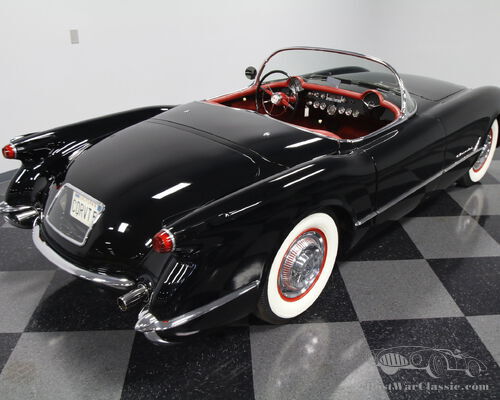
1954 Chevrolet Corvette C1
Fully restored 1954 C1 Corvette in Black. Stunningly beautiful car, feels like driving a sculptural work of Art. Known to be the oldest Corvette on t..
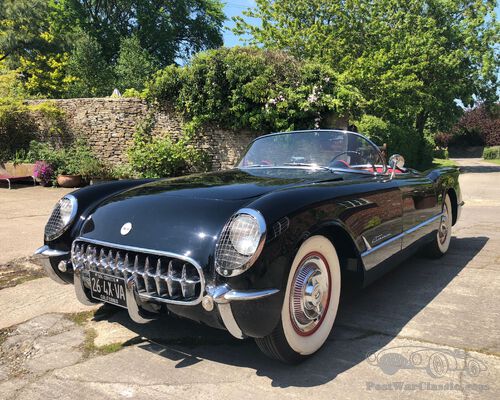
1954 Corvette C1 - SUPER RARE Black!!
Looking for her next lover, my classy 1954 Corvette C1. She's a beautiful sculpture. Never have i had so many adoring comments as when drivi..
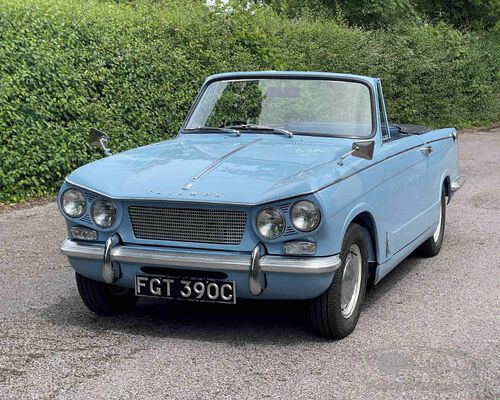
Triumph Vitesse 6 Convertible
Technical SpecificationsMark & Model: Triumph Vitesse 6 ConvertibleYear: 1965Registration plate: UK registered