The global magazine and marketplace for classic car enthusiasts, by enthusiasts.


Filter
Classic Aston Martin for sale - Aston Martin cars for sale
-

1957 Aston Martin DB2/4 MKII
Details: Oldtimer Australia is delighted to offer for sale this very rare and highly desirable 1957 Aston Martin DB2/4 MKII.The factory records on file confirm that this is an Australian delivered, factory right hand drive example that was delivered new to the Penfold family in South Australia. The car was delivered through Aston Martin a.. -
1954 Aston Martin DB2/4 Left Hand Drive Manual Coupe
1954 Aston Martin DB2/4 Left Hand Drive Manual CoupeRegistration: VL86A (Austrian) 435UYL (UK)Chassis Number: LML/733Engine Number: VB6J/299 This stunning left hand drive DB2/4 was subject to a meticulous complete restoration in 2009. Every aspect of the car was removed and has been re finished to the highest of stand.. -
1998 Aston Martin V8 Volante LWB Left Hand Drive.
1998 Aston Martin V8 Volante LWB Left Hand Drive. Chassis number: SCFDAM209WBL89023 Registration number: S17VOL A beautiful rare car with less then 8000 miles from new. The current owner acquired this car from the first owner, a good friend from germany who purchased the car brand new in Monaco & use.. -
2024 Aston Martin Valkyrie Spider | RM Sotheby's | The Monterey Auction
To Be OFFERED AT AUCTION at RM Sothebys' The Monterey Auction event, 13 - 15 August 2026. $3,750,000 - $4,250,000 USD Number 49 of 85 Valkyrie Spiders producedOffered from single ownership and showing just 85 miles at cataloguingDelivered with £255,000 worth of factory optionsAlumite Silver with Speed Red graph.. -
2006 Aston Martin DB9 Volante 6 MT
Reimel Motor Cars is proud to offer this 2006 Aston Martin DB9 Volante 6MT with only 16k miles. It features Silver exterior paint that perfectly complements the Black leather interior. This rare 6-speed DB9 Volante is a well-maintained example, presented in its iconic colors. These V12 6-speed manual models represent an overlooked segment of.. -
2014 Aston Martin Vanquish Centenary Edition ex-Daniel Craig | The Quail Auction 2026
Chassis No. SCFLDCFPXEGJ01702 Centenary Edition No. 007 Aston Martin marked its hundredth year in 2013 with a series of centenary specials, chief among them a limited run of 100 Vanquish coupes celebrating a century of exquisite British craftsmanship. That milestone unfolded alongside a parallel story of nearly equal length. Since Sean.. -
2018 Aston Martin Lagonda Taraf Final Edition | The Quail Auction 2026
Chassis No. SCFTMDCSXJGS56131 Since its founding in 1906, Lagonda has stood as a pillar of British craftsmanship and poise. After its acquisition by Aston Martin in 1947, however, the Lagonda name has come to denote the firm's most exclusive and meticulously crafted models on offer. Four decades after the original Aston Martin Lagonda.. -
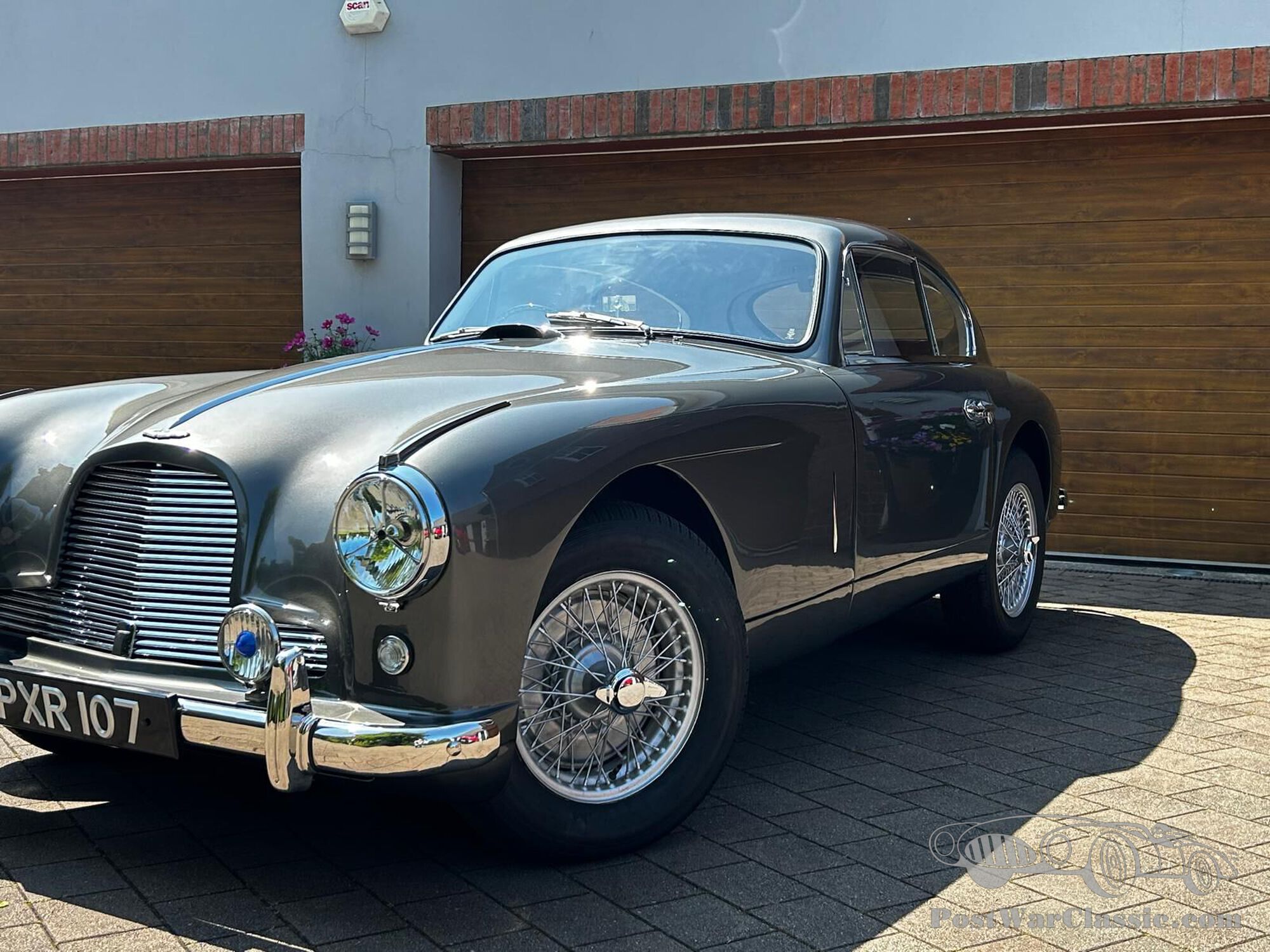
1955 ASTON MARTIN DB2/4
1955 ASTON MARTIN DB2/4 Chassis Number: LML865 Registration: PXR107 Car was purchased in 2016 as a “barn find” . it had been sitting under a tarpaulin for over 40years in a heated workshop! Car subsequently dismantled and subject to a complete nut & bolt restor.. -
1995 Aston Martin Virage Volante.
1995 Aston Martin Virage Volante. Chassis number: SCFDAM2C6PBR60081 Registration number: M15AMV 8000 Miles from new & in Mint condition. This Aston Martin Virage Volante cost a staggering £249,800 when new. It is fiished in unmarked unblemished Salisbuty blue; an attractive .. -
1962 Aston Martin DB4 Series 4.
1962 Aston Martin DB4 Series 4. Chassis Number: DB4/797/R Registration Number: YVH938 Nut & Bolt restored to perfection. Simply put this is like a brand new DB4 being delivered 63 years late!! This car has covered a scant 2000 miles since restoration, having be..




Aston Martin
GB, 1922 to date
(1) Bamford and Martin Ltd, London, W.8, 1922 – 1925
(2) Aston Martin Motors Ltd, Feltham, Middlesex, 1926 – 1929
(3) Aston Martin Ltd, Feltham, Middlesex, 1929 – 1957
(4) Aston Martin Lagonda Ltd, Newport Pagnell, Bucks, 1958 to date
The Aston Martin’s reputation has always far transcended its small-scale production. The first prototype was evolved by Lionel Martin and Robert Bamford in 1914, the Aston part of the name deriving from the Aston Clinton hill-climb. It used a 1.4-litre side-valve Coventry-Simplex engine in an Isotta-Fraschini voiturette chassis, and was followed by a second Aston Martin prototype in 1919. Aston Martin production started in 1922 with a larger 1½-litre side-valve engine in a chassis with 4-speed gearbox and semi-elliptic springs all round. A complete Aston Martin car for sale cost £850, and about 60 were made up to 1925. Successes included 2nd place in the 1922 200-Mile Race at Brooklands, and the collection of a number of world records in the same year. Front-wheel brakes were standard from 1923, and several overhead-camshaft engines were evolved for racing, initially of single-cam type, but later in 16-valve (1922) and 8-valve (1924) twin-cam forms, the former developing 54bhp. These Aston Martin cars were generally less successful than the production side-valves. The Aston Martin company exhibited at Olympia in 1925, but was wound up a few weeks later.
A comeback was staged in 1926, the new Aston Martin machine being an ohc 1½-litre designed by A.C. Bertelli. This was tested in an Enfield-Allday racing chassis and went into production at Feltham in 1927 in 50bhp form, with 4-speed separate gearbox, dash-mounted steering box, and David Brown worm final drive. Bodies were the work of Bertelli’s brother Enrico, and early Aston Martin sports models weighed only 2.128lb complete. A 63bhp dry-sump competition engine was made in 1928, and two dozen Aston Martin cars had been delivered by 1929. The dry-sump engine was standardized in 1930 and the Aston Martin 1½-litre model had a long and distinguished competition history: 6th in the ‘Double-12’ at Brooklands in 1931, the award of the Biennial Cup at Le Mans in 1932, 5th at Le Mans in 1933 and 3rd in 1935, in which year a class win was recorded in the Mille Miglia. In 1938, two years later the Aston Martin 1½-litre had gone out of production, Polledry took 2nd place in the Bol d’Or 24-Hour Race, and a similar car was actually 5th as late as 1951.
Finance was always a problem; there was a brief marketing link with Frazer Nash in 1931 and in 1933 the Aston Martin firm came under the direction of R.G. Sutherland, who retained control until after World War 2. In 1932 the Aston Martin 1½-litre acquired bevel drive and a unit gearbox of Moss make, being sold in 55bhp touring and 70 bhp sports versions, while the handsome Aston Martin MkII of 1934-1936, though it now weighed 2.576lb, was capable of 85mph and sold for £610. Aston Martin’s best sales year was 1933 with 105 cars delivered. The 80bhp Aston Martin Ulster model of 1935 could exceed 100mph. An Aston Martin 2-litre model, still with ohc was prepared for the cancelled 1936 Le Mans race and replaced the 1½-litre the following season, with wet-sump lubrication, synchromesh gearbox and Girling brakes at £575; a dry-sump Aston Martin Speed Model version was still available for £200 more. Prices were slashed to £495 in 1939, in which year the Aston Martin Speed Model was sold with aerodynamic bodywork and the Cross rotary-valve engine was tried, but not adopted. There were also wartime experiments with the Atom saloon with tubular chassis-body structure and Cotal gearbox, but the first post-war Aston Martin for sale, a Claude Hill design, featured a short-stroke pushrod 2-litre engine, independent front suspension, a hypoid back axle, hydraulic brakes and, for the first time, coil ignition. One of these Aston Martin cars won at Spa in 1948, but very few were made, even after the acquisition of the company by David Brown group in 1947.
In 1949 the 2.6-litre twin ohc 6-cylinder engine designed by W.O. Bentley for Lagonda (also part of the David Brown empire) was installed in an aerodynamic Aston Martin coupé using a space-frame with square-section tubes. It ran at Le Mans, reaching production status in 1950 as the Aston Martin DB2 available in 107bhp and 123bhp Aston Martin Vantage forms at a price of £1.915. These cars did well at Le Mans in 1950 and 1951, as well as winning their class in the 1951 Mille Miglia; they led to some out-and-out sports-racing machines, the Aston Martin DB3 (for sale in 1952), with Eberhorst-designed structure and 5-speed gearbox, and the 2.9-litre Aston Martin DB3S (for sale in 1953), which developed 210bhp and reverted to four forward speeds. Three wins in the Goodwood 9-Hour Sports-Car Race, and place at Sebring and 5th in the Mille Miglia in 1953, and twosuccessive 2nd places at Le Mans (1955 and 1956) made the David Brown Astons a powerful force in international racing. The touring Aston Martin DB2 acquired rather occasional rear seats in 1954 and a 140bhp 2.9-litre engine in 1955.
1956 saw the first of two unsuccessful forays into Formula I (the second was in 1959), and the début of the Aston Martin DBR series of sports-racers with space frames and De Dion rear axles, the first Aston Martins to have disc brakes. These were raced in 2.5-, 2.9-, and 3.7-litre forms and scored three successive wins in the Nürburgring 1000-Kilometre race, a win at Spa in 1957, a 1-2-3 victory in the 1958 T.T., and finished 1st and 2nd at Le Mans in 1959. Also in 1959 Aston Martin became the first and only British makers to win the Sports Car Constructors’ Championship. The MkIII version of the Aston Martin DB2/4 (for sale in 1957) had front disc brakes, and could be had with overdrive or automatic gearbox – factory options which are found on all later Aston Martins. Manufacture was transferred to the former Tickford body works (which had made the N.P. car in the 1920s) at Newport Pagnell in 1958. 1959 saw a detuned 240bhp version of the 3.7-litre DBR engine installed in the Aston Martin DB4, an Italian-styled sports saloon with platform frame, trailing-link and coil rear suspension and all-round disc brakes. A 302bhp short-chassis GT version capable of 170mph followed in 1960. A 255bhp Vantage engine was an option on the standard chassis in 1962, and the 4-litre Aston Martin DB5 for sale in 1964 had alternator ignition, a diaphragm clutch and the new transmission option of five forward speeds. The 5-speed box was standard in the 282bhp Aston Martin DB6 which sold in 1966 for £5.084. A 325bhp Vantage version was also available. An additional 1967 Aston Martin model had coupé bodywork by Superleggera Touring of Italy – a return to two-seaters after a lapse of several years. In December 1966 it was announced that the Aston Martin company was developing a 5-litre V8 racing engine to be installed in a Lola chassis. New for 1968 was the Aston Martin DBS coupé with four headlamps and De Dion rear axle, and in 1970 Mk2 versions of the Aston Martin DB6 had power steering as standard and fuel injection as a regular option. A new Aston Martin DBS was powered by Aston Martin’s V8, a 4ohc 5.4-litre unit developing 375bhp; transmission options were a 5-speed ZF gearbox or Chrysler Torqueflite automatic. In 1972 Ogle produced their Karen-styled version of this car with 22 rear lamps, Sundym glass and headlamp washers. Aston Martin changed hands in April of that year, and the 6-cylinder cars were discontinued.
Source: Georgano, encyclopedia of motorcar; MCS
The information is written with the greatest of care. However, if you have any suggested amendments please contact us at office@prewarcar.com




Featured
2020 Aston Martin DB5 Goldfinger Continuation | RM Sotheby's | The Monterey Auction
To Be OFFERED AT AUCTION at RM Sothebys' The Monterey Auction event, 13 - 15 August 2026. $1,000,000 - $1,500,000 USD One of 25 examples co..

Alfa Romeo Barchetrta Bianchi Prototype 600 Kg 150CV
1 of 1. Never repeated. 1985 Alfa Romeo Barchetta "by Bianchi" Built by hand in Argentina. 600kg. 150hp. Twin Webers. Alfa 2300 heart. Tubular stee..
Triumph Vitesse 6 Convertible
Technical SpecificationsMark & Model: Triumph Vitesse 6 ConvertibleYear: 1965Registration plate: UK registered