The global magazine and marketplace for classic car enthusiasts, by enthusiasts.


Filter
Classic Sunbeam, Delahaye for sale - Sunbeam, Delahaye cars for sale
-

1947 Delahaye 135 M Cabriolet "Vedette" by Chapron | RM Sotheby's | The Monterey Auction
To Be OFFERED AT AUCTION at RM Sothebys' The Monterey Auction event, 13 - 15 August 2026. $700,000 - $1,000,000 USD Sam Mann’s first coachbuilt French automobile; part of the collection for 39 yearsWinner of the Grand Prix d’Honneur and Grand Prix at the Grand Concours d’Élégances Automobiles de Paris in June 1948Driven.. -
1965 Sunbeam Tiger Mk I | RM Sotheby's | The Woodcote Park Auction
To Be OFFERED AT AUCTION WITHOUT RESERVE at RM Sothebys' The Woodcote Park Auction event, 8 July 2026. Offered Without Reserve | £50,000 - £70,000 GBP Owned by The Reg and Geoffrey Parker Collection from new through to 2024Presents in its factory-correct colours of Forest Green over Black leatherFord 4,261-cc V-8 engine.. -
1967 Sunbeam Alpine GT Series V
Technical Specifications: Mark & Model: Sunbeam Alpine GT Series VYear: 1967Registration plate: Guernsey registeredChassis Number: B 395002518 OD GTEngine Number: 3090 8342350Engine Capacity: 1724 ccTransmission: 4-speed manual + overdriveMileage: 63,500Body style: 2-door sports -
1963 Sunbeam Rapier Series 3a Convertible
1963 Sunbeam Rapier Series 3a Convertible. Vin Number: B3066458HC0 Chassis Number: OFX810 A very very rare survivor with just 50,000 miles covered from new. This car is in impeccable condition & is an example of Rootes Group at its finest. The p.. -
1946/49 Delahaye 135 MS Coupé
Elegant and extremely rare coachwork by Dutch Coachbuilder Van Leersum Strong 3.6 Litre, Triple-Carb Straight SixCotal-Preselector GearboxExcellent condition throughoutMile Miglia eligible Chassis 800311 was built in 1946 as kind of an interim model, utilising pre-war parts and combining it with technical upgra.. -
Delahaye 135MS 3pos convertible by Guilloré 1949
A real 135MS Delahaye with beautiful coachwork of Guilloré. A grand tourer!. Very good condition with still her original interior. A new overhauled Cotal gearbox by specialist ERKautomobielen. Very good running car. Please contact me to inspect and testdrive the car yourself. -
Delahaye 135MS CL Spéciale 1953
Unique prototype of the Delahaye 235 which was intended to be show at the 1953 Salon de l’Automobile in Paris. Its design has similarities with the Ford Comète designed by Farina, the Bentley Cresta II and the early Facel-Vega. Three owners from new. Magnificent restoration done in 2018-2019 by Dominique Tessier.Coachbuilder: Faget-Var.. -
1948 Delahaye 135 M Cabriolet "Dandy" by Chapron | RM Sotheby's | The Monterey Auction
To Be OFFERED AT AUCTION WITHOUT RESERVE at RM Sothebys' The Monterey Auction event, 13 - 15 August 2026. Offered Without Reserve | $200,000 - $275,000 USD Previously the subject of a feature in Hemmings Sports & Exotic CarBeautifully kept older full restoration in striking, impressive colorsIconic Chapron co..


Sunbeam
GB, 1899 – 1937, 1953 to date
(1) John Marston Ltd, Wolverhampton, Staffs., 1899 – 1905
(2) Sunbeam Motor Car Co Ltd, Wolverhampton, Staffs., 1905 – 1935
(3) Sunbeam Motors Ltd, London W.11, 1936 – 1937
(4) Sunbeam-Talbot Ltd, Ryton-on-Dunsmore, Warwickshire, 1953 – 1970
(5) Chrysler United Kingdom Ltd, Ryton-on-Dunsmore, Warwickshire, 1970 to date
John Marston’s tinplate and japanware firm, which had been making bicycles since 1887, built its first 4hp belt-driven prototype Sunbeam car in 1899, followed by another machine with a twin-cylinder engine in 1901. The first model Sunbeam car to see series production was, however, the diamond-formation and allegedly skidproof Sunbeam-Mabley voiturette with 2¾hp De Dion engine, a number of which were sold for £130 in the 1901-1904 period. More conventional was the 12hp Sunbeam car marketed under T.C. Pullinger’s direction in 1903, which was based on a Berliet design and had a flitch-plate frame, chain drive with Sunbeam cars patent oil-bath chain cases, and a 2.4-litre 4-cylinder engine with automatic inlet valves. A 3.6-litre 6-cylinder Sunbeam car was on the market briefly in 1904, but Sunbeam cars soon progressed to Shaw-designed T-head fours, though another short-lived six Sunbeam car appeared in 1907. Sunbeam cars great years started in 1909 when Louis Coatalen joined the Sunbeam car firm from Hillman. In that season the Sunbeam car company was offering three L-head fours with chain drive, and capacities of 3.4, 4.5 and 6.3-litres, plus an odd 3.2-litre twin-cylinder Station Cart Sunbeam car. Coatalen’s first effort was a T-headed 14/18hp Sunbeam car, available with either shaft or chain drive. This Sunbeam car was followed a year later by a 2.4-litre 12/16 on similar lines, but with pressure lubrication and on overdrive gearbox, while overhead valves were tried out on a racing Sunbeam car, the Nautilus, at Brooklands in 1910. An improved 12/16 Sunbeam car of 3-litres’ capacity with monobloc engine ran in the 1911 Coupe de l’Auto race, foreshadowing an immensely successful touring development which Sunbeam car sold initially for £375. This Sunbeam car had an L-head engine and was made up to 1921. In 74bhp racing guise the Sunbeam car scored 1-2-3 victory in the 1912 Coupe de l’Auto, following this up with a 3rd place in 1913. In 1914 Sunbeam car company built Henri-inspired twin-ohc 4-cylinder racers both for the Tourist Trophy and for the French Grand Prix, and at the outbreak of World War 1 the Sunbeam car range consisted of the 12/16 in standard and sporting forms, a 4-litre 16/20 Sunbeam car of similar general design, and a 6.1-litre 6-cylinder Sunbeam car rated at 25/30hp, all offered with electric lighting. The Sunbeam car company concentrated on aero engines during the war years, though a 4.9-litre twin-ohc 6-cylinder Sunbeam ca was sent to Indianapolis in 1916 and took 3rd place, while Rovers took over production of the 12/16 for the Flighting Services. Renamed the 16, this Sunbeam car reappeared in civilian form with full electrical equipment at £790, along with a smaller vesion of the pre-war 25/30 Sunbeam car powered by a 4½-litre engine.
The Sunbeam car company amalgamated with Talbot and Darracq in 1920 to form the STD combine, and the next five years saw an energetic racing programme of Sunbeam cars. Twin-ohc 108bhp straight-8 Sunbeam cars were made for the 3-litre formula of the immediate post-war years, followed by some unsuccessful 2-litre fours, and finally the twin-ohc 6-cylinder ‘Fiats in green paint’, designed by Bertarione, which won the French and Spanish GPs in 1923, and this Sunbeam car ran supercharged in 1924, as well as having a long and distinguished competition career in later years. Chassagne won the Tourist Trophy on a 3-litre straight-8 Sunbeam car in 1922, while one of the regular 3-litre sports Sunbeam cars finished 2nd at Le Mans in 1925. Sunbeam cars took the World’s Land Speed Record five times in the 1922-1927 period: Lee Guiness started with 133.75mph on the 350hp V12 sprint Sunbeam car, a figure which Campbell subsequently raised, first to 146mph on the 4-litre V12, a Sunbeam car which was also used for road racing, and the following year he became the first man to exceed 200mph on land with the twin-engined chain-drive 45-litre Sunbeam car. Sunbeam cars last record car, the Silver Bullet of 1930, was unsuccessful.
Touring Sunbeam carss of the 1920s were cars of great refinement if not outstanding performance. The basic 16 and 24hp types Sunbeam cars were redesigned with push-rod overhead valves in 19222, ohc sporting versions being also listed, while a more modest 2-litre 14hp Sunbeam car with unit gearbox was available at £725. Front-wheel brakes arried on the 6-cylinder 16/50 Sunbeam car in 1924, and were optional also on the 14/40 Sunbeam car which replaced the 14hp model. An impressive 3-litre 6-cylinder twin-ohc sports Sunbeam car with dry-sump engine was made in small numbers between 1925 and 1930, but the Sunbeam car was ‘too fast for its chassis’ as well as being expensive to make and buy. A big straight-8 Sunbeam car with a push-rod engine, available in 4.8-litre and 5.4-litre forms, was introduced in 1926 at prices from £1.295 up and front-wheel brakes became standard on all Sunbeam cars. All Sunbeam cars had the V-radiator by 1927, when the fours were dropped, and the standard touring sixes were the 2-litre 16hp at £550, the 2.9-litre 20hp Sunbeam car at £750, and the 3.6-litre 25hp at £950, all with plate clutches, spiral bevel final drive, and cantilever rear suspension. Thereafter Sunbeam car design changed little, and sales of Sunbeam cars declined though quality was maintained. Semi-elliptic springs were found at the rear of the smaller 1930 Sunbeam carmodels, in 1931 the Sunbeam cars acquired hydraylic brakes and radiator shutters, and the 16’s engine was enlarged to 2.2-litres. The 1932 Sunbeam cars’ silent-third gearboxes gave way to synchromesh on 1933 16 and 20hp Sunbeams. That year there was also a 2.9-litre Speed Model Sunbeam car with crash box at £745, though its main competitor was STD’s other fast tourer, the Talbot 105. The old Sunbeam car firm’s last new model was a ponderous 1.6-litre ohv four, the Sunbeam Dawn of 1934, with preselector gearbox and independent front suspension. This Sunbeam car was offered again in 1935, along with the 20, the 25, and the Speed Model, but the collapse of the STD combine brought receivership and purchased by Rootes, and an ohv Roesch-designed 4½-litre straight-8 Sunbeam car announced for 1937 never went into production. There were no Sunbeams in 1938, and when the Sunbeam-Talbot range was announced for 1939 the Sunbeam car was based on the later Rootes Talbots.
The name of Sunbeam cars did not reappear until 1953, when it was given to a sports two-seater Sunbeam car of the 2.3-litre ohv 4-cylinder Sunbeam-Talbot 90, the Sunbeam Alpine, which sold for £1.269, and this Sunbeam car collected four Coupes des Alpes in that year’s Alpine Rally, following this up with a Gold Cup (for Stirling Moss) and a Coupe des Dames (for Sheila Van Damm) in 1954. In 1955 the basic 90 saloon Sunbeam car was marketed as the Sunbeam MK III, and further laurels included the Malling/ Fadum win in that year’s Monte Carlo rally. The type Sunbeam car was listed until 1957, being joined in 1956 by a Hillman Minx-based sports saloon, the Sunbeam Rapier, with a 1.4-litre square 4-cylinder 62bhp engine, unitary construction, and overdrive as standard equipment, at £986. This Sunbeam car did well in subsequent Alpines and Monte Carlo Rallies, as well as winning its class in the 1956 Mille Miglia, and by 1958 the Sunbeam car had grown up to 1½-litres and 68bhp, acquiring a less Hillman-like grill in the process, though overdrive was now an extra. A sports two-seater Sunbeam car, another Alpine, with integral construction, was listed for 1960, and subsequent evolution was on regular Rootes lines: diaphragm clutches in 1964, with the option of automatic on the Alpine, all-synchromesh gearboxes in 1965, and 1.7-litre 5-bearing engines in 1966. 1964 brought two new developments of the basic theme Sunbeam car, an Italian-bodied Venezia sports saloon based on the Humber Sceptre, and the Tiger Sunbeam car, which was an Alpine with rack-and-pinion steering and a 4.3-litre, 164bhp Ford V8 engine, this despite the Rootes-Chrysler conncection. In 1966, the Rapier V, Alpine V, and Tiger comprised the Sunbeam car name. A 51bhp Sunbeam car-version of the Imp was available in the home market in 1967, and this Sunbeam car was followed by the more sporting Stiletto coupé for 1968.
An entirely new Rapier Sunbeam car on Hillman Hunter lines was announced for that year, its fastback styling inspired by Plymouth’s Barracuda. It had an 88bhp engine, a close-ratio gearbox, and overdrive as standard.
During 1968 the old Sunbeam Alpine was discontinued (the Tiger had already gone), and the Rapier range was rounded out, first by the H120 of 1969 with twin-carburettor Holbay-tuned engine giving 105bhp and Rostyle wheels, and then by the Alpine, a simplified version of the basic theme introduced for 1970. These three fastback Sunbeam cars were still being made in 1973, along with the Sunbeam Sport based on the Imp saloon. The Stiletto was discontinued during 1972.
Source: Georgano, encyclopedia of motorcar; MCS
The information is written with the greatest of care. However, if you have any suggested amendments please contact us at office@postwarclassic.com
Delahaye
France, 1894 – 1954
(1) Emile Delahaye, Tours, Paris, 1894 – 1898
(2) L. Desmarais et Morane, Tours, Paris, 1899 – 1906
(3) Automobiles Delahaye, Paris, 1906 – 1954
The Delahaye firm was established in 1845 and initially produced brick-making machinery, later launching out into stationary engines. The first Delahaye cars were very much on Benz lines with slow-running, rear-mounted horizontal engines and belt transmission. Radiators and frames were tubular; Archdeacon and Delahaye himself took 4th and 6th places respectively in the Paris-Marseilles-Paris Race of 1896, though the Delahaye firm took little interest in competition and their last appearance was in the Paris-Vienna (1902). By contrast, Delahaye were very interested in commercial vehicles, which made their debut in 1898 and bulked larger and larger in later years. In 1898 a 1.4-litre single and twins of 4½hp and 6hp were being made, the Paris Delahaye works were opened, and Charles Weiffenbach joined the Delahaye firm as Chief Engineer, a post he was to retain until after World War 2. By 1899, 600 Delahaye cars had been delivered, and production was running at 20 Delahaye’s a month. Emile Delahaye himself retired in 1901, when wheel steering was standardized, though the old belt-driven designs were still catalogued as late as 1904, and there was even a short-lived 1902 Delahaye model with front vertical engine and belt drive. More advanced was Delahaye Type 10B, a 2.2-litre 4-cylinder, still with aiv, but with Panhard styling, final drive by side chains, and detachable cylinder heads; this was followed by a bigger 4.4-litre Delahaye car said to develop 28bhp.
In 1904 detachable heads were found on both the 2.7-litre Delahaye Type 15B twin at £420, and on a big 4.9-litre 4-cylinder Delahaye car which also had a water-cooled exhaust system. T-head engines, gate change, and ht magneto ignition made their appearance in 1905, when the range included two twins and three 4-cylinder cars, the largest an 8-litre. The King of Spain bought one of these big Delahaye cars, with two hand and two foot brakes, and a foot-operated decompressor, in 1906. In 1907 licence-production of the Delahaye make was undertaken in Germany by Presto, transverse rear suspension was featured, and the small 2-cylinder model acquired shaft drive. In the usual French tradition L-head Monobloc engines appeared in 1908 on the 1.9-litre 12/16hp (Delahaye Type 32), but the chain-driven cars were listed as late as 1911. An even smaller 1.2-litre 4-cylinder Delahaye sold for £240 in 1909, and the new monobloc engines were used by White in America as the basis for their first petrol car, the 20/30. 1911 brought an interesting departure in the shape of the 3.2-litre Delahaye Type 44, a blockcast V6 with 4-speed gearbox. It sold for £470 in England, and this Delahaye was still being made in 1914. A 4-cylinder car was used for tests with the Parry Thomas electric transmission. Apart from such ingenious features as pressure lubcrication to the spring shackles, the other 1914 Delahaye models were conventional monobloc 4-cylinder machines, available with detachable wheels and electric lighting. They came in 1.6-litre, 2.3-litre, 2.6-litre, 3-litre, 4-litre and 5.7-litre sizes, all but the smallest with 4-speed gearboxes.
After World War 1 the Delahaye company settled down to 14 years of stodgy, dependable, and uninteresting cars, now with full electrical equipment and V-radiators, though at first the foot-operated transmission brake was retained. 4-cylinder Delahaye models were sold with 2.6-litre and 3-litre sv engines, but there was also a 4.1-litre six (Delahaye Type 82), with the unusual combination of detachable head and valve caps, which acquired front wheel brakes in 1921. All other Delahaye models were so equipped by 1925, but in the meanwhile the firm was ringing the changes on a complicated and dull range which included a 1.8-litre in sv and ohv versions, and two bigger inlet over exhaust fours, the 2.4-litre Delahaye 15/35hp and the 2.9-litre Delahaye 18/40hp. 4-speed gearboxes, pump cooling, and wooden wheels were regular features. In 1927 Delahaye formed a consortium with Chenard-Walcker, Donnet and (for a short while only) Unic, which was supposed to rationalize production, and did to the extent that it was hard to distinguish the 6-cylinder Delahaye for sale from its Chenard-Walcker counterpart, though the former had full overhead valves and the latter inlet over exhaust. These sixes appeared in 1928, the Delahaye cars coming in 2.5-litre and 2.9-litre sixes, with magneto ignition up to 1929, and coil thereafter. 1929 was also the last year for the V-radiatored Delahaye for sale, which gave way to an American-style ribbon-type. In 1930 there were also two 4-cylinder models, the smaller a straight-forward sv 1½-litre (Delahaye Type 109), which was still listed in 1932. A bigger 6-cylinder for sale (Delahaye Type 126) pointed the way to better things, and in 1934 independent front suspension was offered on the 2150cc Delahaye Super 12 4-cylinder and on the Delahaye 18CV Superlux, an ohv 6-cylinder which was also available with a Wilson gearbox.
In 1935 Delahaye bought the ailing Delage company, and in 1936 Delahaye were supplying 2.2-litre ohv 4-cylinder engines to Amilcar for installation in that firm’s Pégase model. More important, they had come out with two exciting 6-cylinder sports Delahaye models, both with ohv push-rod engines, independent front suspension, Bendix brakes, and synchromesh or Cotal gearboxes; the 3.2-litre Delahaye Coupe des Alpes had 110bhp, and the 3.5-litre Delahaye Type 135 120bhp. Both were capable of over 100mph in standard form, and the Delahaye 135s proceeded to take 2nd, 3rd, 4th and 5th places in the 1936 French Sports Car Grand Prix, following this up by wins in 1937 and 1939 Monte Carlo Rallies, and at Le Mans in 1938. A Delahaye type 135 also won the controversial ‘Fastest Sports Car Race’ at Brooklands in 1939, where the opposition included a 2.9-litre Alfa Romeo. There was a long-chassis version of Type 135, the Delahaye Type 148, and in 1937 came the Jean Francois-designed Delahaye Type 145, a short stroke 4½-litre ohv V12 with Cotal gearbox and De Dion rar axle; its output was 238bhp, and the two-seater was capable of 165mph. Delahaye tried very hard with this car during the 1938 GP season, even beating Mercedes-Benz at Pau, as well as finishing 4th in the Mille Miglia – a remarkable double. The Delahaye was outclassed, however, and even more so in 1939, despite the introduction of a single-seater version. A very few ‘cooking’ V12s with conventional rear axles, hydraulic brakes, and exotic roadster coachwork were sold by Delahaye in 1939 at £1485; though the 135 continued to do well.
During World War 2 Delahaye joined Baron Petiet’s G.F.A. (Groupe Francaise Automobile) selling organization, these initials appearing on the radiator badges of all post-war Delahaye cars, though the group ceased production in 1952. Production of the 4-cylinder Delahaye 134 as well as the Delahaye 135 was resumed in 1946, though the former did not last long. Output of the sports cars was now 130bhp, and narrower, more ornate radiator grilles were used. In 1948 came the 4½-litre Delahaye Type 175 series with hydraulic brakes; output was quoted as 185bhp, but they were not a success and were dropped from the range in 1951. Penal taxation was in any case making life difficult for France’s quality-car makers, and combined Delahaye and Delage sales dropped from 483 in 1950 to only 77 in 1951. In which year Delahaye won the Monte Carlo Rally for the second and last time. It also marked the introduction of the Delahaye company’s last new designs – a Delahaye jeep-type 4x4 with all-round independent suspension, and an improved 3½-litre, the Delahaye Type 235 with aerodynamic bodywork, its output increased to 152bhp, and still with mechanical brakes. The marque was still exhibiting at the Salon in 1953, but the following year Delahaye merged with Hotchkiss, and under the new management only trucks were made. After 1956 these too only bore the name of Hotchkiss.
Source: Georgano, encyclopedia of motorcar; MCS
The information is written with the greatest of care. However, if you have any suggested amendments please contact us at office@postwarclassic.com


Featured
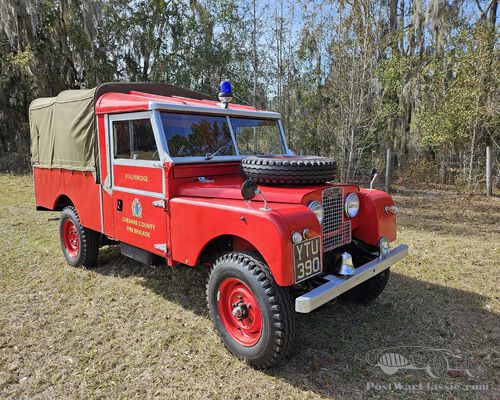
1957 Series 1 Land Rover Fire Engine + Coventry Climax Godiva Fire Pump
Betsy was used by Cheshire Fire Service (UK) from 1957 to 1975. She was based at Hazel Grove and Stalybridge Fire stations. She comes with an exten..

BMW 502 V8 3,2L (Barockengel)
6-seater touring sedan, famous from the german television series "Isar 12"Production period: 1955 – 1959, 2,517 unitsV-engine 8 cylin..
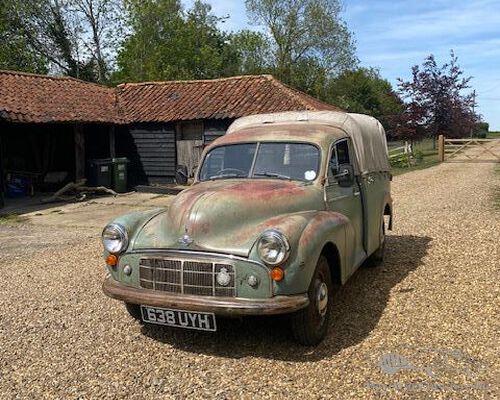
1954 Morris Minor Series II Pick Up
Morris Minor Series II Pick-Up, first registered 15th Jan 1954. Exported from new to Australia, returned to the UK in 2014. Swansea documentation r..