The global magazine and marketplace for classic car enthusiasts, by enthusiasts.


Filter
Classic DKW for sale - DKW cars for sale
-

DKW IFA F8 Exportcabrio Bj. 1955
IFA F8 Exportcabrio Bj. 1955 Wir bieten Ihnen ein sehr schönes IFA F8 Export-Cabrio von 1955 zum Restaurieren an. Der Wagen wurde 1955 nach Dänemark ausgeliefert und einige Jahre dort genutzt. Während der Nutzung wurde er einmal in rot lackiert. Sonst sind keine Veränderungen vorgenommen wurden. Der Km-Stand beträgt: 35.259km (abgelesen)...


D.K.W.
D, 1928 – 1966
(1) Zschopauer Motoren-Werke J.S. Rasmussen-Zschopau; Berlin-Spandau, 1928 – 1939
(2) Auto Union GmbH, Düsseldorf, Ingolstadt, 1950 – 1966
DKW was already a well-known producer of motorcycles when the firm’s first DKW car appeared in 1928 at the Leipzig Fair. It was produced in the former D-wagen works in Berlin, which were taken over by DKW. This first DKW model was characterized by its 2-stroke engine, a principle which DKW used for their DKW motorcycles and which they followed up to the end in 1966. The 584cc 2-cylinder engine developed 16.5bhp. The DKW car was a chassis-less wood-framed construction by Slaby (S.B.). A very popular two-seater sports version with an 18bhp engine was developed from this model. In 1930 the ‘DKW 4/8’ with a 780cc 22bhp engine appeared. 1931 saw the debut of DKW front-driven cars, the F1 with a 490cc and the DKW F2 with a 584cc engine. The front-wheel drive principle was adopted for several subsequent DKW models. In 1932 DKW became a member of the Auto Union Group. The 2-cylinder front-driven 589cc Reichsklasse and 684cc Meisterklasse and the DKW V4 rear-driven models 1054cc Sonderklasse and Schwebeklasse were among the most popular German cars up to 1939.
In 1945 the DKW works were nationalized together with all other Auto Union plants. Auto Union was re-established in 1949 in Düsseldorf and production of the first post-war DKW started in 1950. It was a 2-cylinder 2-stroke 690cc model called the DKW Meisterklasse F89, mechanically based on the last pre-war DKW model but with a new body. A range of DKW Sonderklasse models followed with a 3-cylinder 896cc engine; these were also known by the designation ‘DKW 3/6’ and were based on a 1940 prototype. The ‘1000’ model (3-cylinder, 981cc) was not marketed under the name DKW, but only as the Auto Union, although it was a true DKW. The Junior and the F11, F12 and F102 also had 3-cylinder 2-stroke engines but different bodies from the former models. All post-war DKW models had front-drive.
In 1957/1958 a sports vesion, the DKW Monza, was produced by Fritz Wenk of Heidelberg; ‘3/6’ 896cc, 40bhp and ‘1000’ 981cc, 44bhp engines were used, the latter also in a tuned version developing 55bhp. Chassis were original DKW while the bodies were specially made of fiberglass. This DKW model gained five world records at the Monza circuit and also was successful in several international ocmpetitions. DKW engines were available in several tuned versions and used for Formula Junior racing.
DKW cars are built in Brazil under licence by DKW-Vemag. The nationalized East-German factory also produced DKW’s , in 2- and 3-cylinder form, until 1956. In 1966 production of DKW cars was given up.
Source: Georgano, encyclopedia of motorcar; HON
The information is written with the greatest of care. However, if you have any suggested amendments please contact us at office@postwarclassic.com


Featured
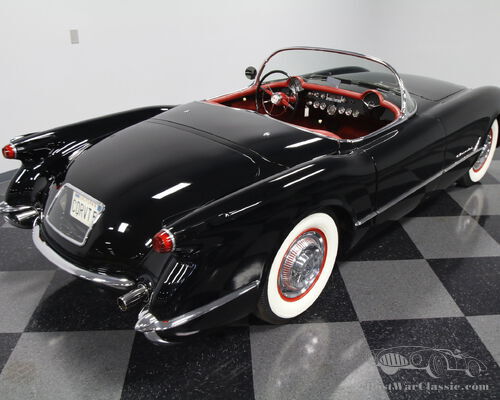
1954 Chevrolet Corvette C1
Fully restored 1954 C1 Corvette in Black. Stunningly beautiful car, feels like driving a sculptural work of Art. Known to be the oldest Corvette on t..

Alfa Romeo Barchetrta Bianchi Prototype 600 Kg 150CV
1 of 1. Never repeated. 1985 Alfa Romeo Barchetta "by Bianchi" Built by hand in Argentina. 600kg. 150hp. Twin Webers. Alfa 2300 heart. Tubular stee..
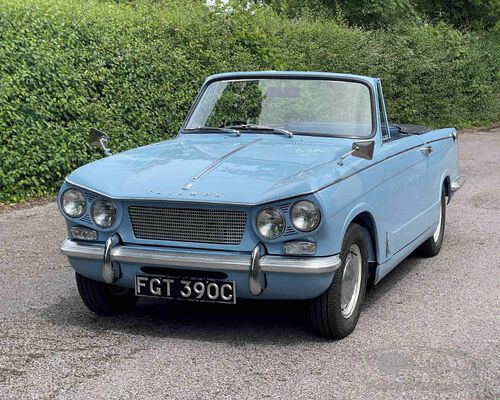
Triumph Vitesse 6 Convertible
Technical SpecificationsMark & Model: Triumph Vitesse 6 ConvertibleYear: 1965Registration plate: UK registered