The global magazine and marketplace for classic car enthusiasts, by enthusiasts.


Filter
Classic Duesenberg for sale - Duesenberg cars for sale
-

1965 Austin-Healey 3000 Mk III BJ8
Body No. 72940 As the final iteration of the "Big Healey" 3000 Mk III rolled onto the scene, the legendary British sports car manufacturer successfully retained the DNA of its classic curvaceous long hood/short deck sports roadster, while tweaking the cockpit to accommodate 2+2 seating and adding amenities directed towards the booming North .. -
1958 Rolls-Royce Silver Cloud 1 LWB
1958 Rolls-Royce Silver Cloud 1 LWB Chassis number: BLC7Registration Number: 877CGD06 (swiss) Kept in underground parking & Chauffeur driven in Switzerland for the last few decades. This car was purchased as a very low mile example in the 1970's from noted dealers Frank Dale & Stepsons. A chauffeurs .. -
1988 Jaguar Daimler Double Six Series 3 RHD
1988 Jaguar Daimler Double Six Series 3 Vin Number: SAJDDRLW3CA479661Registration Number: E897NOW Just 8645 Miles from new!!! This car is so pristine it still has its original plastic protective film on the sill plates. We sourced this car in 2016 from a prominent Japanese collection & supplied it to t.. -
1987 FERRARI TESTAROSSA LHD
1987 Ferrari Testarossa Vin Number: ZFFA17B000067981Registration Number: D138BSA Supplied new to Japan & with just 16,581Kms covered from new. The current Portugese owner is the second owner of the car & we supplied it to him as part of his collection in 2016. We purchased it in Japan from the first o.. -
1958 BENTLEY S1 CONTINENTAL PARK WARD DHC
1958 Bentley S1 Continental Park Ward DHC Chassis Number & Registration available on request to qualified buyers. Please call Richard Biddulph for details. Coming to us from one of the UK's most prominent collections along with a sister car a Bentley S1 fastback. This car is in impeccable.. -
1958 Bentley S1 Continental Fastback Highline Flared Arch
1958 Bentley S1 Continental Fastback Chassis Number & Registration available on request to qualified buyers. Please call Richard Biddulph for details. Recipeint of a full P & A wood restoration under previous ownership & thus in impeccable condition thoughout with a simply massive.. -
1997 Rolls-Royce Silver Spur Dawn "Springfield" Special edition
1997 Rolls-Royce Silver Dawn "Springfield" Special edition Chassis Number: SCAZA12C3VCH59307 Registration Number: P293YGJ Less then 19,000 documented miles from new & freshly serviced in mint condition. This is a very special "Springfield Dawn" version of the last of the Rol.. -
Sportive Jaguar E-Type Series 1, 4.2 Liter from 1967, since 28 years in current ownership
Jaguar E-Type Series 1, 4.2 Liter from 1967, since 28 years in current ownership!The Jaguar E-types remain the icons of British motor history. These cars are so sportive and breathtaking combined with elegance and great power.This lovely E-type is from 1967 and has a mighty 4.2 liter version under its bonnet which delivers 2.. -
FERRARI 250 SWB COMPETIZIONE REVIVAL 1961
The Ferrari 250 SWB Competizione is the most desirable Ferrari of all time and the ultimate example of form following function. With the average value of donor cars escalating beyond the viability of economics and demand outstripping supply, prices of these desirable classics are continually rising.Using an original 1961 SWB Ferrari Compe.. -
1965 Subaru-360 minicar. K111-series
No this is not a car designed by Picasso but it is a very rare Japanese version of the Mini or German Beetle. It has a 356cc 2-cylinder 2 stroke engine at the rear and a foldable canvas rooftop. It is in original condition with some parts bumpers and lights taken off and put inside. We worked on the engine but 34 years ago and it ran ni..


Duesenberg
US, 1920 – 1937, 1966
(1) Duesenberg Motor Co, Indianapolis, Ind., 1920 – 1937
(2) Duesenberg Corporation, Indianapolis, Ind., 1966
Fred Duesenberg began by making bicycles and designed his first Duesenberg car, the Mason, in 1904. He and his brother August made engines with horizontal overhead valves for the 1912 Mason racing cars, and founded Duesenberg Motors in the following year in order to produce marine engines and complete racing cars bearing the Duesenberg name. The most famous of the latter appeared in 1920: a 3-litre Bugatti-inspired Duesenberg straight-8 with single overhead camshaft and three (vertical) valves per cylinder. This Duesenberg won the 1921 French Grand Grand Prix. In the 1920s the Duesenberg racing cars were the great rivals of the Millers at Indianapolis, and victory was assured in 1924 by the adoption of a centrifugal blower on Duesenberg cars. Though a two-stroke 1½-litre 8-cylinder racing engine capable of 7.000rpm was made in 1926, this was not proceeded with. The horizontal-valve Duesenberg engine was taken over in 1920 by the Rochester Motor Manufacturing Co Inc and was used in various sporting and luxury cars.
Meanwhile, at the end of 1920, the first Duesenberg production car made its debut. This Duesenberg Model A was an extremely expensive, if very advanced, luxury car, embodying an 8-cylinder in-line engine – the first to be seen in an American production car – of 4.2 litres, basically similar to the Duesenberg racing unit, but with only two valves per cylinder and developing about 100bhp. There were also hydraulically-operated front wheel brakes – another ‘first’ as far as America was concerned. The Model A was current until 1926. A handful of its little-altered successor, the Duesenberg Model X, was made in 1926-1927, but in the former year E.L. Cord of Auburn acquired control of the Duesenberg company. He stipulated that Fred Duesenberg’s next car should be completely new, and a quite exceptional machine. In fact, the Duesenberg Model J, which made its bow at the end of 1928, was the most remarkable automobile in America: bigger, faster, more elaborate and more expensive than any other, yet also superior to them in refinement and good looks. Its 6.9-litre, 8-cylinder engine, made by Lycoming (a firm which Cord had also bought), had two chain-driven overhead camshafts operating four valves per cylinder; a layout of racing type unique among American cars at the time and said to develop 265bhp at 4250rpm – more than double the output of any rival. Although the complete Duesenberg car weighed more than 4980lb, it was claimed to be capable of 116mph in top gear and 89mph in second. Only Duesenberg Model J chassis were made for which $8500 was asked in 1929. Immensely long and strong and lowbuilt, Duesenberg cars were very popular with all the leading coachbuilders. The Duesenberg company preferred to sell cars complete with bodies designed by them but made by approved builders, such as Murphy, Bohman & Schwarts, Judkins, Derham and Le Baron. In this form, catalogued Duesenberg models cost up to $17.950. The transmission – apart form the double dry-plate clutch – was conventional, as was the suspension by half-elliptic springs and hydraulic shock absorbers. The brakes, of course, were hydraulic, with vacuum servo assistance from late 1929.
In 1932 a supercharged version of the Model J, the Duesenberg SJ, was added. To cope with the 320bhp now alleged to be available, bearings, reciprocating parts and valve springs were strengthened. Usually, the shortest Duesenberg J chassis was used, with the highest axle ratio and stronger front springs. A maximum speed of 129mph was attributed to the Duesenberg SJ, with an acceleration figure of 0-100mph in 17 seconds.
Duesenberg survived the Depression, but died in the collapse of the Cord Corporation in 1937. Attempts to revive the Duesenberg name were made in 1947 and in 1966. The first Duesenberg was unsuccessful, and in 1966 only one Duesenberg car was actually made, powered by a 7-litre V8 Chrysler engine with push-rod overhead valves, developing 431bhp at 5.000rpm. Transmission was automatic, front suspension was independent, and there were disc brakes. Body styling was by Ghia. This Duesenberg venture, too, collapsed.
Source: Georgano, encyclopedia of motorcar; TRN
The information is written with the greatest of care. However, if you have any suggested amendments please contact us at office@postwarclassic.com


Featured
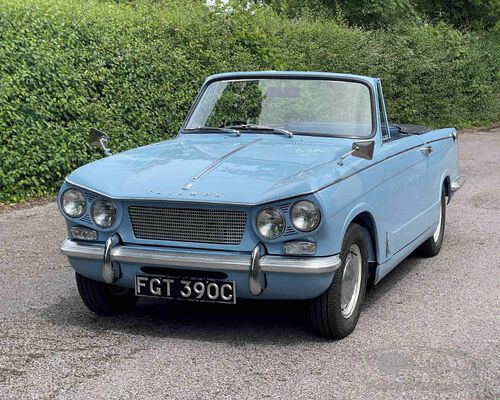
Triumph Vitesse 6 Convertible
Technical SpecificationsMark & Model: Triumph Vitesse 6 ConvertibleYear: 1965Registration plate: UK registered
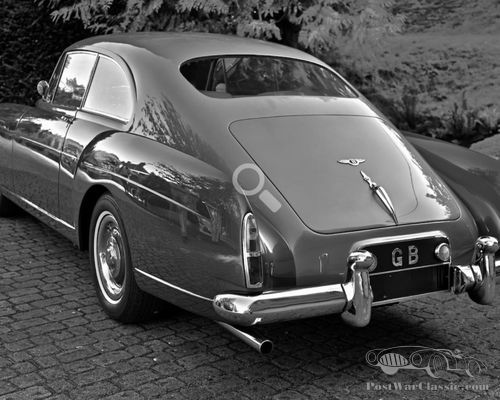
1957 Bentley S1 Fastback by H.J. Mulliner.
1957 Bentley S1 Fastback by H.J. Mulliner.A freshly restored award winning car in like new condition. A later car with Power assited steerin..
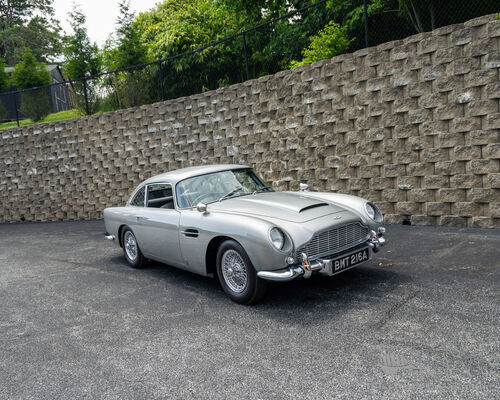
2020 Aston Martin DB5 Goldfinger Continuation | RM Sotheby's | The Monterey Auction
To Be OFFERED AT AUCTION at RM Sothebys' The Monterey Auction event, 13 - 15 August 2026. $1,000,000 - $1,500,000 USD One of 25 examples co..