The global magazine and marketplace for classic car enthusiasts, by enthusiasts.


Filter
Classic Ferrari for sale - Ferrari cars for sale
-

2002 Ferrari 575 Maranello F1 Left Hand Drive
2002 Ferrari 575 Maranello F1 Left Hand DriveVin Number: ZFFBT55B000127230Registration Number: VL518M AustriaOne owner from new & forming part of an important private collection we have been tasked to sell. This Ferrari 575 F1 has seen only dry weather use & has been serviced by the book at Giuseppe Martinis in Udin.. -
2002 Ferrari 575M Maranello | RM Sotheby's | The Monterey Auction
To Be OFFERED AT AUCTION WITHOUT RESERVE at RM Sothebys' The Monterey Auction event, 13 - 15 August 2026. Offered Without Reserve | $375,000 - $475,000 USD One of Ferrari’s greatest modern grand tourersDesirable Grigio Alloy over a Charcoal interior Understood to be one of approximately 177 left-hand-drive examples buil..


Ferrari
Italy, 1940 to date
(1) Auto Avio Costruzione, Modena, 1940 – 1945
(2) Auto Costruzione Ferrari, Modena, 1946 – 1960
(3) Società Esercizio Fabbriche Automobili e Corse Ferrar Maranello, Modena, 1960 to date
No Italian make of car commands such world-wide respect as the Ferrari, yet as a marque Ferrari has scarcely existed that long. Its founder, Enzo Ferrari, left the CMN concern to join Alfa Romeo as driver and tester in 1920, won several races, and in 1929 founded a unique racing stable, the Scuderia Ferrari, using as its escutcheon the prancing Ferrari horse motif formerly used by a famous airman, Francesco Baracca, who died in World War 1.
Soon Enzo Ferrari was running the GP Alfas for the factory, scoring many great victories until, in 1938, the firm decided to race their cars themselves. Ferrari left to form his own company Ferrari, and at short notice built two cars for the 923 mile Brescia sports car Grand Prix of 1940. These cars, entered as Auto Avio Costruzione products, were the first Ferrari cars. They were built in about three months around Fiat frames and suspension, and had straight-8 1½-litre engines developed by Massimo and Nardi, using modified Fiat heads on a light alloy block. Called Ferrari Type 815, they led their class but retired.
War intruded on further development, and Ferrari switched to machine tool manufacture, but by 1946 his works at Maranello, near Modena, reverted to car design. This time the engine was a 1½-litre 60 degrees single-ohc V12, designed by Colombo propelling a light two-seater sports car through a 5-speed gearbox. A tubular frame carried independent front suspension and a live rear axle, with transverse leaf springs front and rear. Raced from 1947, these Ferrari cars gained many successes, while road cars were also built and sold. These were the 2-litre Ferrari Tipo 166 Inter, 2.3-litre Ferrari Tipo 195 Sport, and the 2.5-litre Ferrari Tipo 212 Inter and Export. They carried attractive bodies by Farina, Touring, and Ghia among other coachbuilders, but relatively few touring cars were made at this stage of Ferrari’s history. Engine size of the sports cars was increased to 2-litres, and by 1949 Ferrari had won their first Le Mans victory with the Ferrari Type 166. In the absence of the famous Type 158 Alfa Romeo that same year, Ferrari all-independently sprung single-seaters also dominated Formula 1 and 2 racing, with and without superchargers respectively.
Then Aurelio Lampredi developed the big unsupercharged 4½-litre Ferrari which broke Alfa Romeo’s five-year grip on GP racing in 1951. Next, when races were switched to the 2-litre Formula 2 for 1952-1953, Lampredi’s new unblown 4-cylinder Ferrari cars dominated affairs, Alberto Ascari becoming World Champion in both years.
The new 2½-litre Formula 1 of 1954 – 1960 brought strong opposition and less success for Ferrari at first, but meantime an even bigger sports car, the 4.9-litre V12, had won Le Mans again in 1954. From 1951 onwards a series of large capacity Ferrari V12 touring cars was developed, primarily for the American market. Beginning with the 4.1-litre, 200bhp Ferrari Tipo 342 America, capacity and power were increased to 4.5-litres and 300bhp in the Ferrari Tipo 375 of 1953, and to 4.9-litres and 340bhp in 1955. Disc brakes were introduced in 1959, and the model remained in production as the Ferrari Tipo 500 Superfast, until 1966. In its final form, the engine developed 400bhp, and the 2+2 coupé was the most expensive car on the British market, at £11.519.
When the Lancia concern ran into difficulties in 1955, their 2.5-litre V8 GP cars were handed over to Ferrari to race. Improved for 1956, Ferrari won Fangio his fourth World Championship, while a V6 derivative, named the Ferrari Dino in memory of Ferrari’s son Alfredino, made its mark in racing between 1958, when Mike Hawthorn won the Championship in a front-engined Ferrari, and 1961, when Phil Hill became Champion in a rear-engined model. In the meantime the Ferrari Testa Rossa 3-litre V12 sports car carried Ferrari’s name to further glory, winning LeMans and the World Sports Car Championship in 1958, 1960 and 1961
By 1962 all competition Ferraris, single-seater and prototype sports, were rear-engined; the Ferrari sports type won LeMans in 1962, 1963, 1964 and 1965. The touring V12s, however, retained the front-engined layout. By 1967 these were being made in three forms: the 3286cc Ferrari 275, the 3967cc Ferrari 330 and the 4390cc Ferrari 365. Two years later this last was available as the Ferrari GTB4, with a top speed of 174mph on 352bhp. It cost almost eight million lire. A prototype rear-engined sports model, the Ferrari Dino 246, appeared in 1965. It went into production in 1967 and had a transversely-mounted 1987cc dohc V6 unit, made for Ferrari by Fiat, and fitted in detuned form to Fiat’s own front-engined Dino.
In the racing field Ferrari tried V6, V8 and V12 units, but though John Surtees won the 1964 World Championship. 1966 brought a return to the classic 12-cylinder engines and a decline in the company’s Grand Prix fortunes. There were, however, victories in the Belgian and Italian Grands Prix, and in 1967 sports Ferraris won at Daytona and in the Monza 1000 Kilometers. In 1968 there was only one Formula 1 victory by Ferrari and none at all in 1969, when there were also sallies into Can-Am racing (with large 6.2-litre and 6.9-litre V12s) and Formula 2 (with Dino-engined cars). In 1970 came a new flat-12-engined GP car, the Ferrari 312B. It won the Austrian, Canadian, Italian and Mexican GPs for Ferrari, and the 5-litre Ferrari 512 sports cars won at Sebring and Kyalami. The Ferrari sports cars took 2nd place at Daytone and 3rd at LeMans in 1971, but thought the Formula 1 season started well with a victory in the South African GP, a 2nd at Barcelona and five 3rd in other championship events were less inspiring. The 1972 season was no better for Ferrari, but in the Manufacturers’ Sports Car Championship Ferrari achieved eleven consecutive victories from Buenos Aires in January to Watkins Glen in July.
By 1970 Fiat had a 50 percent holding in Ferrari, and their own Dino (now enlarged, along with the Ferrari version, to 2.4-litres) was being made at Maranello. A Spyder version of the Ferrari Dino with semi-open body appeared during 1972, and a revised 365, the Ferrari GT4 2+2, was announced for 1973. Also new that year was the company’s first touring flat-12, the Ferrari Berlinetta Boxer. This featured a mid-engine installation, all-independent suspension, a 5-speed transaxle, and retractable, swiveling headlamps. Output of the 4.4-litre oversquare unit was 360bhp.
Source: Georgano, encyclopedia of motorcar; CP
The information is written with the greatest of care. However, if you have any suggested amendments please contact us at office@postwarclassic.com


Featured
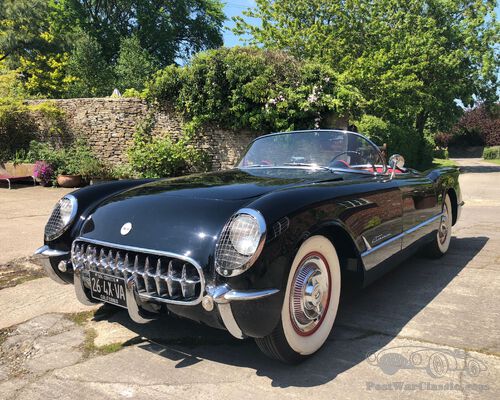
1954 Corvette C1 - SUPER RARE Black!!
Looking for her next lover, my classy 1954 Corvette C1. She's a beautiful sculpture. Never have i had so many adoring comments as when drivi..
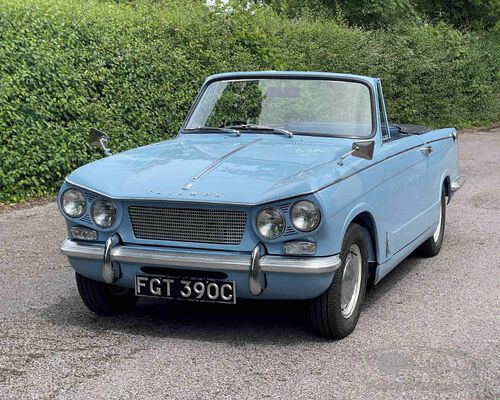
Triumph Vitesse 6 Convertible
Technical SpecificationsMark & Model: Triumph Vitesse 6 ConvertibleYear: 1965Registration plate: UK registered
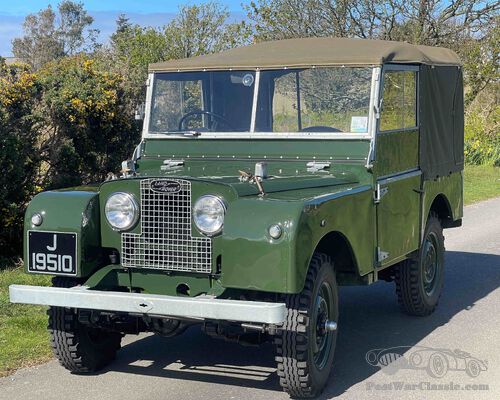
1952 Land Rover Series 1
Technical Specifications:Mark & Model: Land Rover Series 1Year: 1952Registration plate: Jersey registered