The global magazine and marketplace for classic car enthusiasts, by enthusiasts.


Filter
Classic Holden for sale - Holden cars for sale
-

1955 PORSCHE 356 CONTINENTAL (pre A)
1955 PORSCHE 356 CONTINENTAL A true rare collectors item in as new fully restored 100 point condition. In 1955 North American European car importer Max Hoffman persuaded Porsche that cars with a name sold better in North America. He persuaded Porsche to give their 356 model a name, Continental was settled up.. -
1998 Aston Martin V8 Volante LWB Left Hand Drive.
1998 Aston Martin V8 Volante LWB Left Hand Drive. Chassis number: SCFDAM209WBL89023 Registration number: S17VOL A beautiful rare car with less then 8000 miles from new. The current owner acquired this car from the first owner, a good friend from germany who purchased the car brand new in Monaco & use.. -
1963 Porsche 356 B T6 Coupe 1600S
1963 Porsche 356 B T6 Coupe 1600S Registration Number: IG5453 A quite unique opportunity to acquire one, if not the finest example of the iconic 356 in existence today. This car has just completed (March 2021) an extensive and detailed complete restoration to its original factory specificatio.. -
1965 Sunbeam Tiger Mk I | RM Sotheby's | The Woodcote Park Auction
To Be OFFERED AT AUCTION WITHOUT RESERVE at RM Sothebys' The Woodcote Park Auction event, 8 July 2026. Offered Without Reserve | £50,000 - £70,000 GBP Please check back soon as our dedicated cataloguing team is preparing the description for this lot. To view this car and others currently consigned to this auction, please visit the RM website at.. -
1964 Fiat 500 D Transformabile | RM Sotheby's | The Woodcote Park Auction
To Be OFFERED AT AUCTION WITHOUT RESERVE at RM Sothebys' The Woodcote Park Auction event, 8 July 2026. Offered Without Reserve | £18,000 - £24,000 GBP Desirable Transformabile example with extended open roof and rear-hinged “suicide doors”Imported from Italy in 2016 after its long-term owner near Salerno kept the Fiat for almost.. -
1956 Bentley S1 Continental Park Ward Coupe
1956 Bentley S1 Continental Park Ward Coupe Chassis number: BC57BG Registration Number: OFF505 Simply the best of the best; This car is in simply impeccable condition & comes to us from decade long term ownership in a private collection. The wor..


Holden
AUS, 1948 to date
General Motors-Holden’s Pty Ltd., Melbourne, Vic.; Woodwille, S.A.
The Holden car company started life making bodies, their work appearing on imported Morris cars in the 1920s. Under General Motors ownership in the 1930s Holden cars assembled American and British GM products for the Australian market, offering fastback coupés in 1938, or three years before Detroit. The Holden car, conceived after World War 2 as ‘Australia’s own car’, was in fact a development of a ‘compact’ Buick dating back to 1938, which never saw production in its native land. In layout the FX-type Holden car of 1948 was a straightforward General Motors design with a 4-bearing, 6-cylinder, ohv 2.2-litre engine, 3-speed synchromesh gearbox, column change, hydraulic brakes, coil-and-wishbone independent front suspension, hypoid final drive, and unitary construction. The wheelbase of the Holden car was 8ft 7in, and the standard sedan weighed 2.212lb. The initial Australian content was 92%, and it was promoted through a 600 Holden car dealer network. At a price of £A675 (about £540), its 80mph performance and toughness sold 7.725 Holden cars in 1949, rising to 50.000 by 1952, when assembly of the Holden car was being undertaken in three States. The first Holden cars were exported (to New Zealand) in 1954; by 1958 annual production had topped the 100.000 mark, and a year later the Holden car make accounted for 46% of all Australian private-car sales. Exports – now including the Near East and parts of Africa – exceeded 10.000 Holden cars in 1963, and a year later the Holden car factory delivered 190.375 vehicles. A minor facelift had come with the Holden FJ series of 1954, but the basic 1942 look remained on Holden cars for another two seasons until the introduction of the 70bhp Holden FE type, a full six-seater with 13in wheels and recirculating ball steering. 1960 Holden cars had 2.3-litres and 75bhp, plus the unsightly ‘dog’s leg’ windscreen also found on Vauxhalls of the period, but two years later the Holden car range was again restyled, automatic transmission being introduced on the Holden Premier series. 1964 Holden Premiers had 2.9-litre engines, the cheaper Holden Standard and Holden Special using 2.4-litre 100bhp units. The 1965 Holden HD type closely resembled contemporary 6-cylinder Vauxhalls, and was available with front disc brakes. The 1967 line came with 2.4-litre (114bhp) and 3-litre (126 and 145bhp) engines and the same styling as before.
In 1969 came the Holden Torana based on the Vauxhall Viva, but with a 6-cylinder engine and extended wheelbase. The HK line of Holden cars came in two models, the standard Holden Belmont and the de luxe Holden Kingswood, with option of 5-litre Chevrolet V8 engine. There was also a new coupé, the Holden Monaro with 5.4-litre Chevrolet V8 engine, and a long-wheelbase prestige model with air-conditioning called the Holden Brougham. Holden cars produced their first Australian-built V8s in 1970, in 4.1 and 5-litre versions. In 1971 the Holden Brougham was dropped in favour of a new luxury line called the Holden Statesman, in direct opposition to Ford’s successful Fairlane.
Source: Georgano, encyclopedia of motorcar; MCS
The information is written with the greatest of care. However, if you have any suggested amendments please contact us at office@postwarclassic.com


Featured

Triumph Spitfire 1500
This stunning Triumph Spitfire 1500 is a Dutch-delivered example with only two previous owners. In its early years, the first owner carefully prepa..

Rolls-Royce
Rolls-Royce Silver Wraightlinks gestuurd, automatic, stuurbekrachtigingkleur antraciet grijs, lopende auto op Nederlands kenteken
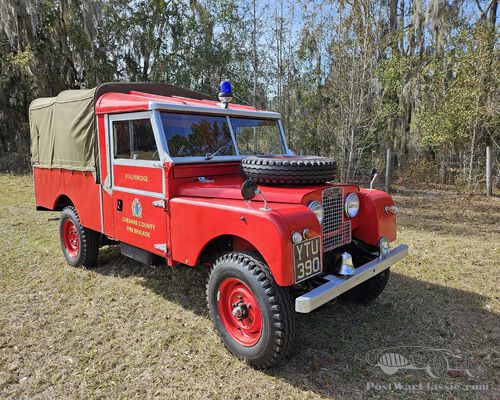
1957 Series 1 Land Rover Fire Engine + Coventry Climax Godiva Fire Pump
Betsy was used by Cheshire Fire Service (UK) from 1957 to 1975. She was based at Hazel Grove and Stalybridge Fire stations. She comes with an exten..