The global magazine and marketplace for classic car enthusiasts, by enthusiasts.


Filter
Classic Isuzu for sale - Isuzu cars for sale
-

2018 Ford Ranger 3.2 litre Wildtrak Auto
2018 Ford Ranger Wildtrak Registration Number: MW67KWT Vin Number: 6FPPXXMJ2PHR79258 A well looked after Ford Ranger with a good service history. This is a low mile vehicle that has covered 32,000 miles to date which will increase somewhat whilst it is in stock with us. -
Volkswagen 1987 TS Camper-bus
1987 Volkswagen T2 bus with NL registration and MOT in camper version. Frank Kennis Telephone: 00.31.622.420.766 or email me: info@KennisCars.NL www.KennisCars.NL Classic car dealer for Europe Cadillac ; Mercedes ; Rolls-Royce ; Delage ; Bugatti ; Bentley ; Dodge ; Opel ; Corvette ; Talbot-Lago ; Chrysler ; Delahaye ; Zagato ; Alfa-Romeo .. -
1989 Mercedes-Benz G Wagen 300GD
Technical Specification:Mark & Model: Mercedes Benz G Wagen 300GDYear: 1989Registration plate: Guernsey registeredEngine Capacity: 2998 ccTransmissions: 5-speed manualBody style: Station wagonInterior color: Grey / checkExterior color: Nautic BlueSeating capacity: 4/5 -
1962 Lotus Elite Series 2
Technical Specification:Mark & Model: Lotus Elite Series 2Year: 1962Registration plate: Jersey registeredChassis Number: EB2021681Engine Number: FW 400-2 11032Engine Capacity: 1216 ccTransmissions: 4-speed manualMileage: 31,491Body style: 2-door coupeInterior color:.. -
1969 Jaguar E type series 2 4.2 Litre LHD OTS
1969 Jaguar E type series 2 4.2 Litre LHD OTS Chassis number: P1R10518 Registration Number: PFJ301G Purchased by the current owner in 2016 from America. This car has had a lot of money spent upon it to bring it up to the standard we find it in today. -
1959 Cooper-Climax Type 51, 2-Litre
The pioneering rear engined Cooper-Climax Formula racing cars of the Type 43/45/51 family stand alongside cars such as the Alfa Romeo Tipo B and Lotus 79 as designs that truly revolutionized the world of Grand Prix racing. Customers flocked to Cooper's garage door to buy their revolutionary rear-engined racing cars. Then in 1955 the centre-seat ..


Isuzu
Japan, 1953 to date
Isuzu Motors Ltd, Tokyo
The present Isuzu car company is an ultimate result of the merging of Jidosha Kogyo (Ishikawajima-DAT) with Tokyo Gas and Electric (TGE) to form Tokyo Jidosha Kogyo in 1937. Hino Motors split away in 1942 as an independent firm; T.J.K. continued and was revamped as Isuzu Motors in 1949.
The merging companies had concentrated primarily on trucks and buses with the Isuzu name used since 1934 on special designs, built to government standards by both Jidosha Kogyo and TGE. After merging, the Isuzu name was retained and used in place of the other trade names, Sumida and Chiyoda, on all equipment constructed by the new Isuzu firm.
Production of commercial vehicles had been an important factor with Isuzu ever since, and in 1953 Isuzu branched into new territory by acquiring a licence to build the Hillman Minx. In 1961 Isuzu replaced the Minx with motor cars of its own design.
First of these as the Isuzu Bellel, a conventional saloon with unitary construction and coil-and wishbone independent front suspension. Three types of 2-litre ohv 4-cylinder engine were available on the Isuzu car, the petrol Isuzu models developing 88bhp and 98bhp, and the diesel 58bhp. This was followed in 1966 by the 1½-litre 5-bearing Isuzu Bellett series, available in various forms up to a 90bhp twin-carburettor GT capable of 100mph. At the 1967 Tokyo Show came a replacement for the Isuzu Bellel, the Isuzu Florian with 1.6-litre ohc engine and servo-assisted drum brakes; an automatic option was offered as well as 3- and 4-speed all-synchromesh gearboxes. Also displayed on the Isuzu was the 1.584cc dohc 117 sports coupé with front disc brakes, but this took more than two years to reach the production stage. At the same time Isuzu cashed in on the fashion for small Jeep-type vehicles with their 1.325cc Isuzu Unicab; this Isuzu had rear-wheel drive only and torsion-bar front suspension. Florians for 1971 had 1.8-litre engines, and at the top of the 1972 Isuzu range were two new versions of the 117, one with Bosch fuel injection and the other with capacity increased to 1.800cc. Isuzu are one of the smaller Japanese manufacturers (22.027 cars only in 1970), and by 1972 General Motors had a one-third stake in the Isuzu company. As a consequence the small car-based Isuzu pick-up truck went on sale on the West Coast of America as the Chevrolet Luv during the year. It had the 1.800cc Isuzu Florian engine and this Isuzu car was retailed at $2.184.
Source: Georgano, encyclopedia of motorcar; BE
The information is written with the greatest of care. However, if you have any suggested amendments please contact us at office@postwarclassic.com


Featured
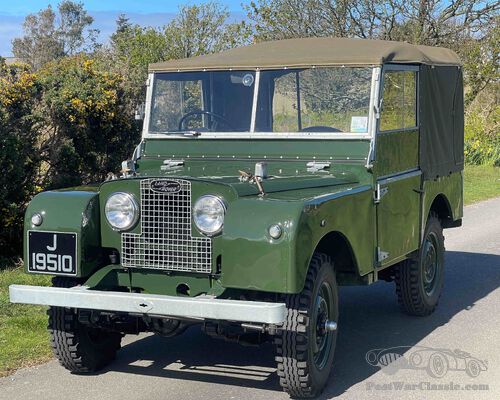
1952 Land Rover Series 1
Technical Specifications:Mark & Model: Land Rover Series 1Year: 1952Registration plate: Jersey registered
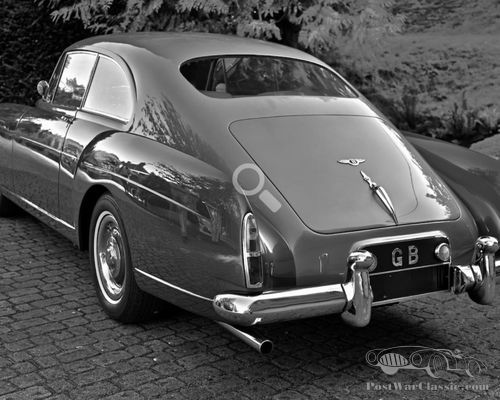
1957 Bentley S1 Fastback by H.J. Mulliner.
1957 Bentley S1 Fastback by H.J. Mulliner.A freshly restored award winning car in like new condition. A later car with Power assited steerin..
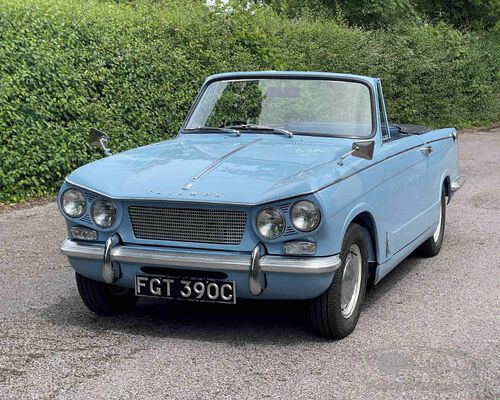
Triumph Vitesse 6 Convertible
Technical SpecificationsMark & Model: Triumph Vitesse 6 ConvertibleYear: 1965Registration plate: UK registered