The global magazine and marketplace for classic car enthusiasts, by enthusiasts.


Filter
Classic Jaguar for sale - Jaguar cars for sale
-

1956 Jaguar XK140MC Special Equipment OTS RHD
1956 Jaguar XK140MC Special Equipment OTS RHDChassis Number: S812408Registration Number: WAF560 (To be retained by Owner.)Nut & bolt restored 5 years ago to as new. Since then the car has covered just over 1000 miles per year bringing the total up to 6431 miles since restoration. The works undertaken are needless to sa.. -
1955 Jaguar XK140 Drophead Coupe 807260
A totally correct and exceptionally original example of a rare UK market, RHD drophead, supplied new in 1955 by The Woodcote Motor Co, Epsom. Sound condition, cosmetically mature and appealing, retaining original, mellowed tan leather interior, and of nicely understated specification with disc wheels and spats. The paint shows its age in a quite.. -
1965 Jaguar E Type FHC HRH Prince Michael of Kent.
1965 Jaguar E type series 1 4.2 Litre FHC. Chassis number: 1E20384Registarion number: DWK464C On the 12th of April, 1965 His Royal Highness Prince Michael of Kent took delivery of this iconic sports car & had it delivered to & registered in Germany where we has serving in the armed forces with the 11th Hussar.. -
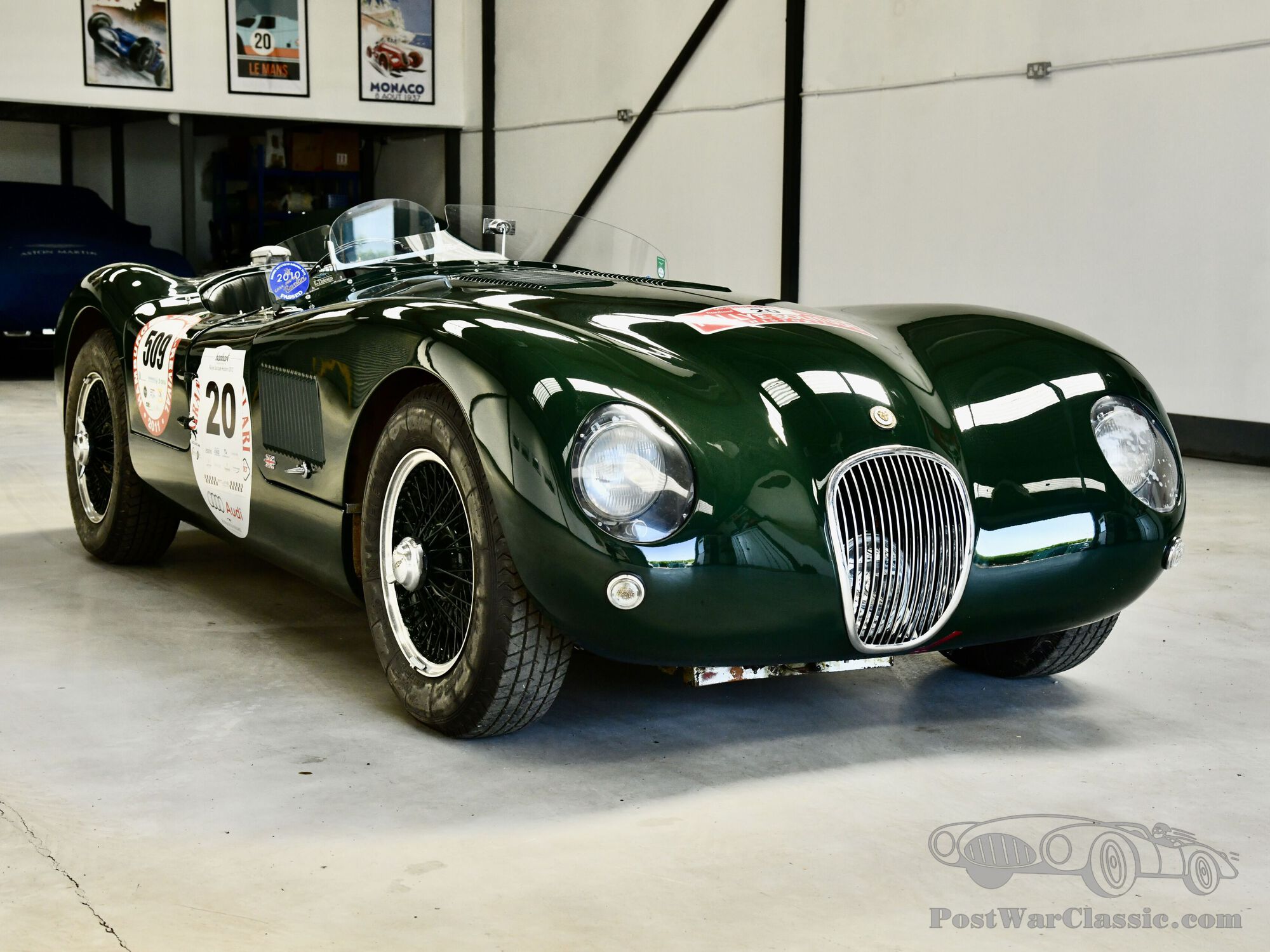
Jaguar C Type
This beautiful C Type Jaguar is a rare beast indeed and is probably the closest you can buy short of an original C-Type with its stratospheric prices. According to the previous owner who commissioned the assembly of the car, he purchased a chassis and an original 3.4 Litre engine block from the Beaulieu Autojumble in 1999. -
2009 Jaguar XJ8 Executive X358
2009 Jaguar XJ8 Executive X358 Vin Number: SAJKC87K18SH20465Registration Number: KX58UDU One of the last examples produced of this rapidly appreciating classic & sought after Jaguar model. This car is a simply pristine Japanese import that has covered a scant 43,000 miles & is in like ne.. -
1962 Jaguar E Type S1 3.8 Roadster - LHD
Technical Specifications Mark & Model: Jaguar E Type S1 3.8 Roadster - LHDYear: 1962Registration plate: Jersey registeredChassis Number: 878580Engine Number: R-8754-9Engine Capacity: 3.8 litreTransmission: 4-speed ManualMileage: Body style: 2-door ConvertibleInterior color.. -
1948 Jaguar Mk IV 3½ litre
Technical SpecificationMark & Model: Jaguar Mk IV Year: 1948Registration plate: Jersey RegisteredChassis Number: 612888Engine Number: S 3522Engine Capacity: 3485 ccTransmissions: 4-speed manualBody style: 4-door saloonInterior color: Green leatherExteri.. -
1956 Jaguar XK1450 FHC RHD
1956 Jaguar XK1450 FHC RHD Chassis Number: 804731 Registration Number: SAD725 Jaguar XK140 1956 FHC. Haggerty agreed value is £95,000. This car has undergone a full bare chassis/body off restoration and has had a significant number of important upgrades undertaken. These include fr.. -
1956 Jaguar Mark VII 3.4 Litre 190BHP
1956 Jaguar Mark VII 3.4 Litre 190BHP Chassis Number: 728823DN Registration Number: PYS465 Under the previous rownership for over 45 years. This car is a very very rare survivor in simply perfect conditon thoughout. It has belonged to a prominenevioust Scottish motor musem for m.. -
Jaguar XJ-SC Targa from 1986 - *** in EXCELLENT NEW CONDITION *** ACTUAL TOP CAR
Registration: K-099-SN (NLD) Chassis: SAJJNACC8CC129149Year: 1986Engine: 3600cc V6 Engine (270 hp / 198 kW)Gear: ManualACTUAL TOP CAR: Description Jaguar XJ-SC Targa from 1986 - (major maintenance in Summer 2021 17,000 euro's). *** in NEW EXCELLENT CONDITION***This truly beautiful and very original 1986 Jaguar ..




Jaguar
UK, 1945 to date
Jaguars Cars Ltd, Coventry, Warwickshire, 1945 to date
Though the name Jaguar was applied to certain models of SS as early as 1936, it only became a make-name from 1945. From 1945 to 1948 the Jaguar cars were really the 1940 SS models with hypoid back axles. These Jaguar cars were made in 1.8-litre, 4-cylinder and 2.7-litre and 3½-litre, 6-cylinder forms with beam axles, push-rod-operated overhead valves, 4-speed synchromesh gearboxes and mechanical brakes. Like their predecessors SS, the Jaguar cars combined a high standard of elegance and performance at a modest price. The 4-cylinder engines in the Jaguar cars were still made by Standard, but all post-war sixes were of Jaguar manufacture. Only sixes Jaguar cars were made from 1949 onward and the new push-rod Jaguar Mk Vs acquired independent front suspension and hydraulic brakes. In addition there was the Jaguar XK120, a revolutionary new sports two-seater with a 3.4-litre twin ohc 6-cylinder engine developing 160bhp, and modern aerodunamic styling. A production Jaguar prototype was timed at 132,6mph and standard versions could reach 120mph, all for £1.263 – though very few Jaguar cars were sold in England, only about 9 per cent of more than 12.000 of the Jaguar car model made up to 1954. The push-rod engines were dropped in 1951, in which year the big Jaguar Mk VII saloon with the twin-cam engine made its appearance, combining American standards of roominess with British appointments and handling. A Jaguar Mk VII won the 1956 Monte Carlo Rally; this Jaguar car model inaugurated a Jaguar dominance in big saloon-car racing that lasted until 1963, and more than 30.000 Jaguar cars were made before it was replaced by the improved Jaguar Mk VIII in 1957. It was available with automatic transmission in 1953 and with overdrive a year later, these two transmission options always being listed on subsequent touring Jaguar cars.
The Jaguar company’s official entry into racing was in 1950 – the idea behind this had been described as ‘the fastest scheduled service over the Sarthe Circuit’. Consequently Jaguar never won the Sports Car Constructors’ Championship, though Jaguar cars won at Le Mans five times – in 1951, 1953 (the year of the disc-braked Jaguar C-types), 1955, 1956 and 1957, in which last event five of the unitary-construction Jaguar D-types started and five finished, in 1st, 2nd, 3rd, 4th, and 6th places. The Jaguar cars were also a force to be reckoned with in almost every branch of motoring competition, among their greater achievements being two TT wins (1950 and 1951), victory in the Sebring 12-Hour race (1955) and Ian Appleyard’s Alpine Gold Cup (1953) for three successive unpenalized runs in his Jaguar XK120 in the Alpine Rally.
Racing experience was also applied to the Jaguar touring cars and full unitary construction appeared in 1956 on the 2.4-litre, first of the compact twin-ohc saloons powered by a 112bhp short-stroke edition of the basic unit. In 1957, the 3.4-litre unit, now giving the Jaguar car over 200bhp, was installed in the same hull, furnishing the Jaguar car company with yet another best-seller which helped them recover from a disastrous fire at the Jaguar car-factory early that year. Disc brakes were standard on the sports-racing ‘Jaguar D’ in 1954, but were also made available on Jaguar sports and touring cars in 1958. The 1959 line offered three engine sizes: 2.4-litre, 3.4-litre and 3.8-litre, with outputs up to 250bhp in the Jaguar XK150 sports model, while the big Jaguar Mk IX had power-assisted steering and the 3.8-litre unit as standard. In 1961 the Jaguar E-type appeared with a 265bhp 3.8-litre engine, all-round independent suspension, and disc brakes all round (Jaguar never fitted them on the front wheels only, offering a reliable 150mph for less than £2.100. Independent rear suspension and unitary construction found their way onto the big cars with the advent of Jaguar Mk X in 1962. In 1964 there was the Jaguar S-type (in 3.4-litre and 3.8-litre versions), also with independent rear suspension, bridging the gap between the compact Jaguar Mk II and the Jaguar Mk X.
In the meantime the Jaguar concern had expanded. Daimler was acquired in 1960, followed by Guy, since 1925 a truck manufacturer only, and the proprietary-engine firms of Coventry-Climax and Meadows. A redesigned version of the Jaguar car engine with a capacity of 4.2-litres was fitted to 1965 versions of the Jaguar E-type and Jaguar Mk X and at the same time all Jaguar car models save the Mk II received a 4-speed all-synchromesh gearbox; this was extended to the 1966 Jaguar Mk II range. Another improvement was the Marles Varamatic variable-rate power-assisted steering on the new Jaguar Mk X. During the year a 2+2 version of the Jaguar E-type became available, this marking the reintroduction of an automatic gearbox option on a sports Jaguar cars, discontinued with the last Jaguar XK150s in 1960. The Jaguar 420 saloon of 1967 filled a gap in the range. It was an improved Jaguar S-type with Mk X appointments and a 245bhp 4.2-litre engine. In the meantime the Jaguar car company merged with the British Motor Corporation to form British Motor Holdings, and in 1968 Jaguar became part of the British Leyland Group. A simplified version of the 2.4-litre saloon, the Jaguar 240, was available at a low £1.390, and the Jaguar E-type was altered to conform to the new US Federal regulations, at the cost of a drop in output to 245bhp. New for 1969 was the Jaguar XJ6, a new saloon with three-box unitary construction, servo-assisted disc brakes, rack-and-pinion steering, and the usual Jaguar car options; the Jaguar car was offered with a choice of two 6-cylinder engines, the 4.2-litre and a new 2.8-litre, and helped the Jaguar car company to set a new production record of 32.000 Jaguar cars in 1970.
Meanwhile experiments of Jaguar cars with a rear-engined prototype 502bhp four ohc V12 sports racer in 1965 bore fruit on 1971’s new Jaguar cars, the Series 3 E-type; this Jaguar car could be had with a 272bhp dohc 12-cylinder engine and transistorized ignition as an alternative to the well-tried six. Power-assisted steering was a factory option, and this Jaguar car sold for £3.123. This and the Jaguar XJ were now the sole Jaguar cars, but during 1972 the V12 became available in a new version of this Jaguar car; this was sold only with automatic transmission.
Source: Georgano, encyclopedia of motorcar; MCS
The information is written with the greatest of care. However, if you have any suggested amendments please contact us at office@postwarclassic.com



Featured

Triumph Spitfire 1500
This stunning Triumph Spitfire 1500 is a Dutch-delivered example with only two previous owners. In its early years, the first owner carefully prepa..
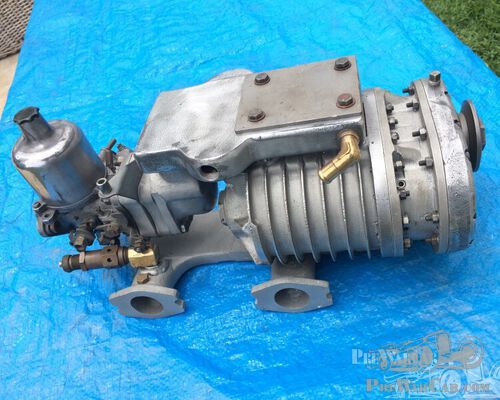
Blower / Compressor / Supercharger - Godfrey Marshall - A Series BMC Engine
SuperchargerA Godfrey Marshall cabin blower Type Mk22 converted to vehicle use by Barry Ekins of Sydney NSW. Ekins created kits for many popula..

Rolls-Royce
Rolls-Royce Silver Wraightlinks gestuurd, automatic, stuurbekrachtigingkleur antraciet grijs, lopende auto op Nederlands kenteken