The global magazine and marketplace for classic car enthusiasts, by enthusiasts.


Filter
Classic Lamborghini for sale - Lamborghini cars for sale
-

1997 Lamborghini Diablo VT Roadster | The Quail Auction 2026
Chassis No. ZA9RU37B2VLA12766 Following the one-off Miura Roadster created by Bertone in 1968, Lamborghini produced only a handful of Targa-bodied models before unveiling the Diablo VT Roadster. Its arrival marked the return of a true open V12 Lamborghini after nearly three decades. Conceived with the ambition of creating the fastest .. -
1984 Lamborghini Countach 5000 S | The Quail Auction 2026
Chassis No. ZA9C00500ELA12736 The Lamborghini Miura, the world's first supercar, was a nearly insurmountable act to follow. Its successor needed to be a forward-thinking purpose-built sports car, oozing futuristic design cues and cutting-edge engineering. Under Lamborghini's orders, no holds were barred for the new "LP112" project, which wou.. -
1989 Lamborghini Countach 25th Anniversary | The Quail Auction 2026
Chassis No. ZA9CA05A7KLA12538 Lamborghini revealed the Countach 25th Anniversary in September 1988 to celebrate a quarter-century of Raging Bull-badged automobiles that had begun with the 350 GT in 1963. With approximately 500 changes over the LP5000 QV, the Countach's final form sported extensive design enhancements penned by a young Horaci.. -
1970 Lamborghini Espada Series II | The Quail Auction 2026
Chassis No. 7897 Unveiled at the 1970 Brussels Motor Show, the Series II Espada refined Marcello Gandini's dramatic 1968 Bertone design. It retained the model's distinctive shooting brake silhouette while introducing a redesigned dashboard. Compression rose to 10.7:1, matching the Miura S, lifting output from 325 to 350 horsepower. Approxima.. -
2022 Lamborghini Countach LPI 800-4
Chassis No. ZHWEA9ZD6NLA11159 In an unusual move from Lamborghini's Centro Stile division, the 2021 Monterey Car Week saw the forward-thinking design studio indulge in nostalgia with the unveiling of the Countach LPI 800-4. A stunning modern interpretation of the seminal 1970s supercar, the limited-production LPI 800-4 paid homage to the or.. -
2022 Lamborghini HURACÀN SUPER TROFEO EVO1
Lamborghini Huracan VIN 7467 ST n. telaio ZHWEC1ZF6HLA07467 Km Telaio 22000 Motore riportato a Zero prima del campionato 2021 fatto 6 gare del campionato, Macchina numero 7 con Jonathan Ceccotto + 1 gara di super Final Sono 550/600 km a gara quindi motore circa 4600km Cambio revisionato a zero, revisionato anche il kit sospensioni Ohl.. -
1992 Lamborghini Diablo | The Zoute Concours Auction 2026
Chassis No. ZA9DE07A0MLA12366 Engine No. L522 382 Please check back for more information shortly. -
2006 Lamborghini Gallardo 5.0 V10 Spyder 4WD 2dr
2006 Lamborghini Gallardo 5.0 V10 Spyder 4WD 2drRegistration: LF06KUE (PN0 5TAR does not go with car)Under the current onwership for the last 14 or so years; this car wants for nothing & comes freshly serviced at a cost of £7,000 including a new clutch. We photographed the car near Bentley/Lamborghini Tonbridge wells whom have.. -
1968 Lamborghini Miura P400 S | The Quail Auction 2026
Chassis No. 3832 Engine No. 2619 Body No. 388 When Lamborghini introduced the Miura S in November 1968, the house of the Raging Bull refined what had already redrawn the supercar template. The S designation brought a series of meaningful changes beneath the Bertone-penned coachwork, sharpening both the driving experience and the .. -
2003 Lamborghini Murciélago 40th Anniversary | RM Sotheby's | The Monterey Auction
To Be OFFERED AT AUCTION at RM Sothebys' The Monterey Auction event, 13 - 15 August 2026. $850,000 - $1,200,000 USD One of 50 examples built to celebrate the 40th anniversary of Lamborghini40th Anniversary-specific finish of Verde Artemis with carbon fiber elements and an asymmetric interior Under single ownership with ..


Lamborghini
Italy, 1963 to date
Automobili Ferruccio Lamborghini SpA, S. Agata Bolognese
In 1946 Ferruccio Lamborghini was an amateur tuning Fiat 500s, but by 1949 he had started a tractor-building venture. His first Lamborghini cars were built up from Allied war surplus, but by 1966 the Lamborghini car company had boomed into a big factory turning out twenty Lamborghini cars a day, with a profitable side-line in oil burners. The Lamborghini car appeared in 1963 as a hobby for its sponsor and was a 3½-litre 4-ohc V12 with six Weber carburettors, developing 360bhp. The specification of the Lamborghini car included a 5-speed ZF gearbox, self-locking differential, multi-tubular frame, all-round independent suspension by coils and wishbones and servo-assisted Girling disc brakes. Lamborghini’s own GT coupé bodies had huge single windscreen wipers and retractable headlamps. Gian Paolo Dallara was responsible for design. Some 200 Lamborghini cars were delivered in 1965, by which time the new make was providing Ferrari with serious competition, though Lamborghini did not race his Lamborghini cars.
For 1966 Lamborghini GT models had 4-litre engines and henceforward the Lamborghini car company made their own gearboxes and final drive units. Even more exciting was the Lamborghini P400 Miura, introduced at Turin in November 1965, with this 4-litre unit mounted transversely at the rear, spur gear final drive and a top speed of 180mph. This Lamborghini car was in production by the end of 1966. In 1967 there as a bizarre prototype on Lamborghini Miura lines, the Lamborghini Marzal with 175bhp 2-litre 6-cylinder engine, and 6-headlamp layout. This Lamborghini car did not go into production, and a year later came a revised conventional V12, the front-engined Espada. A 2+2 edition, the Lamborghini Jarama, followed in 1970. New in 1971 was a small V8, the 2½-litre 220bhp Lamborghini Urraco, a development of the Lamborghini Miura with McPhearson strut suspension replacing the coils and wishbones. This, the Lamborghini Espada and the Lamborghini Jarama were offerd in 1973 by Lamborghini cars, when the Lamborghini Miura gave way to a new coupé, the Lamborghini Countach, powered by a 5-litre 440bhp version of the V12 unit mounted longitudinally at the rear, behind its gearbox. With a claimed maximum speed of over 200mph, the Lamborghini Countach cost £15.200 on the British market. Lamborghini cars wear the emblem of a bull, and have the unusual feature of synchromesh on reverse gear.
Source: Georgano, encyclopedia of motorcar; MCS
The information is written with the greatest of care. However, if you have any suggested amendments please contact us at office@postwarclassic.com


Featured
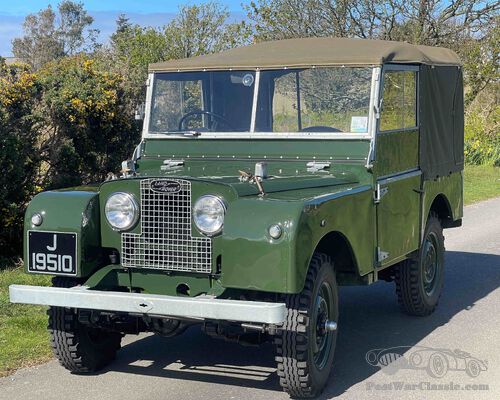
1952 Land Rover Series 1
Technical Specifications:Mark & Model: Land Rover Series 1Year: 1952Registration plate: Jersey registered
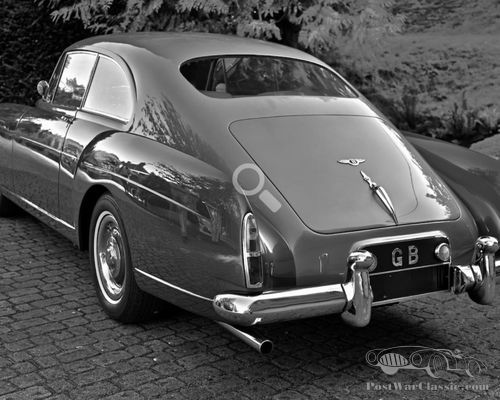
1957 Bentley S1 Fastback by H.J. Mulliner.
1957 Bentley S1 Fastback by H.J. Mulliner.A freshly restored award winning car in like new condition. A later car with Power assited steerin..
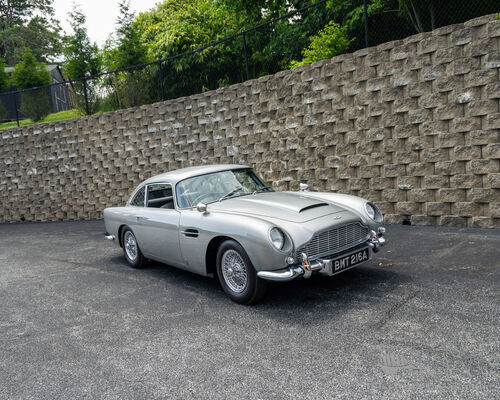
2020 Aston Martin DB5 Goldfinger Continuation | RM Sotheby's | The Monterey Auction
To Be OFFERED AT AUCTION at RM Sothebys' The Monterey Auction event, 13 - 15 August 2026. $1,000,000 - $1,500,000 USD One of 25 examples co..