The global magazine and marketplace for classic car enthusiasts, by enthusiasts.


Filter
Classic Lloyd for sale - Lloyd cars for sale
Change your filters to get results, or show all
Sorry, there are no results with your filters Cars
.
Lloyd
D, 1906 – 1914; 1950 – 1963
(1) Norddeutsche Automobil- und Motoren AG, Bremen, 1906 – 1914
(2) Lloyd Motoren-Werke GmbH, Bremen, 1950 – 1963
The Norddeutsche Automobil- und Motoren AG (Namag), a subsidiary of the Norddeutsche Lloyd shipping line, was founded in 1906 for the production under licence of Kriéger electric cars, for which the brand-name Lloyd was used. The first petrol-driven Lloyd car, designed by Joseph Vollmer, appeared in 1908 and was a 4-cylinder 15/35ps 3.685cc Lloyd car. A few more 4-cylinder Lloyd cars followed. Petrol-electric Lloyd cars were produced from 1908. The Lloyd car make was not widely sold and in 1914 Lloyd cars amalgamated with Hansa, subsequent models being marketed as Hansa-Lloyd cars.
Hansa-Lloyd was taken over in 1929 by Borgward who revived the name of Lloyd in 1950 when a small Lloyd car with a 2-cylinder 293cc engine appeared. The body of this Lloyd car was of wood construction covered with leather. All-steel bodywork was standardized in 1954, and over 45.000 Lloyd cars were sold in 1955. Engine capacity of this small Lloyd car increased to 596cc with the Lloyd Alexander of 1957, which had an all-steel body. There was also an austerity two-stroke ’Lloyd 250’ at DM 2.980 which did not succeed. The last Lloyd car was the 4-cylinder 897cc Lloyd Arabella, introduced in 1957. The failure of the Borgward group also finished Lloyd cars in 1961, although the Lloyd Arabella was continued in limited numbers until 1963 from stock parts. The Lloyd Arabella de luxe model was marketed as a Borgward.
GB, 1936 – 1951
Lloyd Cars Ltd, Grimsby, Lincs.
The pre-1939 Lloyd car was an ultra light open two-seater, powered by a rear-mounted 350cc single-cylinder engine. In 1946 the Lloyd Cars company announced the ‘Lloyd 650’ model which was in production from 1948 to 1951. This Lloyd car used a 650cc vertical twin 2-stroke engine developing only 17½bhp. With a surprisingly large four-seater roadster body, the overall weight of the Lloyd car was 1.344lb, so performance was hardly spectacular (maximum speed was 46mph). The Lloyd car had a tubular backbone chassis and the independent front suspension was by oil-damped horizontal coil springs. Rear suspension on the Lloyd car, also independent, was by vertical coil springs.
The price of the only Lloyd car model offered was £480 in 1948, when the Ford Anglia saloon cost only £293.
Source: Georgano, encyclopedia of motorcar; HON, GNG
The information is written with the greatest of care. However, if you have any suggested amendments please contact us at office@postwarclassic.com


Featured
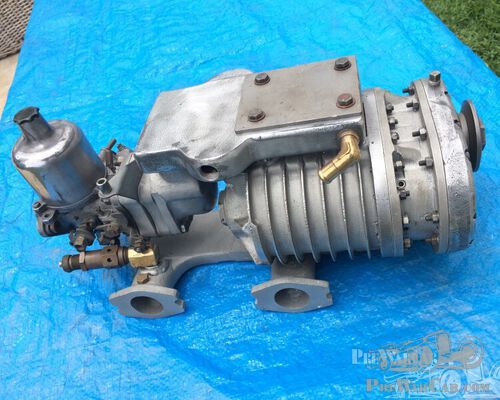
Blower / Compressor / Supercharger - Godfrey Marshall - A Series BMC Engine
SuperchargerA Godfrey Marshall cabin blower Type Mk22 converted to vehicle use by Barry Ekins of Sydney NSW. Ekins created kits for many popula..
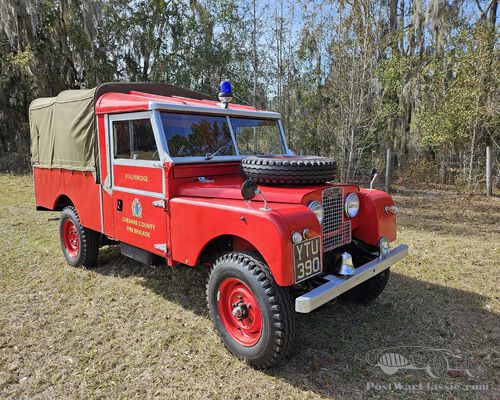
1957 Series 1 Land Rover Fire Engine + Coventry Climax Godiva Fire Pump
Betsy was used by Cheshire Fire Service (UK) from 1957 to 1975. She was based at Hazel Grove and Stalybridge Fire stations. She comes with an exten..

BMW 502 V8 3,2L (Barockengel)
6-seater touring sedan, famous from the german television series "Isar 12"Production period: 1955 – 1959, 2,517 unitsV-engine 8 cylin..