The global magazine and marketplace for classic car enthusiasts, by enthusiasts.


Filter
Classic Lola for sale - Lola cars for sale
-

1973 Porsche 911 Carrera RS Lightweight
Engine No. 6631531 Transmission No. 7831523 Production No. 1038730 At first glance, "homologation" might seem like a dry formality-just another rule in the racing world's dense regulatory playbook. But for those who know, it marks the birthplace of some of the most exhilarating road cars ever built. To homologate the 911 Carrera .. -
1964 Rolls Royce Silver Cloud 3 Flying Spur by H.J. Mulliner
1964 Rolls Royce Silver Cloud 3 Flying Spur by H.J. Mulliner Chassis number: SHS311C Registration Number: 2HKH (By Separate Negotiation.) One of 35 Right Hand Drive examples produced by noted coach builders H.J. Mulliner. This car formed part of the Boros collectio.. -
1957 JAGUAR XK140 MC DHC LEFT HAND DRIVE.
1957 Jaguar XK140 MC DHC Chassis number: S818981Registration Number: GD-81-74 Portugal A rare Jaguar XK140 Drophead coupe with the optional C type head. This car was restored some years ago & has for many years resided in a prominent portugease collection whilst being driven 20kms each month & maintain.. -
Alfa Romeo 1983 Giulietta Berline
Alfa-Romeo Giulietta Berlina with Italian documents. Frank Kennis Phone: 00.31.622.420.766 or mail me: info@KennisCars.NL www.KennisCars.NL Classic Car Dealer for Europe Cadillac ; Mercedes ; Rolls-Royce ; Delage ; Bugatti ; Bentley ; Dodge ; Opel ; Corvette ; Talbot-Lago ; Chrysler ; Delahaye ; Zagato ; Alfa-Romeo ; Pininfarina ; Fleetwood ; .. -
Porsche 356B Carrera II 4-cam
Beautiful original matching numbers Porsche 356B Carrera 2 with the spectacular 4-cam 2000cm3 engine.Full history, only 3 owners from new.Perfectly maintained.Driving this 356 is a experience you will not forget. It's fast and that means: really fast!Don't hesitate to come over and get surprised by this fantastic piec..


Lola
GB, 1958 to date
(1) E. Broadley, Bromley, Kent, 1958
(2) Lola Cars Ltd, Bromley, Kent; Byfleet, Surrey, 1958 – 1961
(3) Lola Cars Ltd, Bromley, Kent, 1961 – 1965
(4) Lola Cars Ltd, Slough, Bucks., 1965 – 1970
(5) Lola Cars Ltd, Huntingdon, 1971 to date
In 1956 Eric Broadley built a sports-racing Lola car for the 100E Ford-engined class, which won every race he drove Lola car in. This design was subsequently developed into the production Lola car. Particularly in the hands of P. Ashdown, P. Gammon, M. Ross and M. Taylor, Coventry-Climax-engined versions swept all before them in 1959, the first full competition season as the Lola car marque. Noteworthy design features included a first full space-frame of both round and square-section tubes, stressed floor, canted engine, coil independent front suspension and rear drive shafts which doubled duty as upper suspension links.
Formula Junior was essayed in 1960, with a similar Lola cardesign incorporating an offset driver. Besides the works Lola cars, D. Taylor and members of the Fitzwilliam Racing Team achieved some good placings with Lola cars. Hustled by Lotus successes, the rear-engined Lola Mark 3 version appeared for 1961, and by 1962 a Lola Mark 5 version was racing. That year the finance firm of Bowmakers sponsored a Formula 1 Lola car team, based on the Junior designs, John Surtees, newly weaned from two wheels, but in some very commendable drivers. At the 1963 Racing Car Show the sensational GT coupé Lola car appeared, with Ford V8 engine behind the driver. Amongst the many who went wild over the Lola car were some senior Ford executives, and thus it formed the genesis of the great line of Ford GT sports-racers. Meanwhile, Lola themselves continued development of the single-seater Lola cars, achieving various successes in the new Formula 2 and 3 in the hands of C. Amon, R. Attwood, M. Beckwith, D. Hobbs, J.Surtees and others. Monocoque structure was introduced on Lola cars in 1965, and the culmination of this line was perhaps theLola Type 90 with which Graham Hill won the 1966 Indianapolis ‘500’ race. Also in 1965, the Lola Type 70 made its debut, and John Surtees ensured that this Lola car quickly made its mark.
Built to comply with Appendix C, Group7 of the International regulations, these Lola cars achieved an enviable reputation in their class, and as in the case of the early 1.100cc sports cars, racing successes of the Lola cars were reflected in the sales figures. Early Lola cars had a punt chassis; the Lola Mark 3 edition used a monocoque construction, with reinforcement from boxed side members containing fuel bags. 4.7-litre Ford or Chevrolet 5½-litre engines were offered as standard, and the body was of fiberglass, partly stressed. In 1967 a Lola GT version also became available, the wheel thus turning full circle to the original progenitor of 1963. A single-seater Lola car, the Lola Type 100, was still listed for the monoposto classes. With the announcement of an agreement between Lola cars and Aston-Martin, who unveiled a double ohc V8 engine at the beginning of the year, came the hope that there might ba an all-British competitor in the large sports-racing class, but after an unsuccessful Le Mans foray, development was shelved.
The first one or two numbers in Lola car-types denote the basic model, the last digit being used for any subsequent developments. The Lola T110 was an abandoned Formula 1 project, Lola T120 a one-off hill-climb car, Lola T130 the chassis designed by Lola for the 1968 Honda Formula 1 car and Lola T140 the Formula A/5000 model. The T142 Lola carversion, priced at £5.500 for 1969, was particularly successful. Lola T160 was the 1968 ‘Can-Am’ car for Group 7 racing, but neither this Lola car nor its successors, the T220 of 1970, T260 of 1971 and the T310 of 1972, ever quite managed to fulfill their obvious promise, despite on occasion drivers in Lola cars of the caliber of Jackie Stewart.
In sports-car racing the 2-litre FVC-engined Lola cars were consistently in the money, winning the European Championship in 1971, mainly with the current Lola T212 in the hands of Jo Bonnier, Guy Edwards, John Love, Ronnie Peterson and others. The T290 of 1972 was a worthy successor of the earlier Lola cars. Both the Lola T200 Formula Ford and the T250 Formula Super Vee series Lola cars, developed over several years, achieved some good performances in their respective classes. Another unraced Formula 1 car took the designation Lola T230. In Formula 5000 Frank Gardner took the 1971 Rothmans Championship, partly with the Lola T192, which he had been instrumental in developing in 1970, and partly with the new Lola T300 based on a side-radiatored Formula 2 design. A South-American derivative of the Lola car was the project of Carlos Avallone of Sao Paolo, who laid down twelve sports cars based on T163 framework with T142 suspension.
The T280 sports-racing Lola car, with 3-litre engine derived from the Cosworth DFV Formula 1 unit, was the only vehicle to challenge Ferrari consistently in speed during the 1972 Championship events, even after the death of the main sponsor, Jo Bonnier, at Le Mans. Unfortunately the Lola cars were not as reliable as the Ferraris and no outstanding results were achieved. Excellent results, however, were achieved with Lola cars in 1972 Formula 5000 racing by Alan Rollinson and David Hobbs with the T300. Lola interest continued at Indianapolis also: the 1972 Lola T270 wide-bodied aluminium monocoque was sponsored by the firm’s US distributor Carl Hass.
During 1970 Lola had sold over 200 Lola cars and in 1971 they maintained their position as the world’s leading racing-car maker with sales of 135 Lola cars in a falling market.
Source: Georgano, encyclopedia of motorcar; DF
The information is written with the greatest of care. However, if you have any suggested amendments please contact us at office@postwarclassic.com


Featured
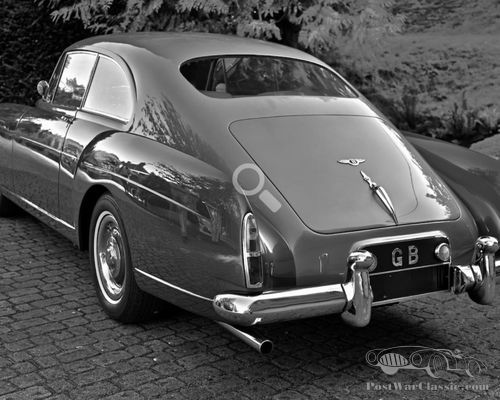
1957 Bentley S1 Fastback by H.J. Mulliner.
1957 Bentley S1 Fastback by H.J. Mulliner.A freshly restored award winning car in like new condition. A later car with Power assited steerin..
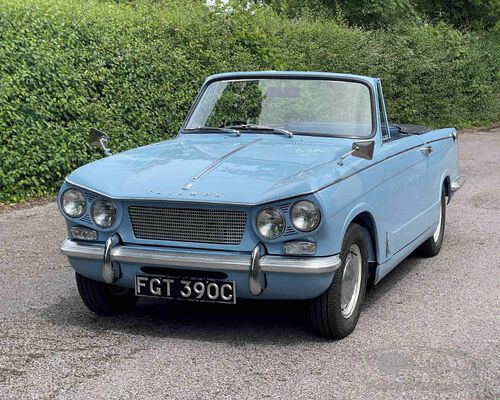
Triumph Vitesse 6 Convertible
Technical SpecificationsMark & Model: Triumph Vitesse 6 ConvertibleYear: 1965Registration plate: UK registered
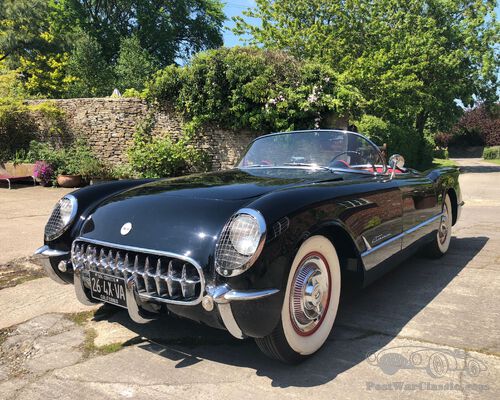
1954 Corvette C1 - SUPER RARE Black!!
Looking for her next lover, my classy 1954 Corvette C1. She's a beautiful sculpture. Never have i had so many adoring comments as when drivi..