The global magazine and marketplace for classic car enthusiasts, by enthusiasts.


Filter
Classic Matra for sale - Matra cars for sale

Matra
France, 1965 to date
(1) Matra-Sports srl, Romorantin, Loir-et-Cher, 1965 to date
(2) Matra-Simca, Division Automobile, Vélizy-Villacoublay, Seine-et-Oise, 1969 to date
Engins Matra’s primary interests are in aerospace and armaments, but in late 1964 Matra took over the assets of the defunct René Bonnet concern, and established Matra-Sports to run the existing Renault-engined sports cars and updated Formula 3 monocoque racing cars, using Cosworth-Ford engines. Production Matra cars pursued the René Bonnet theme with Gordini-tuned 1.108cc Renault engines available in 70 and 94bhp forms, disc brakes on all four wheels and fiberglass bodywork. The 1966 Matra Djet with hemispherical head was capable of 109mph, and in 1967 the Matra car company offered a 1.250cc, 105bhp version as well as a new ‘Matra 2+2’ with 1.7-litre German Ford V4 engine.
In 1968 the Matra Djet was dropped from the range of Matra cars, leaving the angular Matra 530 coupé with mid-mounted 85bhp V4 engine giving a top speed of 107mph. During 1969 Ford Cologne replaced their V4 with a new twin-carburettor unit which Matra cars immediately adopted, while discussions were in hand for a Simca take-over of Matra-Sports. This was indeed concluded, so Matra-Simca came into existence as part of the American-based Chrysler empire. It was intended to continue the 530 Ford into 1973 when a new Chrysler-engined Matra car appeared, the 1.294cc transverse mid-engined Matra Bagheena three-seater coupé.
Matra cars quickly cominated the single-seater classes, and after winning in Formula 2 in 1967 they entered Formula 1 in 1968 with a Matra car, the V12 Matra-engined MS11 running under works colours, and a Cosworth-Ford-engined MS10 appearing under Ken Tyrrell’s aegis for Jackie Stewart. The Ford car won three GPs that season, and a revised version won six GPs in 1969 to give Stewart and Matra the World Championship titles. Jacky Ickx and Johnny Servoz-Gavin won the European F2 Championship for Matra in these seasons, and then from 1970 to 1972 Matra cars ran their own V12-engined F1 cars with little success. In sports-car racing the V12 engined had replaced earlier BRM V8 and Ford V8-engined machines but likewise had little success with Matra cars until 1972, when Graham Hill and Henri Pescarolo won the Le Mans 24-hours for the Matra car marque. This V12 engine was intended to form the basis of a high-performance prestige road Matra car for the mid-1970s.
Source: Georgano, encyclopedia of motorcar; MCS/DCN
The information is written with the greatest of care. However, if you have any suggested amendments please contact us at office@postwarclassic.com


Featured
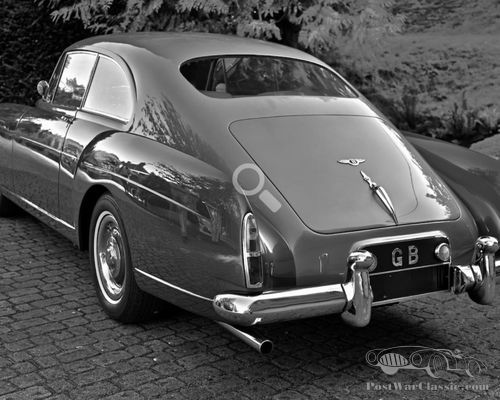
1957 Bentley S1 Fastback by H.J. Mulliner.
1957 Bentley S1 Fastback by H.J. Mulliner.A freshly restored award winning car in like new condition. A later car with Power assited steerin..
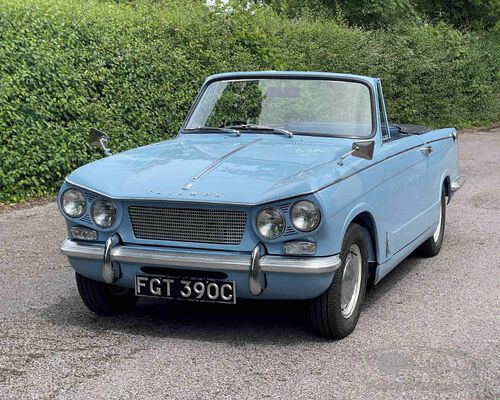
Triumph Vitesse 6 Convertible
Technical SpecificationsMark & Model: Triumph Vitesse 6 ConvertibleYear: 1965Registration plate: UK registered
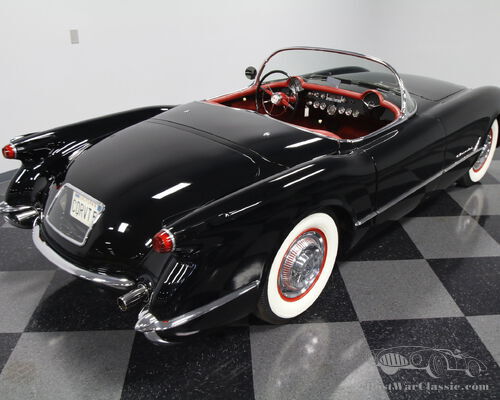
1954 Chevrolet Corvette C1
Fully restored 1954 C1 Corvette in Black. Stunningly beautiful car, feels like driving a sculptural work of Art. Known to be the oldest Corvette on t..