The global magazine and marketplace for classic car enthusiasts, by enthusiasts.


Filter
Classic McLaren for sale - McLaren cars for sale
-

2013 McLaren 50 12C by MSO
Unveiled in 2010, the McLaren MP4-12C marked the marque's long-awaited return to road car production following the legendary F1. The 12C was an innovative powerhouse in both design and engineering, notably introducing McLaren's carbon fiber MonoCell chassis-lightweight, rigid, and foundational to its future models. McLaren unveiled a limited..

McLaren
GB, 1964 to date
(1) Bruce McLaren Motor Racing Ltd, Slough, Bucks., 1964 to date
(2) Elva Cars (1961) Ltd, Rye, Sussex, 1965 – 1966
(3) Elva Cars (1961) Ltd, Croydon, Surrey, 1966 – 1968
(4) Trojan Ltd, Croydon, Surrey, 1969 to date
Bruce McLaren followed Brabham’s example in leaving the Cooper team to construct and drive his own McLaren cars. The prototype sports-racing McLaren car was derived from a Cooper-based special, the ‘Zerex’, converted for the American Roger Penske from an old single-seater machine. For 1965 a new ‘Group 7’ sports McLaren car was made, with large-diameter tubular chassis, and rear-mounted Traco-modified Oldsmobile engine driving through a Hewland gearbox. This McLaren carmodel was also constructed at the rate of some two dozen annually by Elvas, who had greater production and marketing facilities. Driven by C. Amon and McLaren himself, inter alia, some major wins were earned with the McLaren car. The Monopostos McLaren cars were less fortunate – mechanical troubles beset the Formula 1 McLaren cars of 1966 and 1967, although various power units by Ford, Serenissima and BRM were tried. The monocoque construction, based on a ‘Mallite’ wood and alloy sandwich, was later used on some other single-seater McLaren carmodels, succeeding the space-frame layout seen in 1966. The Elva-built ‘production’ Formula 2 and 3 monocoques versions of the McLaren car, however, were based on an aluminium through centre section, with steel bulkheads, tubular sub-frames, and fiberglass covering, and this design was later converted for Formula 1 use. In 1967 the monocoque McLaren M6A works cars of Bruce McLaren and Hulme dominated the Can-Am series of races, and this pattern was repeated in 1968 with the McLaren M8A and the M8B in 1969. Production McLaren carmodels built at Croydon (the M3, M6B and M12 for the respective years) sold well in the United States. Progress continued also with the Robin Herd-designed single-seater McLaren cars, including the M4A Formula 2, and the M5A, M7 series and M9A 4-wheel-drive Formula 1 models.
In 1970 the McLaren M14A Formula 1 car an the M15A Indianapolis machine, designed by Roy Coppuck, were introduced. The very successful McLaren M10B model developed by Jo Marquart took the Formula 5000 Championship in Britain two years running, the 1971 Tasman Championship, and was also the car to beat in the hill-climbs. Tragedy came when Bruce McLaren was killed while testing an M8D Group 7 model. Nevertheless, the McLaren car team succeeded once more in practically monopolizing the Can-Am series.
During 1971 the McLaren M8E team cars of Revson and Hulme once again looked after Group 7 racing, though the M8F and M20 McLaren cars of 1972 faced stiffer opposition. The M19 series of Formula 1 McLaren cars of 1971 and 1972, based on a Ralph Bellamy design initially featuring variable-rate suspension, were often front runners without being winners. The McLaren M16 did the job for which the McLaren car was made in winning the 1972 Indianapolis in Mark Donohue’s hands after coming second in 1971. The McLaren M17 was allocated to an uncompleted sports-car project. For 1971 the M18 succeeded the M10B in Formula 5000. During 1972 customer McLaren cars, built as always at Croydon, included the M21 Formula 2 and the M22 Formula 5000 McLaren cars, the former proving most promising in the hands of Jody Scheckter.
Source: Georgano, encyclopedia of motorcar; DF
The information is written with the greatest of care. However, if you have any suggested amendments please contact us at office@postwarclassic.com


Featured

Alfa Romeo Barchetrta Bianchi Prototype 600 Kg 150CV
1 of 1. Never repeated. 1985 Alfa Romeo Barchetta "by Bianchi" Built by hand in Argentina. 600kg. 150hp. Twin Webers. Alfa 2300 heart. Tubular stee..
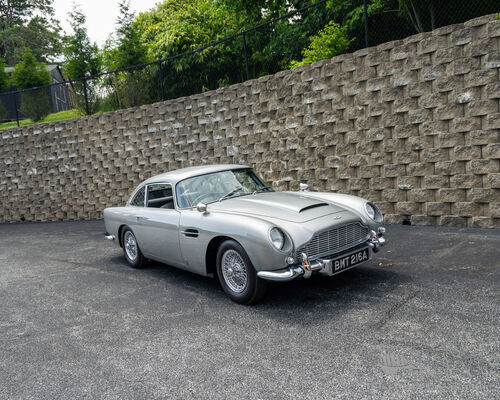
2020 Aston Martin DB5 Goldfinger Continuation | RM Sotheby's | The Monterey Auction
To Be OFFERED AT AUCTION at RM Sothebys' The Monterey Auction event, 13 - 15 August 2026. $1,000,000 - $1,500,000 USD One of 25 examples co..
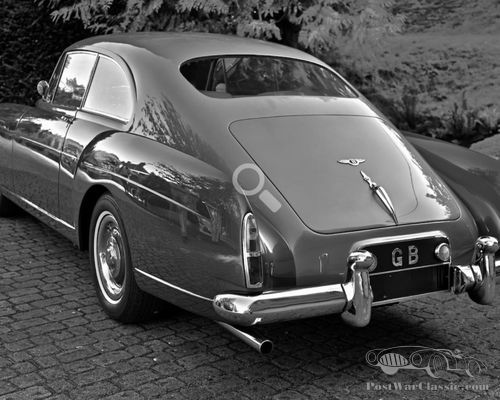
1957 Bentley S1 Fastback by H.J. Mulliner.
1957 Bentley S1 Fastback by H.J. Mulliner.A freshly restored award winning car in like new condition. A later car with Power assited steerin..