The global magazine and marketplace for classic car enthusiasts, by enthusiasts.


Filter
Classic Mercedes Benz for sale - Mercedes Benz cars for sale
-

1986 Mercedes-Benz 560 SEC ABC-Exclusive Widebody | Global Icons: The Patina Collective
Chassis No. WDBCA45D8GA202519 In September 1985, four years after the debut of the 500 SEC-the range-topping coupe version of the second-generation S-Class-Mercedes-Benz unveiled a revised range at the Frankfurt International Motor Show. The update featured a subtle facelift, including changes to the bumpers, side skirts, and wheels, but the.. -
1986 Mercedes-Benz 500 SEC ABC-Exclusive Widebody | Global Icons: The Patina Collective
Chassis No. WDB1260441A226323 When Mercedes-Benz introduced the C126 coupe in 1981, it aimed to build the most accomplished personal luxury car in the world. Penned under design chief Bruno Sacco, the SEC paired the W126's engineering integrity with a pillarless silhouette of rare elegance, and the 500 SEC sat atop the range when launched. I.. -
Mercedes-Benz 1986 200T Combi 124-serie
Mercedes-Benz 200T Estate 124 series, new delivery in the Netherlands with NAP pass Frank Kennis Telephone: 00.31.622.420.766 or email me: info@KennisCars.NL www.KennisCars.NL Classic car dealer for Europe Cadillac; Mercedes; Rolls-Royce; Delage; Bugatti; Bentley; Dodge; Opel; Corvette; Talbot-Lago; Chrysler; Delahaye; Zagato; Alfa-Romeo;..


Mercedes-Benz
D, 1926 to date
Daimler Benz AG, Stuttgart-Untertürkheim; Mannheim
After amalgamation of Mercedes cars and Benz cars in 1926 the Benz 16/50PS model and the Mercedes car models with supercharged engines were continued for some time. New 1926 Mercedes car models were the 6-cylinder Mercedes-Benz 8/38PS 2-litre Stuttgart and the Mercedes-Benz 12/55PS 3.1-litre Mannheim, both conventional and heavy sv machines with coil ignition, 3-speed gearboxes and wood wheels. These Mercedes cars were developed into the 2.6-litre Mercedes-Benz Stuttgart 260 and the 3½-litre Mercedes-Benz Mannheim 350. A new Mercedes car model the Mercedes-Benz Nürburg 460 with an 8-cylinder 4.6-litre engine was added in 1928 and this later grew into the Mercedes-Benz Nürburg 500. These were the last Mercedes car models – except the ‘Grosser Mercedes’ – built to the classic Mercedes car chassis design with U-sectioned frame, rigid axles an semi-elliptic springs. The earlier Mercedes car model 24/100/140PS became the sports model Mercedes-Benz K with shortened wheelbase and a supercharged 6,25-litre 24/110/160PS engine. This Mercedes car was the fastest touring car of its time on the world market. From this Mercedes car a range of very successful types was derived: the Mercedes-Benz S (6,8-litre 26/120/180PS), the Mercedes-Benz SS (7,1-litre 27/140/200PS), Mercedes-Benz SSK (7,1-litre 27/170/225PS), and the Mercedes-Benz SSKL (7,1-litre 27/170/300PS). The Mercedes cars gained numerous victories and places in hill-climbs, and sports carraces. Although the Mercedes cars were not racing cars they nevertheless competed successfully in several events, winnings for Mercedes-Benz cars were, for example, the Ulster TT in 1929, the Irish Grand Prix in 1930, the Mille Miglia and Eifel Race in 1931, and the Avus Race in 1931 and 1932. In 1930 came the first 8-cylinder Grosser Mercedes car with a 7,7-litre engine developing 150bhp, or 200bhp with supercharger. The first version of this Mercedes car was built until 1937 and had the old Mercedes car chassis design, but the succeeding model Mercedes-Benz 770 of 1938 had a modern lay-out with oval tubular frame and swing axles. The engine output of the Mercedes car was increased to 155/230bhp. A maximum speed of over 100mph was possible with this Mercedes-Benz car.
The ‘economy class’ was entered again with a Mercedes car in 1931 using the 6-cylinder, 1.692cc model Mercedes-Benz 170, the first Mercedes car to use independent wheel suspension. The design which followed in Mercedes cars included the rear-engined models Mercedes-Benz 130H, Mercedes-Benz 150H and Mercedes-Benz 170H, with backbone frames, the Mercedes--Benz 260D, the first diesel-engined private Mercedes car to be series produced, and the supercharged Mercedes-Benz 540K sports tourer.
In 1934 Mercedes-Benz took up racing again. For the 750kg Formula an 8-cylinder 3,36-litre supercharged Mercedes car model was designed, developing 354bhp. During the next three years engine capacities of these race Mercedes cars were raised to 5,66-litres giving an output of 646bhp. For 1938 and 1939 a V12 supercharged Mercedes car-model was built to the new 3-litre Formula specification, developing 476 and 483bhp. A 1½-litre, 254bhp Mercedes-Benz racer had to be designed especially for the 1939 Tripoli Grand Prix and 1st and 2nd places in this race were the result. This was one of the last successes for Mercedes-Benz before the outbreak of World War 2, after a long and distinguished record which had begun in 1934 and only been interrupted by Auto-Union, the two firms sharing nearly all major race successes between them. Several world records were also gained by Mercedes-Benz cars. In 1934 the standing-start mile was covered at 117,2mph at Gyor (Hungary), and the flying mile at 193,8mph on the Avus course. In 1936 a world record for the flying 10 miles was set with a V12 aerodynamic-bodied Mercedes-Benz car on the Frankfurt-Darmstadt autobahn with 207.2mph. The Frankfurt autobahn again saw a Mercedes car record early in 1938 when the flying kilometer was covered at 268.9mph, the highest speed ever achieved on a public highway. Caracciola was the driver who gained these world records with Mercedes cars, and also a numer of class records, for Mercedes cars. An aero-engined Mercedes car was being prepared for an attack on the World Land Speed Record in 1939.
The former Benz works at Mannheim were used for the production of private Mercedes-Benz cars until 1939. Since then commercial vehicles have been built in Mannheim and private Mercedes cars in the Stuttgart-Untertürkheim works. At the outbreak of World War 2 the Mercedes car firm were testing a 6-litre V12 intended as a replacement for the Grosser.
World War 2 halted development. The pre-war 1.697cc Mercedes-Benz 170V was taken up again in 1947 and was available as the Mercedes-Benz 170D with a diesel engine. These fours had back-bone-type frames; unitary construction made its appearance in the 1954 ‘Mercedes-Benz 180’ series. The first Mercedes-Benz car with ohc four was the sporting Mercedes-Benz 190SL of 1955. The 6-cylinder models Mercedes-Benz 220 and Mercedes-Benz 300 followed in 1951. The 4-cylinder Mercedes-Benz 170 was progressively increased in size and output from 1.697cc and 38bhp to the 1.988cc and 95bhp of the 200 introduced in 1965. Sports Mercedes car manufacture recommenced in 1952 with the 6-cylinder, 3-litre, 215bhp Mercedes-Benz 300SL with fuel injection, originally a fixed head coupé with gullwing doors, but later sold as a Mercedes-Benz roadster; over 3.250 Mercedes-Benz 300SL cars were made. The Mercedes-Benz 300SL was victorious at Le Mans in 1952. The Mercedes-Benz 300SLR was a sports racing car with an 8-cylinder 3-litre engine of 300bhp and was very successful in competitions. In 1954 Mercedes-Benz cars again took part in formula racing with an 8-cylinder 2.5-litre version. Juan Manuel Fangio was World Champion in 1954 and 1955 on this Mercedes-Benz carmodel. Participation in racing was discontinued after 1955.
The top model of the Mercedes-Benz range of production cars was added in 1964. It was the Mercedes-Benz 600, a luxury car with an 8-cylinder 6.3-litre 250bhp engine, continuing the tradition of the pre-war Grosser Mercedes. This Mercedes-Benz car is available in two wheelbase lengths, 10ft 6in and 12ft 10in. The latter has an overall length of 20ft 6in and is also available with a 6-door body. Early in 1968 the Mercedes-Benz range was revised with a restyled body and new independent rear suspension for the Mercedes-Benz 200, Mercedes-Benz 230 and Mercedes-Benz 250 models. A new 280 engine was introduced, used in the bodies of the former Mercedes-Benz 300 saloons and Mercedes-Benz 250SL sports car. Bridging the gap between the Mercedes-Benz 300 and the Mercedes-Benz 600 was the Mercedes-Benz 300SEL, a Mercedes-Benz 300 saloon using the big 6.3-litre V8 engine. Power-assisted steering, automatic transmission and airconditioning were standard, and this Mercedes-Benz car was capable of 137mph, though attempts to race the Mercedes-Benz car at Spa in 1969 proved abortive. In May 1968 the Mercedes-Benz company delivered its two millionth private Mercedes-Benz car since the end of the war, and in 1969 came a tantalizing prototype sports coupé, the Mercedes-Benz C-111 with rear-mounted fuel-injection 3-rotor Wankel engine developing 280bhp, a 5-speed ZF transaxle, limited-slip differential, and all-disc brakes. Weight of this Mercedes-Benz car was under 2.640lb. By 1970 the Mercedes-Benz car had been redesigned to take a 4-rotor unit with an equivalent capacity of 4.8-litres and an output of 350bhp; top speed was around 190mph. New production models were the Mercedes-Benz 300SEL 3.5 saloon and Mercedes-Benz 280SE 3.5 coupé, powered by 230bhp 3½-litre dohc V8 units with fuel injection; by 1971 this engine had also been applied to the Mercedes-Benz 350SL sports coupé, features of which were trailing-arm rear suspension and a foot-operated parking brake.
Smallest of the 1972 – 1973 Mercedes-Benz carrange was the 2-litre Mercedes-Benz 200, available with 4-cylinder petrol or diesel engine, and during 1972 the medium-sized Mercedes-Benz 280SE gave way to a new 2.8-litre dohc model. Output of this Mercedes-Benz car was 160bhp with carburetors or 185bhp with fuel injection.
Source: Georgano, encyclopedia of motorcar; HON
The information is written with the greatest of care. However, if you have any suggested amendments please contact us at office@postwarclassic.com


Featured
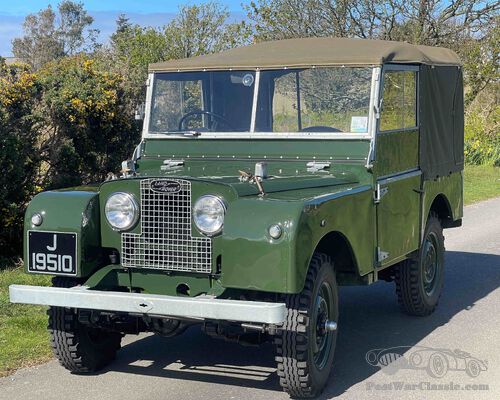
1952 Land Rover Series 1
Technical Specifications:Mark & Model: Land Rover Series 1Year: 1952Registration plate: Jersey registered
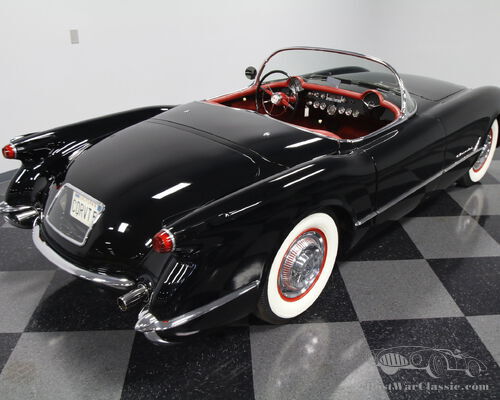
1954 Chevrolet Corvette C1
Fully restored 1954 C1 Corvette in Black. Stunningly beautiful car, feels like driving a sculptural work of Art. Known to be the oldest Corvette on t..
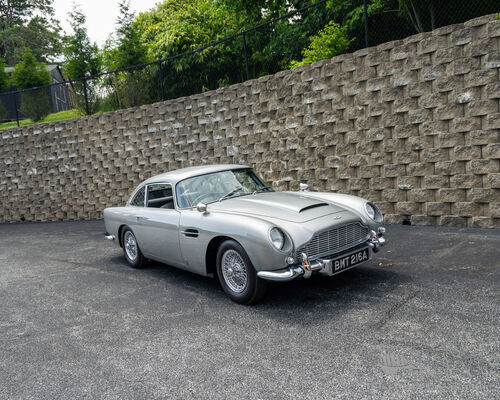
2020 Aston Martin DB5 Goldfinger Continuation | RM Sotheby's | The Monterey Auction
To Be OFFERED AT AUCTION at RM Sothebys' The Monterey Auction event, 13 - 15 August 2026. $1,000,000 - $1,500,000 USD One of 25 examples co..