The global magazine and marketplace for classic car enthusiasts, by enthusiasts.


Filter
Classic Nissan for sale - Nissan cars for sale
-

1970 Porsche 911 S Coupe
Engine No. 6302364 Transmission No. 7107530 The Porsche 911 underwent significant evolution from its introduction in 1964 to the unveiling of the 911 S for the 1967 model year, featuring the first iteration of the famous Fuchs alloy wheels with an engine boasting 160 horsepower - up 30 over the standard model. Noteworthy advancements c.. -
1964 Mercedes-Benz 230 SL
Engine No. 129.980.10.021499 According to the accompanying Mercedes-Benz Datenkarte, chassis 004753 left the works in the summer of 1964 as a 230 SL Roadster finished in Schwarz (Black - DB 040) over a red leather interior (203), fitted with a four-speed manual gearbox. The car was first registered on 1 July 1964. According to the previous o.. -
1971 YETI 903
SAMAS è l'acronimo di SOCIETA' ALBESE MECCANICA AUTOVEICOLI SPECIALI La Samas Yeti, prodotta dal 1971 al 1975, è una vera fuoristrada in miniatura. Una 4×4 dura e pura lunga poco più di tre metri piuttosto rara. La Samas Yeti vede ufficialmente la luce nel 1971 ma non è altro che una versione riveduta e corretta di un veicolo a trazione inte.. -
2006 Bentley Continental GTC
2006 Bentley Continental GTC Vin Number: SCBDE23W17C042901 Registration Number: DO06DOT (Can revert to SN56OJJ if preferred.) A beautiful low mile GTC that has covered a scant 26,000 miles from new backed up by a full set of MOT certificates & service records. This GTC.. -
BMW 1983 315 Sedan 038.307 km odometer read Coupe
BMW 315 in groen metallic origineel nieuw geleverd in Nederland met boekjes aanwezig km-stand: 038.307 km met de cocusmatten nog bij de auto zoals in begin jaren 80 gebruikelijk was. Rijdt super schakelt strak. Frank Kennis Phone: 00.31.622.420.766 or mail me: info@KennisCars.NL www.KennisCars.NL Classic Car Dealer for Europe Cadillac ; Merced.. -
2003 Porsche 911 Carrera RUF 3.6 Kompressor
From the beginning, RUF Automobile has excelled at both manufacturing its own exquisite sports cars and extracting extraordinary performance from existing Porsche road cars. The RUF 3.6 Kompressor Kit pays tribute to that formative era, embodying the tuner's original mission with a factory developed kit that transformed the 996-generation 911 into .. -
Delahaye 135MS CL Spéciale 1953
Unique prototype of the Delahaye 235 which was intended to be show at the 1953 Salon de l’Automobile in Paris. Its design has similarities with the Ford Comète designed by Farina, the Bentley Cresta II and the early Facel-Vega. Three owners from new. Magnificent restoration done in 2018-2019 by Dominique Tessier.Coachbuilder: Faget-Var.. -
Jaguar 1986 XJ-SC Targa Convertible
Jaguar XJ-SC Targa Convertible imported from Soain and now with Dutch documents and APK Frank Kennis Phone: 00.31.622.420.766 or mail me: info@KennisCars.NL www.KennisCars.NL Classic Car Dealer for Europe Cadillac ; Mercedes ; Rolls-Royce ; Delage ; Bugatti ; Bentley ; Dodge ; Opel ; Corvette ; Talbot-Lago ; Chrysler ; Delahaye ; Zagato..


Nissan
Japan, 1937 – 1943; 1960 to date
Nissan Motor Co, Ltd, Yokohama
The Nissan Motor Co. was formed in 1934 and continued production of the Datsun, taking over from a previous firm. It was then decided to expand into the field of larger private Nissan cars. Assited by American Graham-Paige technologu, the Nissan carcompany brought out the Nissan Model 70 five-seater sedan and pheaeton in 1937. Machine tools, dies, gauges and related equipment were purchased from Graham-Paige, who also supplied Nissan cars with engine block and gave further aid where required. Similar in appearance to the Graham Six sedan of the period, the Nissan car was powered by a 6-cylinder, 85hp engine which permitted a speed of 75mph. From 1940 to 1941 a Nissan Model 50 series was also built which was more like a German Opel in styling.
Nissan cars continued to manufacture during World War 2, supplying military equipment to the Japanese armed forces. The Nissan car marque was temporarily abandoned after the war in favour of manufacture of Datsun vehicles and Austin A40 and A50 cars, built by Nissan cars under licence from 1953 to 1960. However, the Nissan Patrol, a Jeep-type vehicle, was already sold as a Nissan car.
On 1 April 1960 the Nissan car name reappeared when the Nissan Cedric sedan was announced to replace the Austin. A large car by Japanese standards, the Nissan Cedric Special was powered by a 118hp, 2.825cc engine; the Nissan Custom and 1900 series Nissan car contain a 95hp, 4-cylinder ohv engine with a cast-iron block and a 3-bearing crank shaft. At the top of the 1967 Nissan car range was the 4-litre Nissan President V8.
Nissan cars took over Prince Motors in 1966, and the two ranges were rationalized. Yue Loong have made Nissan car products under licence in Taiwan since 1958. The Nissan car group’s heavier commercial vehicles invariably carry the Nissan car name, but since the spread of Japan’s export drive in the middle 1960s the tendency has been to sell private Nissan cars as Datsuns, and in some markets (notably Britain) even the larger 6-cylinder machines are Datsuns rather than Nissan cars. The later Nissan car models are described under Datsun.
Source: Georgano, encyclopedia of motorcar; BE
The information is written with the greatest of care. However, if you have any suggested amendments please contact us at office@postwarclassic.com


Featured
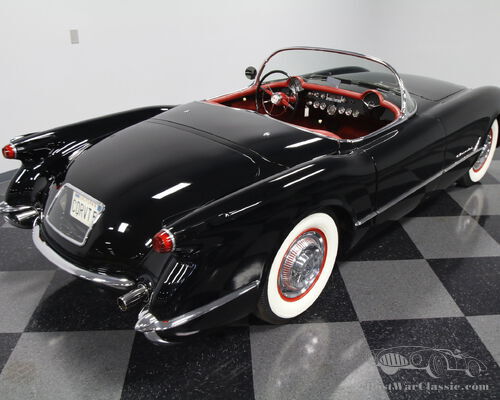
1954 Chevrolet Corvette C1
Fully restored 1954 C1 Corvette in Black. Stunningly beautiful car, feels like driving a sculptural work of Art. Known to be the oldest Corvette on t..
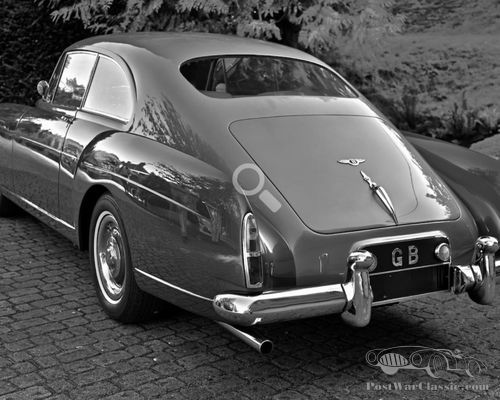
1957 Bentley S1 Fastback by H.J. Mulliner.
1957 Bentley S1 Fastback by H.J. Mulliner.A freshly restored award winning car in like new condition. A later car with Power assited steerin..
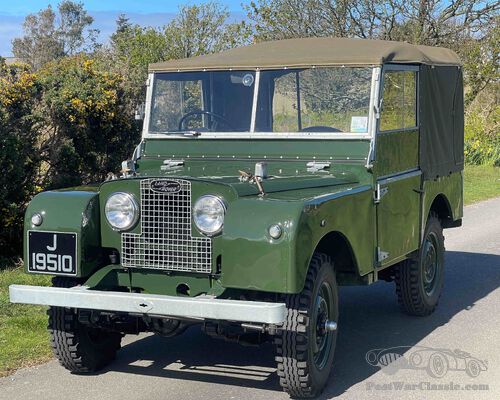
1952 Land Rover Series 1
Technical Specifications:Mark & Model: Land Rover Series 1Year: 1952Registration plate: Jersey registered