The global magazine and marketplace for classic car enthusiasts, by enthusiasts.


Filter
Classic Pegaso for sale - Pegaso cars for sale
-

Pegaso Z-102 Berlinetta Touring 1955 for sale
Very nice Z-102 with period racing history. Please call or email for details.

Pegaso
E, 1951 – 1958
Empresa Nacional de Autocamiones SA, Barcelona
The only post-war Spanish car to have achieved international fame, the Pegaso car was a complex and expensive sports car built in the training works of the old Hispano-Suiza factory. The Pegaso car was first shown to the public at the 1951 Paris-Salon as a 2½-litre V8 with four overhead camshafts, dry sump lubrication and a 5-speed gearbox incorporated in the rear axle. Suspension of the Pegaso car was by torsion bars all round, and the rear axle was of the De Dion type. This Pegaso car was the Pegaso Z102 developing 180/230bhp, and it was followed by the Pegaso Z102B (2.8-litre, 210bhp), Pegaso Z102SS (3.2-litre, 210/289bhp) and Pegaso Z103 (4.0-, 4.5-, and 4.7-litre); the Pegaso Z103 had push-rod overhead valves. Performance of the Pegaso car varied considerably according to compression ratio and axle ratio. Carburation of the Pegaso car was by 2, 4 or 8 Webers, and the Pegaso cars could be supplied with Roots-type superchargers. Only three or four Pegaso Z103 cars were made.
Pegaso cars never made a significant mark in international competition, although the Pegaso cars did well in some Spanish races, and one Pegaso car took records for the flying kilometer and flying mile in Belgium in 1953. A curious asymmetrical Pegaso car with the driver’s seat on the offside was entered for Le Mans in 1953.
In 1958 the designer, Wilfredo Ricart, retired, and Pegaso car company policy changed in favour of concentrating on heavy lorries and buses, which had always been their main production. Only 125 Pegaso cars were built, mostly to special order.
Source: Georgano, encyclopedia of motorcar; JRV
The information is written with the greatest of care. However, if you have any suggested amendments please contact us at office@postwarclassic.com


Featured
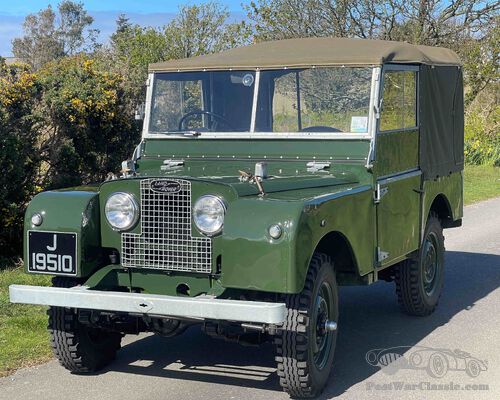
1952 Land Rover Series 1
Technical Specifications:Mark & Model: Land Rover Series 1Year: 1952Registration plate: Jersey registered
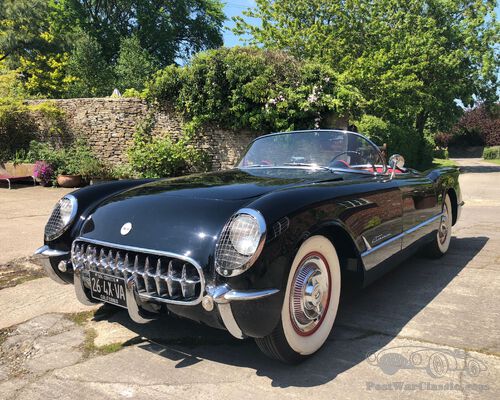
1954 Corvette C1 - SUPER RARE Black!!
Looking for her next lover, my classy 1954 Corvette C1. She's a beautiful sculpture. Never have i had so many adoring comments as when drivi..
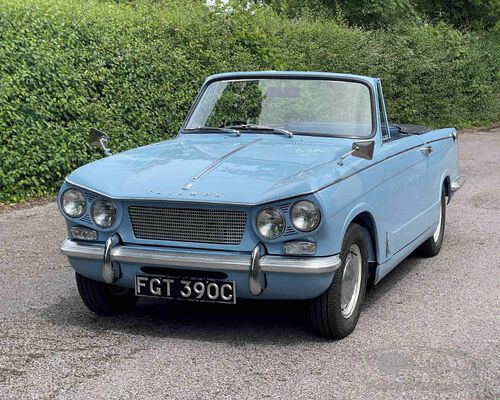
Triumph Vitesse 6 Convertible
Technical SpecificationsMark & Model: Triumph Vitesse 6 ConvertibleYear: 1965Registration plate: UK registered