The global magazine and marketplace for classic car enthusiasts, by enthusiasts.


Filter
Classic Porsche for sale - Porsche cars for sale
-

1970 Porsche 911 S Coupe
Engine No. 6302364 Transmission No. 7107530 The Porsche 911 underwent significant evolution from its introduction in 1964 to the unveiling of the 911 S for the 1967 model year, featuring the first iteration of the famous Fuchs alloy wheels with an engine boasting 160 horsepower - up 30 over the standard model. Noteworthy advancements c.. -
2003 Porsche 911 Carrera RUF 3.6 Kompressor
From the beginning, RUF Automobile has excelled at both manufacturing its own exquisite sports cars and extracting extraordinary performance from existing Porsche road cars. The RUF 3.6 Kompressor Kit pays tribute to that formative era, embodying the tuner's original mission with a factory developed kit that transformed the 996-generation 911 into .. -
1973 Porsche 911 Carrera RS Lightweight
Engine No. 6631531 Transmission No. 7831523 Production No. 1038730 At first glance, "homologation" might seem like a dry formality-just another rule in the racing world's dense regulatory playbook. But for those who know, it marks the birthplace of some of the most exhilarating road cars ever built. To homologate the 911 Carrera .. -
1961 Porsche 356 D'Ieteren Roadster
Rare 356 B 1600 RoadsterChassis 89175, originally sold to the USA in June 1961Upgraded with 90 HP engine, non-matching, but correct seriesOriginal colour scheme black with red letheretteSolid example in good, useable condition with slight patina. Sold by myself 12 years ago. This rare 356 B Roadster spen..


Porsche
D, 1948 to date
(1) Porsche Konstruktions-GmbH, Gmünd (Austria), 1948 – 1950
(2) Dr. Ing.h.c. F. Porsche KG, Stuttgart-Zuffenhausen, 1950 to date
Ferdinand Porsche, well-known designer of Lohner, Austro-Daimler, Steyr and Mercedes cars as well as Auto Union racers and the Volkswagen, started to produce Porsche cars on his own account in 1948.
Prototypes and a first series of 50 Porsche cars with light metal bodies were built in Austria, but real production of Porsche cars started in 1950 at Stuttgart, where Porsche cars had owned a factory since before World War 2. This first model Porsche carwas the Porsche 356 which was built in various versions until 1964. The rear-mounted engine of the Porsche car was a Volkswagen-based air-cooled 4-cylinder unit of 1.086cc, developing 40bhp. Except for minor alterations the body style of the Porsche car remained unchanged until the last model, the Porsche 365 2000GS of 1964, which Porsche car developed 130bhp from its 1.966cc engine.
From the beginning Porsche car was active in racing and the Porsche car gained innumerable wins in all continents in road and track racing and in hill climbs. The first Porsche works entry was for LeMans in 1951, and the Porsche car won the 1.100cc class. Several records at Montlhéry followed with Porsche cars the same year. A 1.500cc class win in the Mille Miglia, another 1.100cc class win with a Porsche car at Le Mans, and 1st, 3rd and 4th places in the Liège-Rome-Liège Rally were the outstanding successes of Porsche cars in 1952. Le Mans, Mille Miglia, Nürburgring, Targa Florio, Carrera Panamericana are just some of the circuits which saw further Porsche cars triumphs. Formula 1 and 2 racing was also attempted with Porsche cars, but this was only an interlude, as the Porsche car company concentrated on sports car and GT events.
In 1964 Porsche introduced the Porsche 905 (Porsche Carrera GTS), built specially as a competition Porsche car, in which form the 1.966cc engine developed 180bhp. The ‘civil’ Porsche car version was capable of 155bhp. The coupé body of the Porsche car was made of fiberglass. Also in 1964 the Porsche 911 was introduced with a new body and a 1.991cc, flat-6 engine capable of 130bhp. The Type 912 Porsche car replaced the Porsche 356C in 1965; this Porsche car had the Porsche 911 body and the 4-cylinder 1.582cc engine of the Porsche 356C. A new competition model, the Porsche Carrera 6, based on the Porsche 911, was brought out in 1966 with a twin-ohc 1.991cc engine giving 210bhp. Again fiberglass was used for the body of this Porsche car. A works-authorized four-seater saloon Porsche car version of the 356 was made by the Swiss coachbuilder Beutler, who also built the bodies for the first 50 Austrian Porsche cars. The Porsche 907 2.2-litre prototypes were 1st and 2nd in the 1969 Sebring 12-hour race, other good performances of the season being a 2nd at Le Mans with a Porsche car, and wins in the Monte Carlo and Swedisch Rallies. The last year of the 4-cylinder Porsche 912 was 1969, but on the competition side the Porsche car company evolved the 4.494cc 520bhp flat-12 Porsche 917 sports car with 4ohc, fuel injection, dry-sump lubrication, multi-tubular space-frame and a 5-speed transaxle. Theoretical top speed of this Porsche car was 240mph, and the Porsche car was actually catalogued at DM140.000 (about £14.600). This Porsche car was not immediately successful, either in sports car or Can-Am racing, but 1970 was a Porsche year, with victories in the Buenos Aires 1.000 Kilometres, Le Mans and the Österreichring 1.000 Kilometres.
The 6-cylinder Porsche 911 touring series was progressively developed: semi-automatic transmission was an option on this Porsche 911 in 1968, and fuel injection on the Porsche 911 in 1970, when capacity of the Porsche 911 was increased to 2.195cc. Bigger 2.343cc units were standardized on Porsche cars in 1972, when the Porsche 911S with fuel injection offered 190bhp and 143mph; this range Porsche cars was continued into 1973 with minor improvements. Competition successes of Porsche cars continued: a Porsche car won the Sports Car and GT Championships in 1971, and 1972’s score included the Arctic Rally with a Porsche 911 and a 3rd at Le Mans. In America the Porsche car marque returned to Can-Am events with the Porsche 917-10, a formidable spyder version of the basic Porsche 917 theme with a 5-litre turbocharged engine developing 950bhp. The Porsche car company announced a return to the Grand Touring category of racing in 1973 with a lightweight Porsche 911-based coupé, the Porsche Carrera RS. This Porsche car had a spoiler and a 2.687cc engine producing 210bhp. The Carrera Porsche car won the 1973 Daytona 24-Hour and Targa Florio Races.
Source: Georgano, encyclopedia of motorcar; HON
The information is written with the greatest of care. However, if you have any suggested amendments please contact us at office@postwarclassic.com


Featured
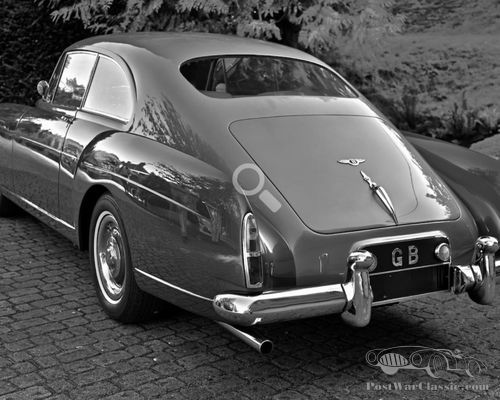
1957 Bentley S1 Fastback by H.J. Mulliner.
1957 Bentley S1 Fastback by H.J. Mulliner.A freshly restored award winning car in like new condition. A later car with Power assited steerin..
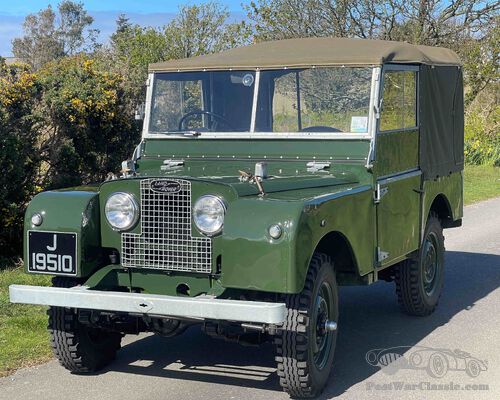
1952 Land Rover Series 1
Technical Specifications:Mark & Model: Land Rover Series 1Year: 1952Registration plate: Jersey registered
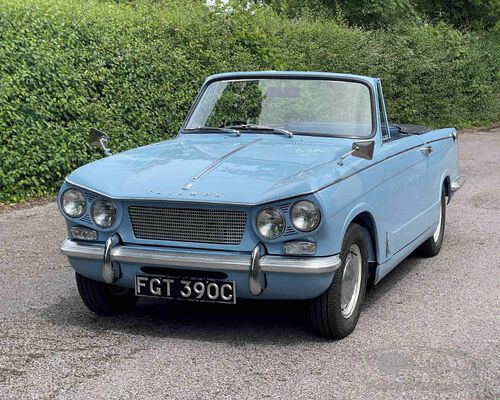
Triumph Vitesse 6 Convertible
Technical SpecificationsMark & Model: Triumph Vitesse 6 ConvertibleYear: 1965Registration plate: UK registered