The global magazine and marketplace for classic car enthusiasts, by enthusiasts.


Filter
Classic Subaru for sale - Subaru cars for sale
-

1965 Subaru-360 minicar. K111-series
No this is not a car designed by Picasso but it is a very rare Japanese version of the Mini or German Beetle. It has a 356cc 2-cylinder 2 stroke engine at the rear and a foldable canvas rooftop. It is in original condition with some parts bumpers and lights taken off and put inside. We worked on the engine but 34 years ago and it ran ni..

Subaru
Japan, 1958 to date
Fuji Heavy Industries Ltd, Tokyo
One of the companies formed from the disbanded Nakajima Aircraft Co, Fuji Heavy Industries built the Rabbit motor scooter. They introduced their rear-engined unitary-construction 360 minicar, the Subaru car, in 1958. The transversely-mounted air-cooled 2-stroke twin engine developed 16bhp, suspension of this little Subaru car was all-independent by torsion bars, and initially a 3-speed synchromesh gearbox was used, though by 1969 there were four forward speeds; the basic model Subaru car was still quoted as late as 1971. A light commercial version, the forward-control Sambar Subaru car, was also made as a station wagon. A full-sized Subaru car appeared in 1968, the front-engined 997cc front wheel drive FE. All-independent springing was retained on the Subaru car, but new features were pushrod ohv and water-cooling, as well as an electric fan and an electric fuel pump. The 4-speed gearbox had synchromesh on all the ratios of the Subaru car, the 67bhp sports version Subaru car had Ajebono front disc brakes. The FF Subaru car was the first Japanese car fitted with radial-ply tyres as standard. A 1.088cc unit was standardized on Subaru cars in 1970, and a 1.300cc 80bhp version became available in 1971.
In 1970 Subaru cars had updated their minicar, producing the roomier R2 Subaru car on a lengthened wheelbase with a 30bhp engine and synchromesh on bottom gear. Nearly 160.000 Subaru cars were made that year. The 1972 range Subaru cars included saloon and station wagon models of the R2, and a wide range of FF Subaru car derivatives extended from the basic 62bhp 1.1-litre 2-door saloon at 449.000 yen up to the Leone GSR, a semi-fastback 2+2 coupé Subaru car that cost 719.000 yen. This Subaru car had a twin-carburettor 1.361cc engine giving 93bhp, and was credited with 106mph. Curiously, drum brakes were standard on Subaru cars, though front disc were used on the intermediate 1.3-litre types.
Source: Georgano, encyclopedia of motorcar; MCS
The information is written with the greatest of care. However, if you have any suggested amendments please contact us at office@postwarclassic.com


Featured

Triumph Spitfire 1500
This stunning Triumph Spitfire 1500 is a Dutch-delivered example with only two previous owners. In its early years, the first owner carefully prepa..
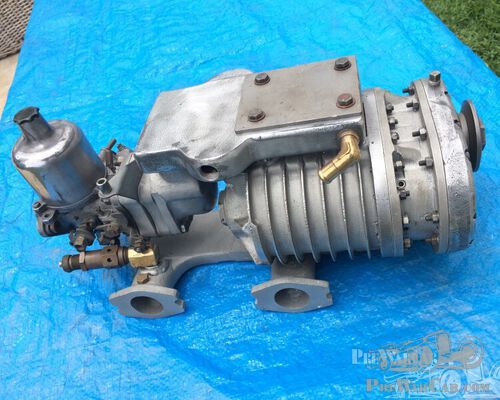
Blower / Compressor / Supercharger - Godfrey Marshall - A Series BMC Engine
SuperchargerA Godfrey Marshall cabin blower Type Mk22 converted to vehicle use by Barry Ekins of Sydney NSW. Ekins created kits for many popula..

Rolls-Royce
Rolls-Royce Silver Wraightlinks gestuurd, automatic, stuurbekrachtigingkleur antraciet grijs, lopende auto op Nederlands kenteken