The global magazine and marketplace for classic car enthusiasts, by enthusiasts.


Filter
Classic Tatra for sale - Tatra cars for sale
-

Coming soon -1961 Jaguar E Type Series 1 LHD Flat Floor outside bonnet lock
Coming soon - 1961 Jaguar E Type Series 1 LHD Flat Floor outside bonnet lock Registration Number: OAGP008 (Belgium) Chassis Number: 875340 Arriving soon from a prominent European collection. EEC Registered & EEC taxes paid Full de.. -
An icon: Morgan 3 Wheeler with Krazy Horse Specs from 2016
The Morgan 3 Wheeler has become a cornerstone in the Morgan’s Malvern enterprise's history. This three-wheeled cyclecars first produced in 1910, has become an icon since it was launched at the Geneva Motor Show in 2011. This vehicle has its own personality. An impressive fast car that balances between modern look and performance and old-f.. -
2017 Citroen DS3 Prestige Cabriolet 1.6 litre THP S/S Manual.
2017 Citroen DS3 Prestige Cabriolet 1.6 litre THP S/S Vin Number: VF7SB5GZMHW502159 Registration Number: WM66VJJ Manual 6 speed Gear box. A really nice example with the higher power high pressure turbo engine that was jointly designed with BMW & is renown.. -
Alvis TE 21 Park Ward Coupe
BARN Find , this verry rare Alvis TE 21 Park Ward Coupefrom 1965. Between 1963 and 1966 there have only been produced 352 these special Park Ward Coupe's. You can recognise the Park Ward Coupe on his headlights two above each other. The Alvis has a six cylinder engine of 3000 cc which produces 130 HP which could reach a top of 170 km an hour. Th.. -
1984 Lamborghini Countach 5000 S | The Quail Auction 2026
Chassis No. ZA9C00500ELA12736 The Lamborghini Miura, the world's first supercar, was a nearly insurmountable act to follow. Its successor needed to be a forward-thinking purpose-built sports car, oozing futuristic design cues and cutting-edge engineering. Under Lamborghini's orders, no holds were barred for the new "LP112" project, which wou.. -
1965 Porsche 911 | The Quail Auction 2026
Chassis No. 300718 Engine No. 900893 Transmission No. 223981 (See Text) Porsche 911 chassis number 300718 was completed the same day as its sibling-The Quail Auction 2026 Lot 296-and was likewise delivered new via Porsche Car Northwest. It was sold to Pacific Northwest drag-racing champion John Schmauder and remained in the regio.. -
1965 Porsche 911 | The Quail Auction 2026
Chassis No. 300717 Engine No. 901417 (See Text) Transmission No. 100790 Porsche unveiled the 901, famously later changed to "911" at the Frankfurt Motor Show in September 1963 with series production beginning just a year later. The car arrived as GT heir to the four-cylinder 356, in particular the sporting and powerful 4-cam mode.. -
1968 Alfa Romeo 1750 Spider Veloce | Global Icons: Zoute Online 2026
Chassis No. 1411156 Engine No. 03536 Please check back for more information shortly.


Tatra
CS, 1923 to date
(1) Tatra-Werke AG, Koprivnice, 1923 – 1935
(2) Ringhoffer-Tatra-Werke AG, Koprivnice, 1935 – 1941
(3) Tatra, np, Koprivnice, 1945 to date
At first the Tatra car was a continuation of the Nesselsdorf, producing the pre-war Types T and U Tatra cars, the latter a 6½-litre ohc 6-cylinder. The first real Tatra car of 1923 was completely different from the last Nesselsdorf models. After his return from Steyr, Hans Ledwinka produced a car which became one of the classics in the history of automobile design. This Tatra car was characterized by an air-cooled opposed-twin engine of 1.056cc developing 12bhp, a central tubular frame, and special rear swing axles and differential. It was known as the Type 11, and was the basis of later Tatra car models, commercial vehicles as well as private Tatra cars. Type 12 was identical with the Type 11, but this Tatra car had 4-wheel brakes. The Tatra car design was not intended for sporting events, but nevertheless two of these Tatra cars participated in the 1925 Targa Florio and gained 1st and 2nd place in the 1.100cc class, driven by Fritz Hückel and Kart Sponer. These were standard production Tatra cars, except that two inlet valves instead of one were fitted, and the front transverse-leaf springing was replaced by swinging half axles. Josef Vermirovsky was another competition driver on the small Tatra carmodel; his successes with Tatra cars included winning a 5.000 kilometre (3.107 miles) trial from Leningrad via Tiflis to Moscow in 1925. About 25.000 Tatra cars of Types 11 and 12 were built up to 1930. Some 4-cylinder Tatra cars followed, built on the same lines with air-cooled opposed engines, central tubular frames and swing axles: the Tatra 30 (1.680cc, 40bhp) and Tatra 52 (1.910cc, 40bhp). There were also the in-line 6-cylinder Type 70 Tatra car of 3.400cc and 60bhp, and the 6-litre V12 Type 80 Tatra car with 100bhp, both featuring the same frame construction and swing axles. The Type 80 Tatra car was built only in limited numbers, like the single-cylinder, 528cc 3-wheeler Tatra car (Type 49).
The next important development was the Tatra 57 which appeared in 1932. This Tatra car had the central tubular frame and swing-axles which were traditional by this time, and an air-cooled opposed 4-cylinder engine of 1.160cc developing 22bhp. Engine capacity of the Tatra car was later increased to 1.690cc, and this Tatra car was built until 1938. The German Röhr Junior was the Tatra 57 design built under licence. Under the name of Austro-Tatra the light Tatra cars were also manufactured in Vienna.
Ledwinka and Tatra were destined to make automobile history again with the Tatra Type 77 of 1934. The all-enveloping body of the Tatra car was built strictly to aerodynamic principles. A central box-type frame was used, and in its forked rear end – behind the rear axle – an air-cooled V8 engine of 3.400cc was placed. It developed 70bhp and gave the Tatra car a maximum speed of 95mph. The 1937 Tatra 87 incorporated the same technical principles and this Tatra car used a basically similar body. Engine capacity of the Tatra car was reduced to 2.960cc; output was 75bhp – a result of weight reduction. This Tatra car was capable of 100mph. In the same year the Tatra 97 was introduced with the same body, but an opposed 4-cylinder unit of 1.760cc and 40bhp was fitted. After the district of Koprivnice had come under German occupation, and the restriction of numbers of types which had been introduced in Germany in the 1930s was enforced in Czechoslovakia too, production of the Tatra 97 ceased and only the 87 Tatra car was continued until about 1941. In 1945, after the war, the Tatra car factory were nationalized by the Czechoslovak government, and production of Tatra cars was devoted to the front-engined Type 57B Tatra car and the rear-engined Tatra Type 87. These Tatra car were replaced in 1948 by a single model, the 2-litre rear-engined Tatraplan, derived from the pre-war Type 97 Tatra car. This Tatra car was made until 1954, after which there was a three-year period when no private Tatra cars were made. In 1957 the Tatra 603 was introduced; this Tatra car again had an air-cooled V8 engine of 2.472cc mounted in the rear. The Tatra car is still in production today as the T3-603, with twin-carburettor engine, servo-assisted disc brakes, and powere assisted steering, although Tatra concentrate on commercial vehicles and railway carriages. In preparation for 1973 was the 3.4-litre T613, a development of the existing theme.
Source: Georgano, encyclopedia of motorcar; HON
The information is written with the greatest of care. However, if you have any suggested amendments please contact us at office@postwarclassic.com


Featured
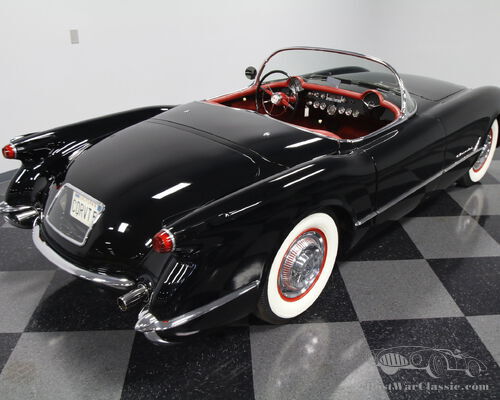
1954 Chevrolet Corvette C1
Fully restored 1954 C1 Corvette in Black. Stunningly beautiful car, feels like driving a sculptural work of Art. Known to be the oldest Corvette on t..
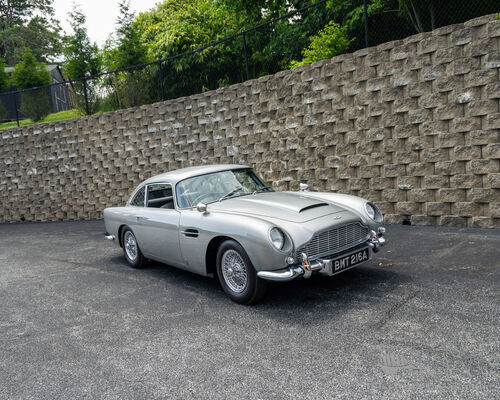
2020 Aston Martin DB5 Goldfinger Continuation | RM Sotheby's | The Monterey Auction
To Be OFFERED AT AUCTION at RM Sothebys' The Monterey Auction event, 13 - 15 August 2026. $1,000,000 - $1,500,000 USD One of 25 examples co..
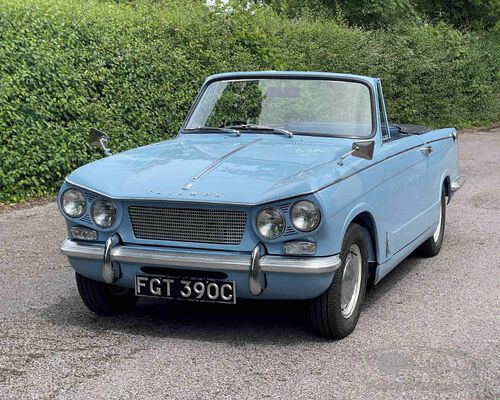
Triumph Vitesse 6 Convertible
Technical SpecificationsMark & Model: Triumph Vitesse 6 ConvertibleYear: 1965Registration plate: UK registered