The global magazine and marketplace for classic car enthusiasts, by enthusiasts.


Filter
Classic Toyota for sale - Toyota cars for sale
-

1993 Ferrari Conciso Concept by Michalak | RM Sotheby's | Sealed June
To Be OFFERED AT AUCTION at RM Sothebys' Sealed June event, Bidding Closes 24/25 June 2026. Estimate Available Upon Request A one-off, road legal, concept car built on a Ferrari 328 GTS drivetrain and chassisShown at the 1993 Frankfurt Motor Show and 1994 Geneva Motor ShowDriven by Jay Leno for Jay Leno’s Garage and rec.. -
1998 BMW 840CI E31 M62
Reg: R778CCX Vin: WBAEF820X0CC66950 Mileage: 98000 Vintage and Prestige is proud to offer one of German finest machines; this excellent example of BMW 840ci, presented in Artic Silver Metallic and black leather interior. The BMW 840ci E31 is incredibly stylish & a car with Car.. -
1955 PORSCHE 356 CONTINENTAL (pre A)
1955 PORSCHE 356 CONTINENTAL A true rare collectors item in as new fully restored 100 point condition. In 1955 North American European car importer Max Hoffman persuaded Porsche that cars with a name sold better in North America. He persuaded Porsche to give their 356 model a name, Continental was settled up.. -
1998 Aston Martin V8 Volante LWB Left Hand Drive.
1998 Aston Martin V8 Volante LWB Left Hand Drive. Chassis number: SCFDAM209WBL89023 Registration number: S17VOL A beautiful rare car with less then 8000 miles from new. The current owner acquired this car from the first owner, a good friend from germany who purchased the car brand new in Monaco & use.. -
1963 Porsche 356 B T6 Coupe 1600S
1963 Porsche 356 B T6 Coupe 1600S Registration Number: IG5453 A quite unique opportunity to acquire one, if not the finest example of the iconic 356 in existence today. This car has just completed (March 2021) an extensive and detailed complete restoration to its original factory specificatio.. -
1965 Sunbeam Tiger Mk I | RM Sotheby's | The Woodcote Park Auction
To Be OFFERED AT AUCTION WITHOUT RESERVE at RM Sothebys' The Woodcote Park Auction event, 8 July 2026. Offered Without Reserve | £50,000 - £70,000 GBP Please check back soon as our dedicated cataloguing team is preparing the description for this lot. To view this car and others currently consigned to this auction, please visit the RM website at.. -
1964 Fiat 500 D Transformabile | RM Sotheby's | The Woodcote Park Auction
To Be OFFERED AT AUCTION WITHOUT RESERVE at RM Sothebys' The Woodcote Park Auction event, 8 July 2026. Offered Without Reserve | £18,000 - £24,000 GBP Desirable Transformabile example with extended open roof and rear-hinged “suicide doors”Imported from Italy in 2016 after its long-term owner near Salerno kept the Fiat for almost.. -
1956 Bentley S1 Continental Park Ward Coupe
1956 Bentley S1 Continental Park Ward Coupe Chassis number: BC57BG Registration Number: OFF505 Simply the best of the best; This car is in simply impeccable condition & comes to us from decade long term ownership in a private collection. The wor..


Toyota
Japan, 1936 to date
(1) Toyota Automatic Loom Works, Kariya City, 1936
(2) Toyota Motor Co, Toyota City, 1937 to date
The Toyota Works, a flourishing textile concern, began experimenting with cars and in 1935 completed the A1 prototype, still named Toyoda. In the first years of manufacture, Toyota cars concentrated on the AA and AB models Toyota cars, a 4-door sedan and a tourer respectively, based on the A1. These Toyota cars were powered by 6-cylinder, in-line, ohv engines of 65hp at 3.000rpm, and the Toyota cars had bodies reminiscent of the Chrysler Airflow.
In 1938 the design of the Toyota car was revised as the model AC, and this was joined by the newly styled 2.258cc AE series Toyota car in 1939.
During World War 2 a number of experimental types Toyota cars were constructed, including the BA sedan Toyota car with a 4-cylinder 48bhp engine and the larger B Toyota car with a 6-cylinder engine of 85bhp and a seven-seater body. When the war was over the SA model Toyota car was marketed and was the first of the Toyota car firm’s products to use the Toyopet trade mark. In more recent years its use has been limited to machines for the home market, with the Toyota name replacing it on exports.
The Model SA Toyota car was a neatly styled 2-door sedan with 27bhp, a backbone chassis and independent coil-spring front suspension; a total of 215 Toyota cars were built from October 1947 to May 1952. The Toyota car firm expanded rapidly, adding many models of Toyota cars, trucks and buses to its range. Production boomed from 700 Toyota cars a month in 1955, and 11.750 in 1958, to 50.000 Toyota cars by 1964. By 1955 the 1.453cc ohv 4-cylinder Toyota Crown was available, with 3-speed synchromesh gearbox, column change, hydraulic brakes, and hypoid final drive. A 1-litre Toyota car, first of the Toyota Coronas, followed in 1958.
In 1961 the 700 series Toyota car was introduced and in 1964 the Toyota Corona and Toyota Crown private cars were redesigned for an increased export trade. In 1967 theToyota Publica 700 was the smallest of the Toyota cars, using a 2-cylinder air-cooled engine. The conventional 1.100cc 60bhp Toyota Corolla sold in England for £700 and the handsome and well-equipped Corona Toyota car line was powered by 1½-litre 74bhp and 1.6-litre 95bhp engines. The Crown models Toyota cars had 6- and 8-cylinder units. The Toyota Crown Eight was the largest Toyota car built for 1967 and contained a 115bhp V8 engine, and Toyoglide automatic transmission. There were also two sports Toyota cars with twin-ohc engines, a four and a six, and the big Toyota Land Cruiser, a 4-wheel-drive Toyota car using Toyota’s 3.9-litre push-rod 6-cylinder Truck engine.
Like Nissan, Toyota cars explored Group 7 racing, as well as building up an empire. Hino were absorbed in 1966, their private Toyota cars being discontinued shortly afterwards. Daihatsu followed in 1968, which was Toyota car companys first million year. Meanwhile the Crown series Toyota car had been re-engineered with perimeter frames, and emerged with the formidable choice of two 2-litre engines (a pushrod four or an ohc six), and four transmissions, 3- or 4-speed manual and 2- or 3-speed automatic. The Crown 8 Toyota car, never a great success, gave way to the unitary-construction Toyota Century 8 with 3-litre all-aluminium engine developing 150bhp, and such options as power-assisted steering and air suspension. With an overall length of 16ft 2in, the Toyota car was one of Japan’s largest private cars. The Publica, Corolla and Corona series Toyota cars were continued into 1969. New during 1970 were the Toyota Carina and Toyota Celica. The former Toyota car was a conventional pushrod four sold in 1.4-litre and 1.6-litre forms, with live axle and coil rear suspension, bridging the gap between the Corolla and the Corona. The later Toyota car represented serious international competition for cars like the Fiat 124 Sport and the MGB-GT. The Toyota car had a 1.588cc dohc 4-cylinder engine developing 115bhp, front disc brakes and a 5-speed all-synchromesh gearbox.
Toyota cars 1972 line-up was complex and comprehensive. Rear suspension of the Toyota cars alternated between orthodox semi-elliptics (Publica, Corona) and live axles with coils. Front disc brakes were standard on the Toyota Corona and the Toyota Celica, and offer on the more expensive variants of other series. The smallest Toyota car was still the 790cc air-cooled flat-twin Publica on a 7ft 1in wheelbase; this Toyota car was also available with 1-litre and 1.2-litre in-line water-cooled fours. Toyota Corollas had 7ft 10in wheelbases, and these Toyota cars came with pushrod engines of 1.2-, 1.4- or 1.6-litres: a 5-speed gearbox was used on the high-performance SR coupé. The Corolla’s two larger engine options were common to the Carina, though the 1600GT Toyota car ran to two carburetors and hohc. Most Toyota Corona cars used 1.707cc or 1.858cc single-cam engines and 4-speed gearboxes, though extremes of the range were a 3-speed 1½-litre for the home market, and the 5-speed twin-cam 2-litre GSS with 140bhp. The Toyota Celica remained a dohc 1600, the Toyota Crown was now available only with 6-cylinder engines (in 2-litre, 2.3-litre, or 2.6-litre sizes), and the Toyota Century’s output was increased ot 170bhp. The 4x4 LandCruiser Toyota cars were continued, these Toyota cars being made under licence in Brazil with Mercedes-Benz disel engines. Toyota cars were also being manufactured or assembled in twelve other countries.
Source: Georgano, encyclopedia of motorcar; BE
The information is written with the greatest of care. However, if you have any suggested amendments please contact us at office@postwarclassic.com


Featured

One of one 1955 Mercedes-Benz 300 B with Durham coachwork and floor shift manual transmission
One owner from new, this 1955 Mercedes Benz 300 B sedan carries custom coachwork by Durham and is equipped with its original factory four speed flo..
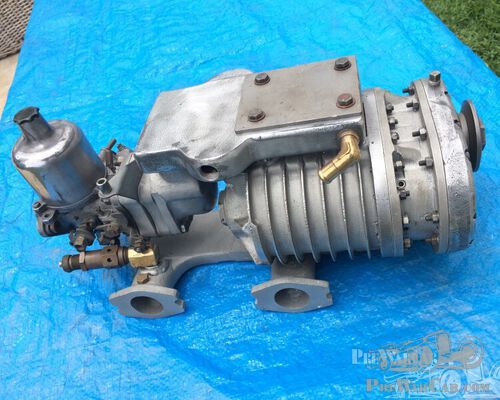
Blower / Compressor / Supercharger - Godfrey Marshall - A Series BMC Engine
SuperchargerA Godfrey Marshall cabin blower Type Mk22 converted to vehicle use by Barry Ekins of Sydney NSW. Ekins created kits for many popula..

Rolls-Royce
Rolls-Royce Silver Wraightlinks gestuurd, automatic, stuurbekrachtigingkleur antraciet grijs, lopende auto op Nederlands kenteken