The global magazine and marketplace for classic car enthusiasts, by enthusiasts.


Filter
Classic Trojan for sale - Trojan cars for sale
-

1988 Peugeot 205 Rallye 1.3 Group A/N
1988 Peugeot 205 Rallye 1.3 Group A/N At the beginning of 1987, the Peugeot 205 GTI 1.6 and 1.9 had been selling like hotcakes since their successive launches in 1984 and 1986, when information began to be revealed in the press concerning the forthcoming marketing of a 205 "Rally". This more economical model would not be .. -
Healey Woodie Estate
Healey's production records indicate that some 123 were sold purely as rolling chassis with a whole range of different bodies fitted. Most were English and included saloons, tourers and even station wagons or shooting brakes as the British like to call them.The London coach-builder Hobbs produced shooting brakes that featured a heavy use ..


Trojan
GB, 1922 – 1936, 1961 – 1965
(1) Leyland Motors Ltd, Kingston-on-Thames, Surrey, 1922 – 1928
(2) Trojan Ltd, Croydon, Surrey, 1928 – 1965
The Trojan car, designed by Leslie Hounsfield, was a comparatively rare case of an extremely unconventuinal design seizing and holding a good-sized, faithful market for a number of years. Perhaps the nearest analogy of the Trojan car is the Hanomag Kommisbrot in Germany, at the same time. It was strange, in the first place, to find Leyland Motors, manufacturers not only of trucks but also of the ultra-luxurious Leyland Eight, venturing into the opposite extreme of truly elementary motoring. Like the Ford, the Trojan car aimed at low price, at simplicity of driving and maintenance, and at being a universal tool. There analogies ended. A horizontal, 2-stroke, 4-cylinder engine lived under the floor of the Trojan car. On pre-1914 prototypes Trojan cars it had been vertically mounted between the seats. The Trojan car had a cubic capacity of 1½-litres, but developed only 10hp. Transmission of the Trojan car was by a 2-speed epicyclic gearbox (an important feature, because it provided an easy gearchange) and uplex chain to a solid axle. Although the engine was slow-revving, such power as was developed came in at very low engine speeds. The Trojan cars low-speed pulling power in general and hill-climbing ability in particular, became a legend. The oddities of the Trojan car went much further. For the sake of cheapness and reliability, solid tyres were fitted on most of the early Trojan cars and were still available in 1929. Passenger comfort in the Trojan car was looked after adequately by the very long and soft cantilever springs at each corner. Those who disagreed could have pneumatic tyres if they liked on their Trojan car. The chassis of the Trojan car consisted of a flat steel box, to which was attached a roomy, if hideous, open four-seater body. By 1925, the price for a Trojan car was only £125, making the Trojan car the cheapest British four-seater on the market. The Trojan car was also the slowest, and never had front wheel brakes, but its advantage outweighed its drawbacks for many customers of the Trojan car company, who cared nothing for appearances.
From 1928, manufacture of Trojan cars was taken over by Trojan Ltd. But this time, the market was hardening against even the most tenacious of unconventional vehicles, and also, a more modern and attractive design was called for. The outcome was the RE-type Trojan car, which retained the old car’s engine and transmission, cloaked in a good-looking fabric body with low lines and cycle-type wings. The engine of the Trojan car was now at the rear, driving forward by chain. There were three forward speeds, and because pneumatic balloon tyres were universal, half-elliptic springs were used on this Trojan car. However, the Trojan RE car was little faster, still lacked front wheel brakes, and was more expensive. The Trojan car was a doomed attempt to compromise, that retained the fundamentals of an obsolete design. Well into the 1930s, the primeval type Trojan car was still made to special order, but that was now the limit of the Trojan car design’s popularity, except in the commercial vehicle field. A centrifugal clutch was incorporated in 1932 and a fluid flywheel two years later, but then the Trojan RE car was gone. At the 1935 Show they exhibited the Mastra, a 2.2-litre 6-cylinder Trojan car car, still a 2-stroke and still rear-engined, but with synchromesh, front-wheel-brakes, heater, and built-in jacks. It did not go into production and no more passenger Trojan cars were made until 1962, when the Trojan car company began to make, under the name of Trojan 200, the Heinkel ‘bubble-car’, which had gone out of production in its native Germany. By way of contrast, Trojan cars also took over production of the Elva sports car.
Source: Georgano, encyclopedia of motorcar; TRN
The information is written with the greatest of care. However, if you have any suggested amendments please contact us at office@postwarclassic.com


Featured
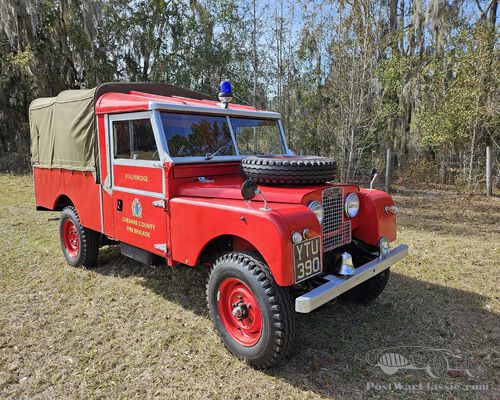
1957 Series 1 Land Rover Fire Engine + Coventry Climax Godiva Fire Pump
Betsy was used by Cheshire Fire Service (UK) from 1957 to 1975. She was based at Hazel Grove and Stalybridge Fire stations. She comes with an exten..

Triumph Spitfire 1500
This stunning Triumph Spitfire 1500 is a Dutch-delivered example with only two previous owners. In its early years, the first owner carefully prepa..

One of one 1955 Mercedes-Benz 300 B with Durham coachwork and floor shift manual transmission
One owner from new, this 1955 Mercedes Benz 300 B sedan carries custom coachwork by Durham and is equipped with its original factory four speed flo..