The global magazine and marketplace for classic car enthusiasts, by enthusiasts.


Filter
Classic Willys for sale - Willys cars for sale
-

1993 Porsche 911 Carrera RSR 3.8 'Strassenversion' | RM Sotheby's | The Woodcote Park Auction
To Be OFFERED AT AUCTION at RM Sothebys' The Woodcote Park Auction event, 8 July 2026. £1,850,000 - £2,200,000 GBP One of only two ‘Strassenversion’ examples built by Porsche Motorsport with a fully trimmed interior; among the most bespoke Porsche Exclusive commissions ever madeCompletely original with delivery use only; odomete.. -
1960 Chevrolet Corvette LM | RM Sotheby's | The Monterey Auction
To Be OFFERED AT AUCTION at RM Sothebys' The Monterey Auction event, 13 - 15 August 2026. $2,000,000 - $2,500,000 USD Proudly offered from the Cunningham family One of three Corvettes entered in the 1960 24 Hours of Le Mans, the Corvette model’s debut at the world’s most legendary raceDriven by Briggs Cunningham and Bil.. -
1960 Buick Electra 225 Convertible "Harlow Curtice" | RM Sotheby's | The Hershey Auction
To Be OFFERED AT AUCTION at RM Sothebys' The Hershey Auction event, 7 - 8 October 2026. $200,000 - $250,000 USD Please check back soon as our dedicated cataloguing team is preparing the description for this lot. To view this car and others currently consigned to this auction, please visit the RM website at rmsothebys.com/auctions/hf26/. -
Citroen DS ID 19 B, Motor überholt, top gepflegt!
Wunderschöner und top gepflegter Citroen ID 19 B aus den 1960er Jahren! Zum Wagen gibt es noch die alten französischen Fahrzeugpapiere "certificat d'immatriculation". 2000 kam der Wagen von Frankreich in die Niederlande. Dort war er immer in Liebhaberhand und wurde stets gehegt und gepflegt. Es wurde viel investiert. Es gibt einen Ordner mit Rec.. -
2005 Porsche Carrera GT | RM Sotheby's | Sealed June
To Be OFFERED AT AUCTION WITHOUT RESERVE at RM Sothebys' Sealed June event, Bidding Closes 24/25 June 2026. Offered Without Reserve | €2,250,000 - €2,750,000 EUR One of just 80 Carrera GTs finished in Guards Red, the rarest standard factory colourC00 German delivery exampleJust four German owners from new and 20,408 km .. -
1995 Mercedes-Benz SL Brabus 7.3S V12 | RM Sotheby's | The Tegernsee Auction
To Be OFFERED AT AUCTION at RM Sothebys' The Tegernsee Auction event, 4 July 2026. €200,000 - €250,000 EUR The “Beast from Bottrop”, the ultimate SL—top speed of 304 km/h; one of very few produced between 1995 and 2001Finished in desirable “quad black” colour combination of Pearl Black over Anthracite leather with black soft-top.. -
1949 Alfa Romeo 6C 2500 Super Sport Cabriolet by Pinin Farina | RM Sotheby's | The Woodcote Park Auction
To Be OFFERED AT AUCTION at RM Sothebys' The Woodcote Park Auction event, 8 July 2026. £180,000 - £220,000 GBP Please check back soon as our dedicated cataloguing team is preparing the description for this lot. To view this car and others currently consigned to this auction, please visit the RM website at rmsothebys.com/auctions/wp26/... -
1971 Mini Cooper S
1971 Mini Cooper S Registration Number: EIA2317 The car sits on genuine Minilite wheels. The car has been kept as part of a private collection of mostly high end cars in a controlled environment where it shares garage space with none other then John Coopers personal Mini Cooper S with just 1000.. -
1990 Mercedes-Benz 190 E 2.5-16 Evolution II | RM Sotheby's | The Tegernsee Auction
To Be OFFERED AT AUCTION at RM Sothebys' The Tegernsee Auction event, 4 July 2026. €250,000 - €280,000 EUR The roadgoing version of AMG-Mercedes’ two-time championship-winning touring car; among the most sought-after homologation specialsDelivered new to Berlin; the 72nd of approximately 500 examples producedJust three ..


Willys
US, 1903 – 1963
(1) Standard Wheel Co, Terre Haute, Indiana, 1903 – 1905
(2) Overland Co, Indianapolis, Indiana, 1905 – 1907
(3) Willys-Overland Co, Toledo, Ohio, 1908 – 1963
The makes Willys, Overland and Willys-Knight are inseparable, if only ecause of their confusing nomenclature. The original product of the Standard Wheel Co was a tiller-steered single-cylinder runabout with solid tyres which differed from most of its contemporaries in having its engine mounted in front under a real bonnet. It sold for $595. This had grown up by 1905 into a wheel-steered 1.3-litre twin, still with planetary transmission, and the company changed its style and moved to Indianapolis. Financial difficulties In 1907 brought John North Willys, and Elmira, N.Y. automobile dealer into the picture, and under his ownership a $1.250 4-cylinder Willys car model was produced, this Willys car having a pedal-controlled planetary transmission in the Ford manner, separately-cast cylinders, and a transaxle. There were two sixes Willys cars in 1909, an Overland at $2.000, and the 45hp Willys car costing $250 more. Both the Willys car name and multi-cylinder engines disappeared in 1910, and production of 4-cylinder Willys cars was concentrated in the old Pope factory at Toledo. During these years the Willys car company continued to distribute the Marion, for which he had held an agency in the Elmira days. High-tension magneto ignition was used on the 1912 Overland cars, which included a 3.2-litre 2-speed Model 58 at $850, a 3-speed version (Model 59) with conventional gearbox at $900, and two bigger 4s at $1.200 and $1.500 respectively. By 1914 Overland had moved into the ranks of the best-sellers with the 79 series at $950, a 4-litre car which helped to sell 80.000 that year. New also was the Willys-Knight with Knight double sleeve-valve 4-cylinder engine: this ws in fact the former Edwards-Knight, which concern Willys had acquired, and early production was undertaken for Willys-Overland by Garford of Elyria, hitherto associated with the manufacture of cars for sale by Studebaker. 1915 saw a sv Overland 6 at $1.145, with the group moving up into second place behind Ford in the sales race. Willys-Knight, still a young make, was placed eighteenth: and in 1916 a second Willys 6, with 5-litre engine, joined the range, to remain there for three seasons. Willys-Knight had a V8 on a 10ft 5in wheelbase for $1.950 in 1917, but in 1919 4s only were being made, the chassis L-head Overland having made its appearance at the low price of $495. The 4-cylinder Willys-Knight had 3.3-litre engines and sold around the $1.400 mark.
During World War 2, Willys-Overland, along with Ford, were responsible for series production of the famous 4x4 Bantam inspired ‘Jeep’, and WIllys continued its manufacture to civilian account after the War, licences being sold to Hotchkiss in France and Mitsubishi in Japan among others. Station wagon and sports 4-seater versions with 2-wheel drive and 6-cylinder engines were added to the range. It was not until 1952, however, that he company again offered orthodox private cars, these being fairly small vehicles with either the well-established 4- or a 2.6-litre ioe 6, unitary construction, and coil-and-wishbone independent front suspension, selling in the region of $1.750. An sv 6 was available in 1953, when 4-door sedans were offered alongside the 2-door type. 1953 also saw the purchase of the company by Kaiser, and the ‘Aero’ line was dropped in 1956, though development and production have continued in the Willys-Overland do Brasil factory at Sao Paulo. Activities at Toledo have centred round the ‘Jeep’ family. The firm’s name was changed to Kaiser-Jeep Corporation in 1963.
Source: Georgano, encyclopedia of motorcar; MCS
The information is written with the greatest of care. However, if you have any suggested amendments please contact us at office@postwarclassic.com


Featured
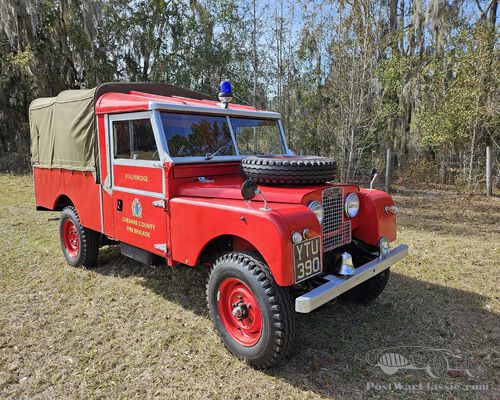
1957 Series 1 Land Rover Fire Engine + Coventry Climax Godiva Fire Pump
Betsy was used by Cheshire Fire Service (UK) from 1957 to 1975. She was based at Hazel Grove and Stalybridge Fire stations. She comes with an exten..

One of one 1955 Mercedes-Benz 300 B with Durham coachwork and floor shift manual transmission
One owner from new, this 1955 Mercedes Benz 300 B sedan carries custom coachwork by Durham and is equipped with its original factory four speed flo..

Rolls-Royce
Rolls-Royce Silver Wraightlinks gestuurd, automatic, stuurbekrachtigingkleur antraciet grijs, lopende auto op Nederlands kenteken