The global magazine and marketplace for classic car enthusiasts, by enthusiasts.


Filter
Make a choice:
- Cars
-
Make >>
-
Year >>
-
- Bikes
-
Make >>
-
Year >>
-
-
Location >>
- Parts & more
-
Make of car >>
-
Manufacturer >>
-
Category >>
-
Countries


Dream of the future or nightmare on wheels?

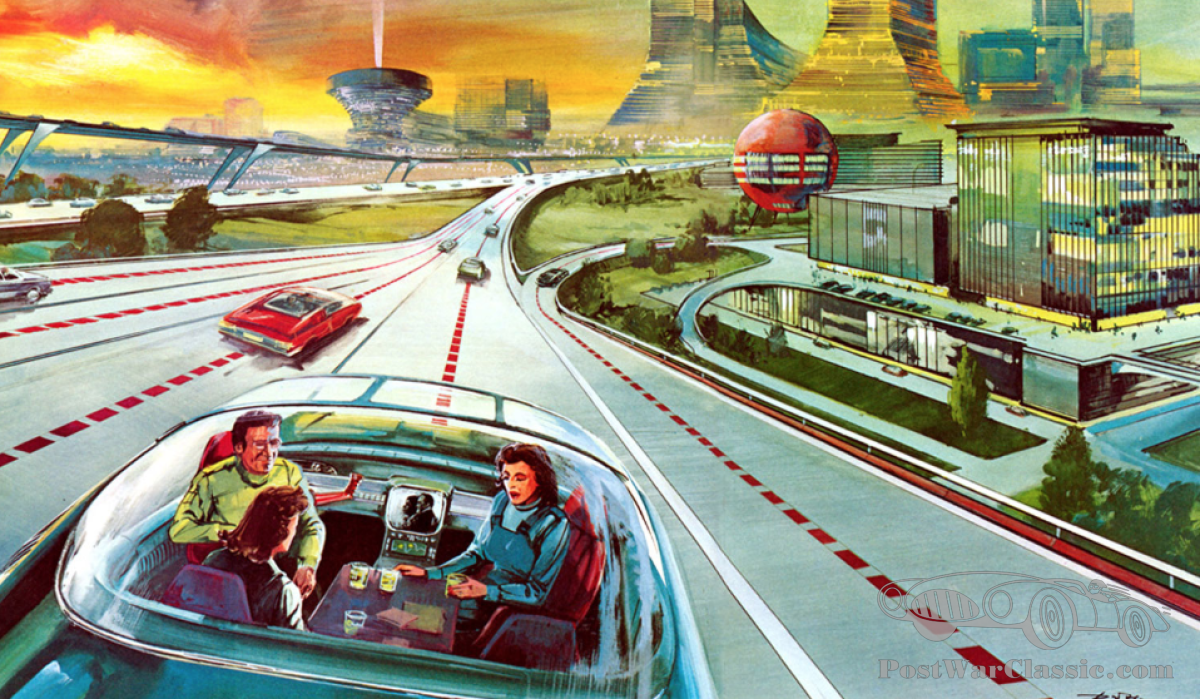


Take a look at this photo from our archives: it’s from a 1972 advertisement by oil giant Esso, boldly promoting a futuristic idea. The headline reads:
“Just imagine… falling asleep on the motorway.”
The copy continues: “A future dream vehicle, to drive off to your holiday destination in one long stretch.” Back then, this seemed like a distant fantasy—an idealistic vision of what motoring might someday become. And for decades, it remained just that: a dream. But now that technology is catching up, the reality is starting to look less utopian and more controversial.
We’d just finished reading an article on autonomous cars. You’ve probably heard that self-driving vehicles are giving governments and tech companies serious headaches. The promise of letting the car take over while you relax or sleep is no longer sci-fi—it’s here, and it’s risky.
In Arizona, Uber suspended all autonomous vehicle testing after one of its self-driving cars was involved in a fatal crash. Around the same time, Tesla confirmed that a driver was killed in an accident while the car was operating under its Autopilot system.
This raises an urgent question: Should autonomous vehicles be heavily regulated and strictly monitored until we can guarantee they’re 100% safe?
Not everyone thinks so.
One commentator argues that this line of thinking is flawed. He writes:
“It’s not a good thing that self-driving cars have killed people, but testing them in real-world situations is a necessary step if we want to move toward a safer, brighter future. Unless we want to jeopardize that future, we need to get over our fears. Self-driving cars are going to kill people. Period.”
And he concludes bluntly: “Get over it.”
So—what do you think?
Is this a brave, realistic look at progress, or an irresponsible dismissal of human life and accountability?
We’d love to hear your thoughts.
Published:
Thursday June 26th, 2025
Facebook
LinkedIn
Twitter
WhatsApp
Email
Copy
Comments
Peter Maguire
29 June 2025, 16:26
Not by me, but I have always remembered it.
Self-driving (?) cars raise a simple question..'WHY'..!
If you want to move people around then why do it in an extremely inefficient way from the point of view of.................
Enviromental pollution ( regardless of it being an electric car, you have to make it and current battery technology is extremely polluting).
Inefficiency.
Cost (Unit/person per road mile. Then wear - road/tyres/vehicle/etc).
Space considerations (Coach = 3 cars but around 15 times as many people-see above!!)
AND so on...( How about Trams ,railways, walking (if under a mile))...!!
BUT , mainly, unless they use human logic which is, in machine sense often illogical, they will not fit in. So, unless every vehicle on the road is 'self-driving', expect a lot of problems/accidents.**
In my estimation good driving is based on a lot of things that you cannot factor in to a manual on 'driving' and logic is not necessarily part of all of it.
I am always happy to be corrected (not).
By the way, so far AI is not to be confused with human intellegence, which it is not.
As far as I am aware we do not yet totally understand how memory works, nor intuition, or creativity, or dreams and so it goes on. Again, as I understand it, AI is just 'number crunching' by a different name, in so far as it is based on assimilating an enormous amount of information and choosing the optimum result. Basing that on personal preference does not constitute intellegence, though it could be one attribute .
I could say a lot more (nashes teeth!).
Anyway climate change will probably sort us out first ( where I live tomorrow will be over 40C, somewhat unusual until the last few years).
** This once did not apply after closing time. (English joke, not applicable in the EU).