The global magazine and marketplace for classic car enthusiasts, by enthusiasts.


Filter
Make a choice:
- Cars
-
Make >>
-
Year >>
-
- Bikes
-
Make >>
-
Year >>
-
-
Location >>
- Parts & more
-
Make of car >>
-
Manufacturer >>
-
Category >>
-
Countries


Jaguar’s C-Type; simply a diet 120?
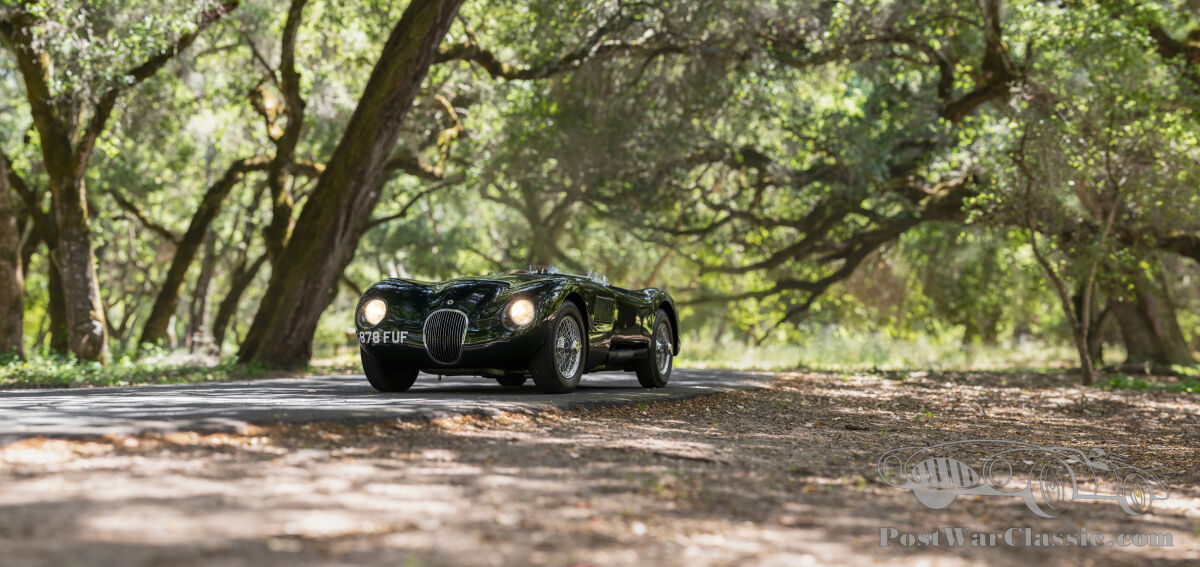


Sometimes the machines of yesterday retain perennial beauty: a design language that defines the recognisable styles of esteemed marques. Yet none has matched the enrapturing qualities of Jaguar’s C-Type.
Famed as the Coventry-based firm’s Le Mans champion, the C-Type represents the pinnacle of Jaguar’s post-war achievements. The success of the XK120 demonstrated the refined 3.4-litre overhead camshaft engine, designed by chief engineer William “Bill” Heynes. Jaguar’s six-cylinder propelled the 120 into prominence, the fastest production car in the world at its launch in 1948. Enthralling press and public alike with its elegant lines and aerodynamic futurism, the XK marked a new era of British automotive design. Far removed from its pre-war predecessors, Jaguar hauled the language of the sports car into the streamlined age. The resounding success of the road-going XK convinced general manager William Lyons to form a racing department. By June 1951, this newly created specialist team was tasked with producing the firm’s first purpose-built racing car.
On the surface, the C-Type could be regarded as the XK without the frills – the “diet 120”, stripped of comforts and given a new body atop an already proven engine. Yet Jaguar’s slimmed-down racer was entirely reconceived. In place of the road-equipped chassis, the standard mechanical running gear was seamlessly integrated with a specifically designed lightweight tubular frame. Gone was the typical coachbuilt bodywork; in its place stood a curved and streamlined shell, shaped for aerodynamic efficiency by coachbuilder Abbey Panels. Heynes’ reimagined racer not only underpinned the C-Type’s triumph at Le Mans but also laid the foundation for Jaguar’s future design ethos.
The elliptical radiator grille and smooth flow of the wheel arches show the C’s close connection to its road-going counterpart. Yet its curvaceous profile, faired-in headlights and sloping side louvres reveal clear departures from its older siblings. As Jaguar’s first foray into world-class motor racing, these changes were introduced to withstand the gruelling 24 Hours of Le Mans. The dynamic design modifications formed Heynes’ primary blueprint for Jaguar’s lineage of everlasting classics, from the tantalising tapers of the renowned E-Type to the C’s undulating successor, the finned D-Type. Jaguar’s C-Type is certainly no 120 in disguise.
Words by Alexander Simmons-Miller
Photo by RM Sotheby's
Published:
Thursday October 2nd, 2025
Facebook
LinkedIn
Twitter
WhatsApp
Email
Copy
Comments
Christopher Jenkins
05 October 2025, 12:07
Nothing about Malcolm Sayer, how strange
Read more