The global magazine and marketplace for classic car enthusiasts, by enthusiasts.


Filter
Make a choice:
- Cars
-
Make >>
-
Year >>
-
- Bikes
-
Make >>
-
Year >>
-
-
Location >>
- Parts & more
-
Make of car >>
-
Manufacturer >>
-
Category >>
-
Countries


Peking to Paris 2025 Reaches Kazakhstan






Press release
- Day 14 of 37 – Crews Leave China and Cross into Kazakhstan
- Perez Companc crew from Argentina regain overall lead
- Cars and crews battered in the Gobi Desert, but spirits remain high
The 2025 Peking to Paris Motor Challenge has truly tested endurance as teams from 15 countries navigated the demanding conditions of the Gobi Desert. With high winds, freezing temperatures, and deceptive desert tracks, drivers and navigators were pushed to their limits. The treacherous terrain of gullies, rocks, and sand wasn’t just a route to Paris—where crews are expected on June 22nd—but also the battleground for Sporting Time Controls, Regularities, and Tests. Success depends on survival, pace, and the ability to play the long game.
So far, the Argentine team of Jorge and Christobal Perez Companc, in their 1939 Chevrolet Master Coupe, have shown themselves to be the wily foxes of the desert. Although they briefly lost the overall lead, they regained it after Britons Brian Scowcroft and Mark Gilmour, driving a Chevrolet Fangio Roadster, missed a difficult turn during a competition section. Just 40 seconds now separate the rival crews.
In the Classic Class, French navigator Corinne Vigreux has been performing exceptionally well, guiding Dutch driver Harold Goddijn through the punishing terrain in their Porsche 911. They currently lead the Australian crew of John Henderson and Lui MacLennan in their Volvo 144 by 52 seconds. Germans Gerd Bühler and Laurenz Feierabend, also in a Porsche 911, have moved into third place, displacing Brits Brian Palmer and David Bell, whose striking Peugeot 504 Coupe now sits fourth in class.
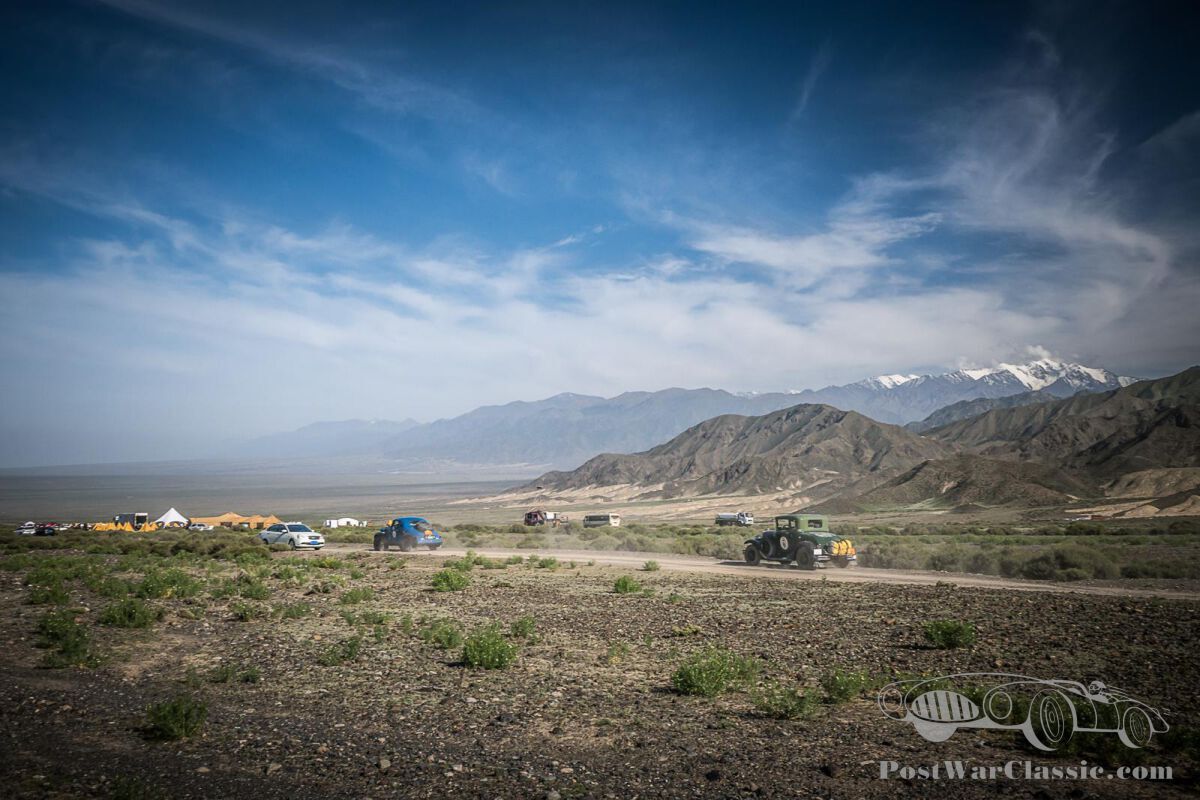
Despite the hardships, crews have been treated to stunning and rarely-seen landscapes across China. They've traversed the historic Great Sea Road, part of the ancient Silk Road used since the Han Dynasty, leading into GSR National Park. The following day saw them cross the park and head out into a desolate, Mars-like desert of eroded rocks and vast canyons.
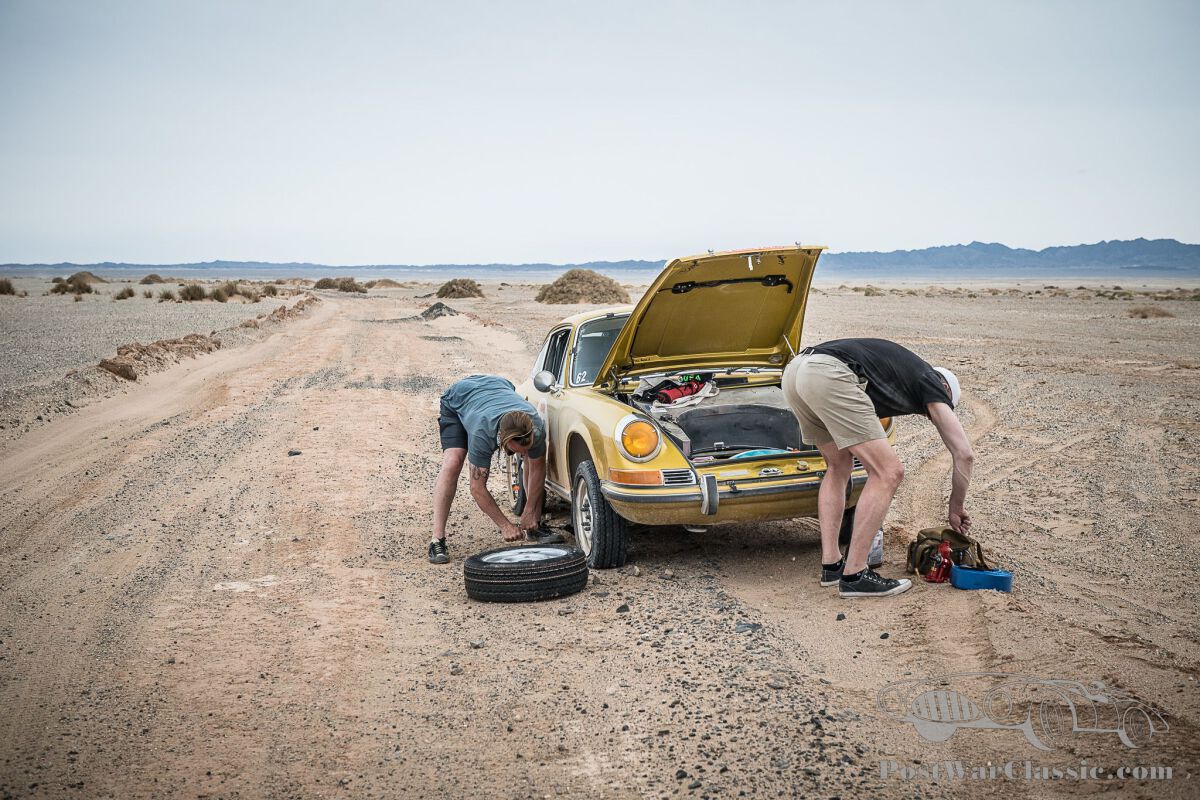
Conditions worsened with 50 mph winds, severely battering cars and crews. Open-top vintage vehicles suffered most, enduring relentless sandblasting. Their destination was Ürümqi, the most remote city in the world, offering much-needed refuge. Some crews arrived in the early morning hours, others by flatbed truck.
The next day, spirits lifted as they drove toward the Tianshan Mountains in Xinjiang Province and camped with a view of the Himalayas—a welcome sight of greenery after endless desert. For many, it was a moment of calm amidst the chaos.
Day 11 was particularly brutal. Attrition hit both cars and crews hard. Car 1, the 1917 LaFrance of Alan and Leigh Maden (AU), was already on a flatbed. So was Car 9, the 1931 Ford A Coupe of Carlos Reider and Stefan Roth (CH). Car 77, the Datsun 260Z of Mike and James Cattermole (AU), suffered from fuel starvation. Car 50, the Volvo PV544 of Nicholas and Max Merlino (CH), had a broken wishbone and previously shredded tyres, causing them to fall down the order.
Solo driver Tomas de Vargas Machuca encountered a clutch failure and further ignition issues in his 1925 Bentley, eventually requiring a five-hour wait for recovery. Fellow Bentley driver Jonathan Turner and navigator Nick English also broke down. The two Bentleys later met on the back of flatbeds at the only service station for hundreds of miles—deep in the Chinese night. Before that, Turner had been hosted by the local police, relaxing in their luxury van before they were called away on an emergency, leaving him to explore... and quickly leave after discovering the detainee seats!
Tomas, Jonathan, and Nick eventually traveled together and arrived in Ürümqi in the early hours, managing only two hours of sleep before beginning major repairs.
Mechanical failures continued:
- Car 32 (1951 Bentley B Racer Special), driven by Peter Pollett and Alexander De Groot (BE), had front suspension issues.
- Car 55 (Peugeot 504 V6 Coupe), crewed by Christophe Bouchut (FR) and Alfonso de Orleans-Bourbon (ES), broke down exiting the National Park.
- Car 19, the Chevrolet Master Coupe of Brian and John Caudwell (GB), limped across the desert with gearbox issues.
- Car 22 (1939 Ford Model A) of Marc Schätzle and Sandro Tanner (CH), suffered a split radiator.
The day tested human resilience as well. Car 31, the 1948 Bentley Bobtail of Mark Vervisch and Bernard Vanderplaetsen (BE), became stranded on a rocky mound. Media cameraman Gary Williams filmed—and then helped dig them out. Austrians Christina and Alex Gruber dropped their 1947 Bentley Justine Special into a gulley. Though briefly perched at a dangerous angle, they were lucky to be pulled out safely.
However, not all suffered. The standout performance came from Steve Osborne and Robert Smith in Car 65, the 1972 Ford Escort RS1600, who incurred only 13 seconds of penalties over the grueling day.
A fascinating entry in the new 4x4 Classic Class is the 1984 Toyota Hilux of Paul Maddicott and Lee Potter (GB)—a truck with over 520,000 miles on the clock. With no special preparation, it’s running like clockwork. Paul hopes to reach Paris—and eventually push the Hilux to a million miles.
By the end of Day 13, crews had covered 5,392 km, just over a third of the distance to Paris. Thursday, May 29, saw them tackle a dramatic regularity with steep switchbacks. The 1947 Bentley of Peter Berveling and Pieck van Hoven (NL) couldn’t manage the climb, but the spectacular alpine-like scenery softened the blow. It was a preview of the kind of terrain the rally will encounter in Austria later in June.
Now, the rally has arrived at Khorgas, on the Kazakh border. According to Tomas de Vargas Machuca, it’s been a brilliant drive with breathtaking views. With the border crossing ahead and Almaty just a day away, crews are looking forward to their next full rest day—and preparing for the second major phase of the rally: the deserts and rough roads of Kazakhstan.
Photos by Ian Skelton Photography
Published:
Monday June 2nd, 2025
Facebook
LinkedIn
Twitter
WhatsApp
Email
Copy