The global magazine and marketplace for classic car enthusiasts, by enthusiasts.


The Market; all post-war cars and bikes for sale
Overview of related ads to ad 1976 Alfa Romeo Sports Coupé by Autotecnica del Lario | RM Sotheby's | The Woodcote Park Auction
-

1955 Alfa Romeo 1900C SSZ | Amelia Island Auctions | Gooding & Co | March 2-3, 2023
Alfa Romeo’s first all-new postwar model introduced innovations that influenced the Italian automaker’s next half-century of sports car production. The 1900 series paired modern unibody construction with a twin-cam, inline four-cylinder engine featuring an aluminum head with hemispherical combustion chambers. Variants were constructed by Italy’s.. -
1964 Ferrari 500 Superfast | Amelia Island Auctions | Gooding & Co | March 2-3, 2023
The hands-down headline attraction among the 15 new designs exhibited by Pininfarina at the March 1964 Geneva Motor Show was the Ferrari 500 Superfast, which debuted as a larger, more powerful, and even more luxurious replacement for the 400 Superamerica. Based on its speed, power, and extreme cost, it captured the public’s imagination in a mann.. -
1967 Ferrari 275 GTB/4 | Amelia Island Auctions | Gooding & Co | March 2-3, 2023
In October 1964, the 275 GTB made its landmark debut at the Paris Motor Show alongside its open 275 GTS stablemate to replace the outgoing and long-running 250 GT and its many variants. The 275 GTB signaled an important evolution in Ferrari road cars, as it had a fully independent suspension layout, which had been tested, developed, and proven o.. -
1963 Alfa Romeo Giulia Spider | Amelia Island Auctions | Gooding & Co | March 2-3, 2023
Having previously built large, expensive cars, Alfa Romeo found their bearings for mass production postwar in spectacular fashion by introducing the Giulietta in 1954. It was smaller than its forebear but gave up nothing to earlier Alfa Romeos in terms of technical sophistication or aesthetic character. Compared to the 6C, the Giulietta cost con.. -
1966 AAR Gurney Eagle Mk 1 | Amelia Island Auctions | Gooding & Co | March 2-3, 2023
Dan Gurney’s legacy as one of America’s most successful and well-loved racing drivers is perhaps surpassed only by the reputation he holds as a race car builder and innovator. Between 1965 and 2012, Gurney’s All American Racers built 158 cars in total, the very first being the example offered here – one of just four Formula 1 Eagles ever produce.. -
1969 Chevrolet Corvette 427/435 Roadster | Amelia Island Auctions | Gooding & Co | March 2-3, 2023
1969 marked the last year of the iconic 427, with the 435 hp L71 being the hottest of the street-oriented big blocks, thanks to its tri-power carburetors, 11.0:1 compression ratio, solid lifters, and more aggressive camshaft.This particular Corvette is a magnificently original, award-winning example, which is extensively documented. Delivered ne.. -
1968 Lamborghini Islero 400 GT | Amelia Island Auctions | Gooding & Co | March 2-3, 2023
Following the successful production of 247 examples of their 400 GT 2+2 and the world-shifting introduction of the Miura, Lamborghini sought to update their GT coupe. The bankruptcy of Carrozzeria Touring, which had built the bodies for the 350/400 GT series of cars, forced Lamborghini to find another option, which came in the form of ex-Touring.. -
1965 Ford Cortina Lotus Mk I Estate Custom | Amelia Island Auctions | Gooding & Co | March 2-3, 2023
One of the most successful racing-homologation specials built during Ford Motor Company’s glorious 1960s “Total Performance” corporate racing program was the Lotus-tuned Ford Cortina built specifically for Group 2 competition. Powered by the Lotus-developed Ford “Kent” engine with special DOHC cylinder head, the four-speed gearbox from the Lotus.. -
1962 Mercedes-Benz 300 SL Roadster | Amelia Island Auctions | Gooding & Co | March 2-3, 2023
In March 1957, Mercedes-Benz introduced the 300 SL Roadster, employing a host of mechanical advancements and stylistic revisions in creating a new open-top version of the successful 300 SL Gullwing. Chief among these were a new rear-axle design that improved high-speed handling, a more powerful engine, and modified space-frame chassis, which all.. -
1963 Ferrari 250 GT Lusso | Amelia Island Auctions | Gooding & Co | March 2-3, 2023
An Italian gran turismo of inimitable style, the 250 GT Lusso combined the finest qualities of Pininfarina design and Ferrari performance in one exceptional package. As the last-production 250 GT model, the Lusso was the culmination of a decade of steady chassis development and benefited from a rugged yet compliant suspension, ..


Featured
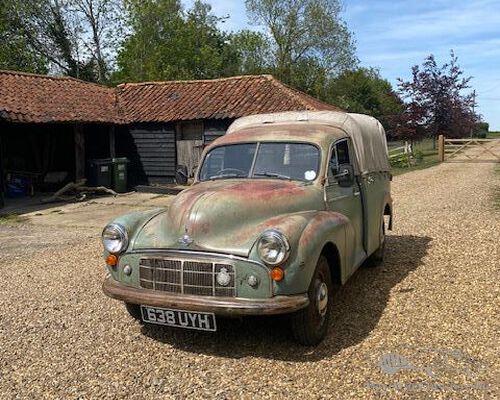
1954 Morris Minor Series II Pick Up
Morris Minor Series II Pick-Up, first registered 15th Jan 1954. Exported from new to Australia, returned to the UK in 2014. Swansea documentation r..
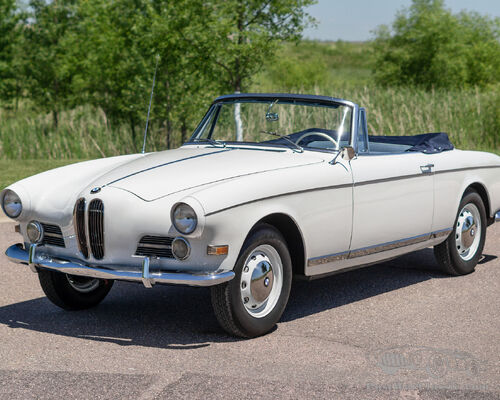
1957 BMW 503 Cabriolet (V8) 1 of 13 Built for US Market #Matching Example
1957 BMW 503 Cabriolet Series 1 Original Aluminum V8 # Matching Original Aluminum Body with Factory Stampings 1 of ..